Work-Life Balance When WFH: Setting Boundaries That Stick
The most effective WFH boundary is a physical one — a dedicated workspace with a door you close at the end of the day — combined with a consistent shutdown ritual that signals your brain to disengage from work mode.
Quick Answer
The most effective WFH boundary is physical — a dedicated workspace you can close down at day's end — combined with a consistent shutdown ritual and clearly communicated hours. Boundaries fail when they live only in your head: tell your household, tell your team, and let the ritual do the enforcement.
Key Takeaways
Practical strategies for maintaining work-life balance while working from home — from physical boundaries and shutdown rituals to communicating with your household and protecting your evenings.

As an Amazon Associate I earn from qualifying purchases. Product prices and availability are subject to change.
The promise of remote work is freedom. The reality — for a lot of people — is that work bleeds into everything. You check Slack from the couch at 9 PM. You "quickly" respond to an email during dinner. Your commute used to create a forced transition between work-you and home-you, and now that buffer is gone.
A 2025 study from the National Bureau of Economic Research found that remote workers log an average of 48 minutes more per day than their in-office counterparts. That's over 200 extra hours a year — essentially a full month of additional work — and most of it is invisible, uncompensated, and happening in the margins of your personal life.
The fix isn't discipline or willpower. It's systems and boundaries built into your physical space, daily routine, and communication habits. Here's how to set ones that actually stick.
Create a Physical Boundary
This is the single most impactful change you can make. When your "office" is also your living room, dining table, or bedroom, your brain never fully shifts out of work mode. The space where you relax becomes charged with work associations.
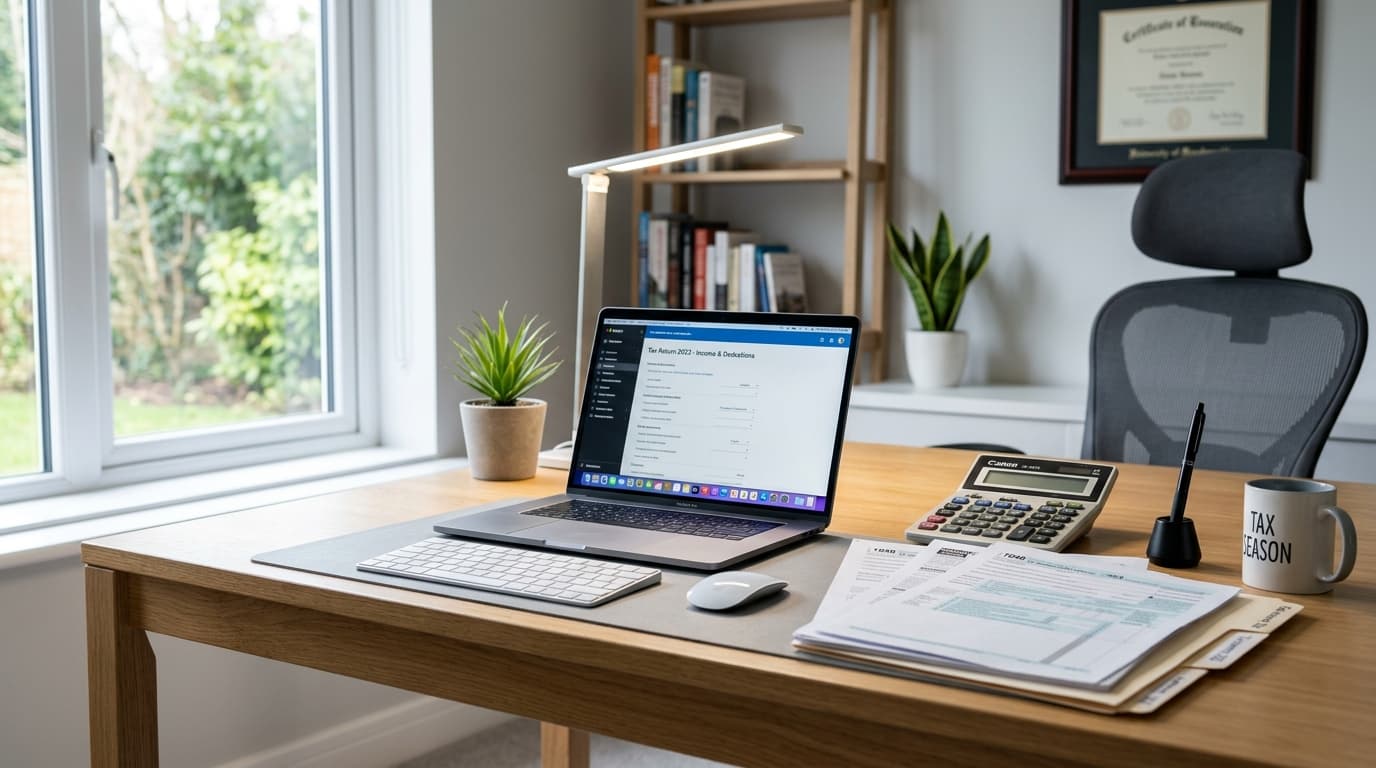
If you have a spare room: Use it as a dedicated office and close the door when you're done for the day. This sounds obvious, but the door is the critical part. A closed door is a clear signal — to your brain and to your household — that work is contained.
If you don't have a spare room: Create a visual boundary. A room divider, a bookshelf, even a specific corner with a desk that faces away from the rest of the room. The goal is to create a zone that is only for work. When you leave that zone, work is over.
For tips on building out a proper workspace within your means, our ultimate WFH setup guide covers everything from layout to gear.
Build a Shutdown Ritual
Cal Newport coined the term "shutdown ritual" in Deep Work, and it's the most effective boundary-setting technique we've found. The idea is simple: create a repeatable sequence of actions that signals to your brain that the workday is done.
Here's a shutdown ritual that works:
- Review your task list and note what you'll tackle first tomorrow.
- Check email and Slack one final time — respond to anything urgent, star anything that can wait.
- Write tomorrow's top 3 priorities in a notebook or task app.
- Close all work tabs and apps. Not minimize — close.
- Say a phrase out loud like "shutdown complete" or "done for the day." This feels silly for about three days, then it becomes weirdly powerful.
The whole ritual takes 5–10 minutes. After a week, your brain starts associating the sequence with the end of work, and you'll find it much easier to mentally disengage.
Set and Communicate Your Hours
One of remote work's biggest traps is implied availability. Because your colleagues know you're at home, the assumption becomes that you're reachable at all hours. You have to proactively push back against this.
- Put your working hours in your Slack profile or email signature. Something like: "Available 8:30 AM – 5:30 PM ET. Messages outside those hours will be seen the next business day."
- Turn off notifications after hours. Every major platform — Slack, Teams, Gmail — supports scheduled Do Not Disturb. Use it.
- Don't respond to non-urgent messages outside work hours. Every time you do, you train your colleagues to expect it.
This isn't about being rigid or unhelpful. It's about being clear so that people know what to expect. Consistency is what makes it work.
Communicate With Your Household
Boundaries aren't just about work — they're about the people you live with, too. If you share your home with a partner, kids, or roommates, your work-from-home arrangement affects them directly.
Have a real conversation about:
- When you're interruptible and when you're not. A simple system like a closed door = do not disturb, open door = come on in works well. Some people use a small desk lamp — on means focused, off means available.
- Shared space schedules. If you work at the kitchen table, agree on times when the table is your office vs. communal space.
- Noise expectations. If you're on calls regularly, your household needs to know your call schedule. Share your calendar or post a daily note.
- Lunch and breaks. Be intentional about when you take breaks with your household. It's one of the genuine perks of WFH — use it.
The goal is mutual respect. You need uninterrupted focus time; they need to not feel like they're tiptoeing through their own home.
Protect Your Transitions
The lack of a commute seems like a benefit, but you lose something important: the transition time that lets your brain shift gears. Without it, you go from bed to desk in minutes and from desk to couch in seconds. Work and personal life blur into one undifferentiated blur.
Create artificial transitions:
- Morning: Walk around the block before starting work. Even 10 minutes outside replicates the mental shift of a commute.
- Evening: Same thing. Close your laptop, leave your workspace, and take a short walk or do a brief activity that has nothing to do with screens.
- Lunch: Leave your desk. Eat somewhere other than where you work. This sounds simple but most WFH people eat lunch at their desk — and it eliminates your one guaranteed mid-day reset.
Guard Your Evenings and Weekends
The most insidious boundary erosion happens in small increments. You check email "real quick" at 8 PM. You review a document on Saturday morning "just to stay ahead." Each instance feels harmless, but the cumulative effect is that you never fully rest, and you return to work Monday already depleted.
Two rules that help:
- No work apps on your phone — or at minimum, no notifications. If your company requires Slack on your phone, configure it so notifications only come through during work hours.
- One day per weekend is completely work-free. Not "I'll just check in for 20 minutes" — truly no work. Your brain needs at least one full day of recovery per week to sustain long-term productivity.
When Boundaries Get Tested
Let's be realistic: there will be weeks when deadlines force you to work late or a crisis demands weekend attention. That's not a failure — it's reality. The key is making those moments the exception, not the pattern.
After a boundary-breaking week, actively restore the boundary the following week. Take a half-day off. Start late one morning. Go for a long lunch. Show your brain — and your household — that the disruption was temporary, not the new normal.
If you find that work-from-home boundaries are impossible to maintain because of your workload, the problem isn't your boundaries. It's your workload. That's a conversation to have with your manager.
FAQ
How do I stop feeling guilty about not being "available" after hours?
Remind yourself that boundaries make you better at your job, not worse. Research consistently shows that overwork degrades cognitive performance, creativity, and decision-making. Being unreachable in the evening means you show up sharper the next morning.
What if my company culture expects constant availability?
Start by setting boundaries quietly — stop responding after hours and see what happens. Most of the time, nothing happens. If there's genuine pushback, have a direct conversation with your manager about sustainable work expectations.
How do I stay focused during work hours so I don't need to work late?
That's a whole topic on its own — read our guide to staying focused while working from home for specific strategies and tools.
Should I keep a separate work phone?
If your employer provides one, absolutely use it — and leave it in your office at the end of the day. If not, use Focus/DND modes on your personal phone to achieve the same effect without the second device.
The Bottom Line
Work-life balance while working from home isn't about perfect discipline — it's about building physical, temporal, and social boundaries that make the separation automatic. Create a dedicated workspace, build a shutdown ritual, communicate your hours clearly, and protect your transitions. The boundaries feel awkward for the first week or two, then they become the structure that makes remote work actually sustainable.
Your next step
Rituals that make quitting time real.
Hilly Shore Labs
Editorial TeamWFH Lounge is published by Hilly Shore Labs. Every recommendation is built by synthesizing ergonomic research, manufacturer specs, expert reviews from outlets like Wirecutter, RTINGS, and The Verge, and aggregated long-term owner sentiment from thousands of verified buyers.
All product reviews are independently researched. Our recommendations are based on ergonomic guidelines, manufacturer specifications, and verified buyer sentiment. See our methodology.