Skip This: Gaming Chairs as 8-Hour Office Chairs
Skip this
Racing-style gaming chairs used as 8-hour office chairs
Built for short, leaned-back gaming — not all-day upright work. Fixed lumbar geometry, bucket seat pan, and recline-first tuning fail Cornell ergonomics criteria for 8-hour office seating.
Quick Answer
Skip gaming chairs for 8-hour workdays: the bucket-seat shape blocks position changes, the fixed lumbar pillow sits wrong for most spines, and the recline-focused build skimps on the seat foam you actually live on. Real ergonomic chairs at the same price (used Steelcase/Herman Miller, or new budget ergonomic brands) fit work, not LAN parties.
Key Takeaways
Gaming chairs are built for short, leaned-back sessions. As 8-hour office chairs they fail on lumbar support, seat shape and adjustability. Here's the fix.
As an Amazon Associate I earn from qualifying purchases. Product prices and availability are subject to change.
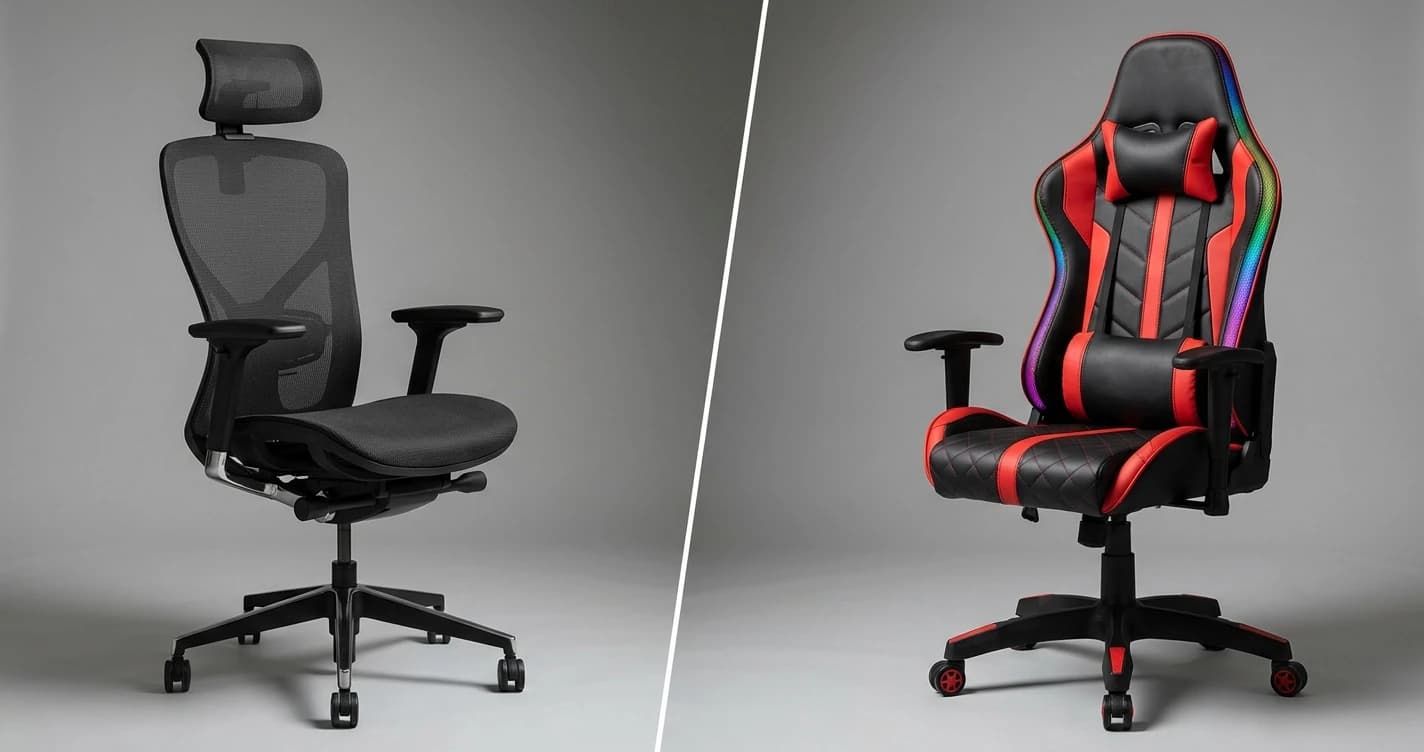
Racing-style gaming chairs (DXRacer, Secretlab, AKRacing, and the long tail of imitators) were designed around marketing photos of esports players, not Cornell ergonomics research. As short-session gaming chairs they're fine. As your 8-hour-a-day office chair, they fail in three specific ways.
Where they fail at all-day work
- Wrong lumbar geometry. Racing-style buckets force a fixed lumbar curve that fits one body shape (the marketing model's). Real ergonomic chairs let you adjust both lumbar height AND depth — gaming chairs let you adjust neither.
- Bucket seat pan. The raised side bolsters that look cool in product photos compress your outer thigh during 8-hour days, restrict cross-legged sitting, and make leaning forward over a keyboard awkward.
- Recline-first design. Gaming chairs are tuned for 110–130° leaned-back gaming posture. Office work needs the opposite: a 90–105° upright posture with active lumbar engagement.
What real ergonomic chairs do differently
Cornell's ergonomics research consistently flags four adjustments as load-bearing for all-day chairs:
- Seat depth (sliding seat pan) — to keep 2–4 fingers between knee and seat edge.
- Lumbar height AND depth — to match individual spine curvature.
- Armrest height, width, and pivot — to support typing without shoulder shrug.
- Synchro-tilt with adjustable tension — to let your back move while keeping your feet planted.
Gaming chairs typically offer 1 of those 4 (armrest height, sometimes). Real office chairs offer all 4.
What to buy instead
If your budget is under $500, the Branch Ergonomic Chair Pro has all four core adjustments — and ten more — at about $499. The standard Branch Ergonomic Chair ($389) covers three of the four — its lumbar moves in height but not depth — with seat-depth adjustment, 3D armrests and a synchronous tilt with tension. If both are too much and you mainly want the gaming chair gone, the Branch Daily Chair is the same brand's stripped-back option: upright posture, a breathable mesh back, seat height, tilt tension and recline lock, but a fixed lumbar rest and no arm adjustment. It beats a racing chair for 8-hour work; it does not replace an adjustable-lumbar chair. If your budget allows, the Steelcase Leap V2 and Herman Miller Aeron are the long-term gold standards — and both turn up on the used market for half retail.
Sources
- Cornell Human Factors and Ergonomics Research Group — Office Ergonomics
- BIFMA G1 Ergonomics Guideline for office seating
Your next step
Real ergonomic chairs, real budgets.
Hilly Shore Labs
Editorial TeamWFH Lounge is published by Hilly Shore Labs. Every recommendation is built by synthesizing ergonomic research, manufacturer specs, expert reviews from outlets like Wirecutter, RTINGS, and The Verge, and aggregated long-term owner sentiment from thousands of verified buyers.
All product reviews are independently researched. Our recommendations are based on ergonomic guidelines, manufacturer specifications, and verified buyer sentiment. See our methodology.