Standing Desk vs. Sitting: What the Science Actually Says
The science supports standing desks — not for calorie burn, but for enabling the sit-stand transitions that break up prolonged sitting and improve blood sugar, energy, and long-term health.
Quick Answer
Neither standing-only nor sitting-only is ideal. Research shows the real target is movement variety: switch postures every 30–60 minutes. A standing desk converter or motorized sit-stand desk with a height-reminder app is more effective than either extreme.
Key Takeaways
We dug into the research on standing desks so you dont have to.
As an Amazon Associate I earn from qualifying purchases. Product prices and availability are subject to change.
Standing desks have become a staple of modern home offices. Walk into any co-working space or browse any WFH setup photo on social media and you'll see them everywhere. The marketing claims are bold — standing desks will burn more calories, fix your back pain, improve your mood, and add years to your life. But how much of that is actually supported by research?
We spent weeks digging through peer-reviewed studies, meta-analyses, and expert opinions to separate the evidence from the hype. Here's what the science actually says about standing desks vs. sitting.
The Case Against Prolonged Sitting
Before we evaluate standing desks, let's establish why sitting has gotten such a bad reputation. The concern is legitimate.
A landmark 2012 meta-analysis published in Diabetologia analyzed data from 18 studies covering nearly 800,000 participants. It found that those who sat the most had a 112% increase in their risk of developing type 2 diabetes, a 147% increase in cardiovascular events, and a 49% increase in all-cause mortality compared to those who sat the least.
More recent research has reinforced these findings. A 2023 study in the Journal of the American Heart Association followed over 100,000 adults and found that sitting for more than 8 hours per day without physical activity was associated with a significantly higher risk of cardiovascular disease and death.
The mechanism appears to be related to metabolic function. When you sit for extended periods, your body's ability to regulate blood sugar and blood pressure decreases. Your muscles aren't contracting, so they consume less glucose and burn less fat. Blood flow slows, and your metabolism essentially downshifts.
So yes — prolonged, uninterrupted sitting is genuinely bad for your health. But does standing fix it?
What Standing Actually Does to Your Body
Standing engages more muscles than sitting. Your legs, core, and back muscles all work harder to keep you upright. This increased muscle activation has measurable metabolic effects — but they're smaller than most people assume.
A 2016 study published in the Journal of Physical Activity and Health found that standing burns approximately 0.15 calories more per minute than sitting. That works out to roughly 9 extra calories per hour. Over a full 8-hour workday, switching from all sitting to all standing would burn about 72 additional calories — roughly the equivalent of a single apple.
Standing does, however, appear to have benefits beyond calorie burn. A 2018 study in the British Medical Journal examined the effects of sit-stand desks in office workers over 12 months. The results showed that participants who used sit-stand desks reported improvements in job performance, work engagement, occupational fatigue, daily anxiety, and quality of life compared to the seated control group.
Standing also appears to improve blood sugar regulation. A 2014 study in Occupational and Environmental Medicine found that alternating between sitting and standing throughout the workday reduced post-lunch blood glucose spikes by 11.1% compared to sitting all afternoon.
The Problems with Standing All Day
Here's where the nuance matters. If prolonged sitting is bad, you might assume prolonged standing is the solution. It's not.
Standing for extended periods comes with its own set of health problems. A 2017 study published in the American Journal of Epidemiology found that occupations requiring predominantly standing were associated with a roughly two-fold risk of heart disease compared to occupations involving predominantly sitting. This was observed even after controlling for other risk factors.
Prolonged standing can cause varicose veins, swollen ankles, and foot pain. It increases the load on your lower back and can actually exacerbate back problems if you have poor posture while standing. Workers who stand all day (retail, food service, manufacturing) have higher rates of musculoskeletal complaints than those in mixed-posture occupations.
The lesson is clear: standing all day is not better than sitting all day. Both extremes are problematic.
The Sweet Spot: Alternating Between Sitting and Standing
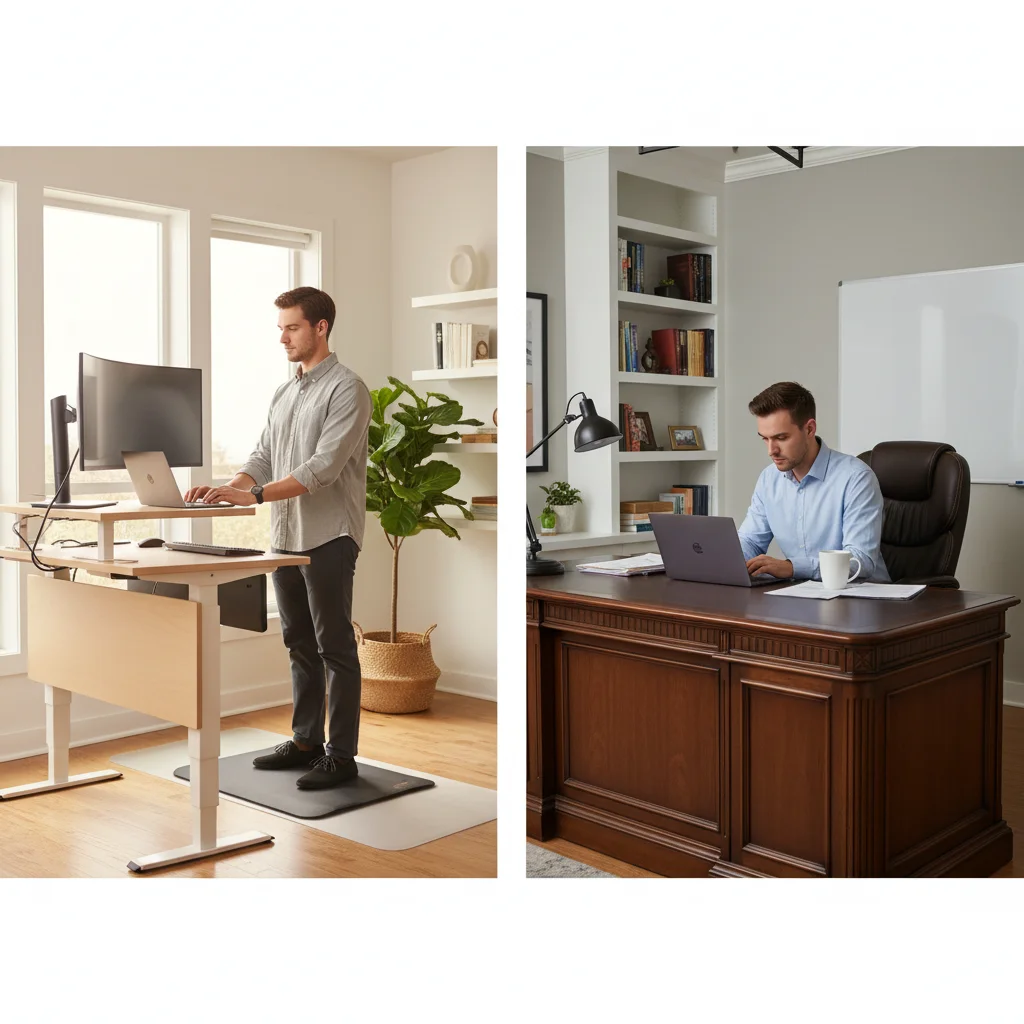
The strongest evidence supports a mixed approach — alternating between sitting and standing throughout the day. This is exactly what adjustable sit-stand desks are designed for.
A 2015 expert statement published in the British Journal of Sports Medicine by a panel of international experts recommended the following for office workers using sit-stand desks:
- Accumulate at least 2 hours per day of standing and light activity during working hours, eventually progressing to 4 hours.
- Break up seated work with standing work regularly — don't sit for more than 30 to 60 minutes at a stretch.
- Be mindful of posture in both positions.
This recommendation aligns with a 2019 review in Applied Ergonomics that found the optimal sit-to-stand ratio is between 1:1 and 3:1 (sitting to standing), with transitions every 30 to 60 minutes.
In practical terms, this means standing for about 15 to 30 minutes per hour and sitting for the remainder. Most people find a rhythm that works for them — often standing during phone calls, certain types of focused work, or after meals (when blood sugar benefits are greatest).
Does a Standing Desk Help with Back Pain?
This is one of the most common reasons people buy standing desks, so let's look at the evidence directly.
A 2011 study published in the Centers for Disease Control and Prevention's Preventing Chronic Disease journal found that participants who used a sit-stand desksit-stand deskA desk whose surface raises and lowers (electric or crank) so you can alternate sitting and standing through the day. Cornell ergonomics research recommends ~30-min sitting / ~10-min standing / ~2-min walking cycles, not all-day standing. for 7 weeks reported a 54% reduction in upper back and neck pain. When the sit-stand desks were removed, the improvements reversed within 2 weeks.
A 2018 Cochrane systematic review, however, was more cautious. It examined 34 studies on sit-stand desks and concluded that there was "low-quality evidence" that sit-stand desks reduce sitting time at work by between 30 minutes to 2 hours per day. The evidence for effects on back pain and work performance was classified as "very low quality."
The truth likely lies somewhere in the middle. If your back pain is primarily caused by prolonged sitting and poor posture, a sit-stand desk that enables position changes will probably help. But it's not a magic bullet — you also need to address chair quality, monitor height, core strength, and overall physical activity.
Standing Desks and Productivity
One concern people have is whether standing affects their work performance. Can you think as clearly and type as fast while standing?
A 2016 study in IIE Transactions on Occupational Ergonomics and Human Factors examined the productivity of call center employees over 6 months. Those using sit-stand desks were 46% more productive than seated colleagues. However, the researchers noted that the productivity increase developed gradually over the study period and may have been influenced by factors beyond the desk itself.
A smaller 2014 study at Texas A&M found no significant difference in productivity between sitting and standing conditions, but participants reported feeling more focused and energized while standing.
The consensus from multiple studies seems to be that standing doesn't hurt productivity and may modestly improve it, particularly for tasks that benefit from increased alertness and energy. Detailed, fine-motor tasks (like precise graphic design work) may be slightly easier while seated due to stability.
The Verdict: Are Standing Desks Worth It?
Based on the current evidence, here's our honest assessment:
Standing desks are worth it — but not for the reasons most people think.
They won't help you lose significant weight. They won't single-handedly fix your back pain. They aren't a substitute for regular exercise.
What they do is enable the behavior that the science most strongly supports: breaking up prolonged sitting with regular position changes. The health benefits of a standing desk come from the transitions — sitting to standing and back — not from standing itself.
A sit-stand desk makes these transitions effortless. Without one, you'd need to consciously get up, walk around, and come back. With one, you press a button and keep working. That friction reduction matters over months and years of daily use.
Practical Recommendations
If you're considering a standing desk, here's what we recommend based on the research:
-
Get an electric sit-stand desk with memory presets. Manual crank desks add friction that discourages transitions. Electric desks with presets let you switch positions in seconds.
-
Start gradually. Don't try to stand for 4 hours on day one. Begin with 15-minute standing intervals and increase over weeks.
-
Use a timer or reminder. Set a recurring alarm to prompt position changes every 30 to 45 minutes. Many smartwatches have built-in stand reminders.
-
Invest in an anti-fatigue mat. Standing on hard floors is uncomfortable. A cushioned mat makes standing periods much more sustainable.
-
Wear supportive shoes or go barefoot on the mat. Dress shoes and heels are not standing-desk-friendly.
-
Don't neglect exercise. A standing desk is a supplement to regular physical activity, not a replacement. Aim for 150 minutes of moderate exercise per week regardless of your desk type.
-
Pay attention to your body. If something hurts, change positions. The best position is always the next one.
The standing desk won't transform your health on its own. But as one component of a thoughtfully designed home office — alongside a good chair, proper monitor placement, regular movement, and exercise — it's a valuable tool that the science supports.
Related Reading
- →Standing Desk Buying GuideWhat to look for when shopping
- →Best Standing Desk Converters for Small SpacesSit-stand without replacing your desk
- →How to Build an Ergonomic Home Office on Any BudgetComplete ergonomic setup guide
- →Best WFH Chairs Under $500For when you do sit down
- →How to Stay Active When You WFHMovement beyond your desk
- →Standing DesksShop standing desks and converters
- →Office ChairsPair your desk with a great chair
What about walking while you work?
The sit-stand binary is incomplete — adding a slow-walking option is the third lever. Our sister site GymScored covers the walking pad research (Ben-Ner 2014, Bergouignan 2016, Levine's NEAT work) and the spec floor that determines whether a pad actually fits under your standing desk.
Your next step
Convinced? The desks worth buying.
Hilly Shore Labs
Editorial TeamWFH Lounge is published by Hilly Shore Labs. Every recommendation is built by synthesizing ergonomic research, manufacturer specs, expert reviews from outlets like Wirecutter, RTINGS, and The Verge, and aggregated long-term owner sentiment from thousands of verified buyers.
All product reviews are independently researched. Our recommendations are based on ergonomic guidelines, manufacturer specifications, and verified buyer sentiment. See our methodology.