How to Stay Active When You WFH No Gym Required
The key to staying active while working from home is building movement into your daily routine through micro-exercises, walking habits, and intentional breaks rather than relying on separate workout sessions.
Quick Answer
Build movement into the workday instead of around it: a non-negotiable daily walk, 'movement snacks' every 45-60 minutes, five minutes of stretching twice a day, and walking meetings for calls that don't need a screen. Consistency beats intensity — the goal is undoing eight seated hours, not training for anything.
Key Takeaways
Working from home killed your step count. Here are practical, no-gym ways to stay active throughout the workday and beyond.
As an Amazon Associate I earn from qualifying purchases. Product prices and availability are subject to change.
Here is a number that should alarm you: the average remote worker takes about 2,000 fewer steps per day than their office-going counterpart. That is not because office workers are athletes. It is because going to an office involves walking to your car, walking through a parking lot, walking to the elevator, walking to meetings, walking to the break room, and walking back to your car. Those incidental movements add up to significant daily activity.
When you work from home, your commute is 12 steps from your bed to your desk. Your longest walk is to the kitchen. The bathroom is 10 feet away. On a bad day, your step count might not break 1,000. Over months and years, this sedentary lifestyle compounds into real health problems — weight gain, back pain, poor cardiovascular health, low energy, and worse sleep.
The good news: you do not need a gym membership, fancy equipment, or an hour-long workout to fix this. You need movement built into the fabric of your day.
The Problem With "I Will Work Out Later"
Most remote workers approach fitness with the same mindset they had when they commuted: separate exercise from work. "I will go to the gym after work" or "I will run in the morning." And sometimes they do. But the research consistently shows that even people who exercise for 30 to 60 minutes a day can still suffer the effects of prolonged sitting if the remaining 14 waking hours are sedentary.
This concept is called being an "active couch potato" — someone who exercises regularly but sits for the vast majority of their day. The exercise helps, but it does not fully counteract eight to ten hours of continuous sitting.
The real solution is not one workout. It is distributed movement — small doses of activity scattered throughout the entire day. This approach is actually easier to maintain than a gym habit, and for most remote workers, it delivers better results.
The Movement Menu: Pick and Mix
Instead of prescribing a rigid schedule, think of this as a menu of movement options. Mix and match based on what works with your day, your meetings, and your energy level.
Walking (The Non-Negotiable)
Walking is the single most underrated form of exercise. It requires no equipment, no special clothes, no warmup, and no recovery. And for remote workers, it does double duty as both exercise and a mental reset.
Build walking into your day at these natural transition points:
- Morning walk (15 to 20 minutes). Before you start work, walk around your neighborhood. This replaces your commute and primes your brain for the day. Morning sunlight exposure also helps regulate your circadian rhythm, which improves your sleep.
- Lunch walk (10 to 15 minutes). After you eat, take a short walk. This aids digestion, resets your focus for the afternoon, and adds steps without taking significant time.
- End-of-day walk (15 to 20 minutes). After your last meeting, walk. This is your "commute home" — the transition that signals your brain that work is done.
Three short walks total 40 to 55 minutes of activity and can add 4,000 to 6,000 steps to your day. That alone brings most remote workers close to the often-cited 10,000-step target.
Movement Snacks (Every 45 to 60 Minutes)
A "movement snack" is a one-to-three-minute burst of activity between tasks or during natural breaks. Set a timer or use the natural rhythm of your pomodoro sessions to prompt these:
- 10 bodyweight squats
- 10 pushups (or wall pushups if needed)
- 30-second plank
- 20 calf raises
- A quick set of lunges across the room
- 30 seconds of jumping jacks
- Stand up and do arm circles and shoulder rolls
These are not workouts. They are resets. They take less than two minutes, they spike your heart rate just enough to clear brain fog, and over the course of a day they add up to meaningful volume. Ten sets of 10 squats scattered throughout the day is 100 squats. That is more than most gym sessions.
The Standing Desk Advantage
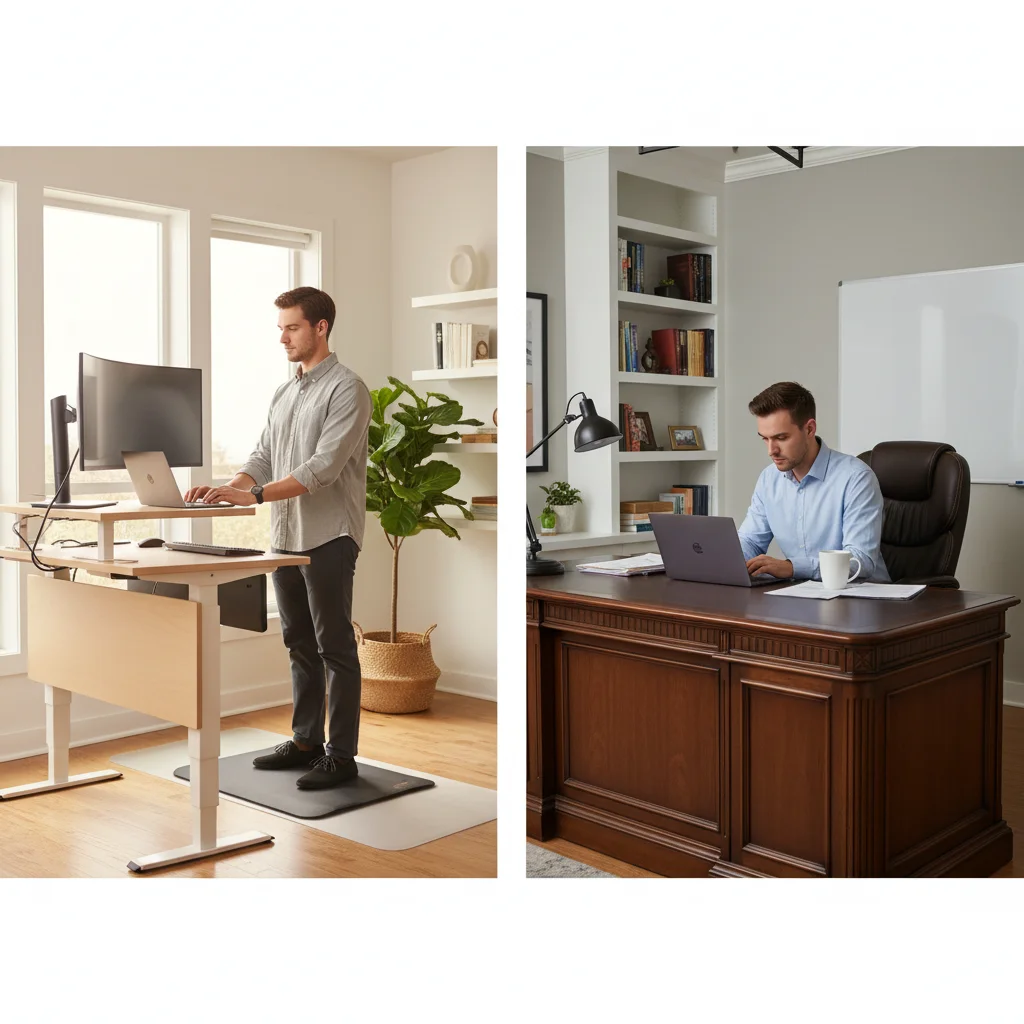
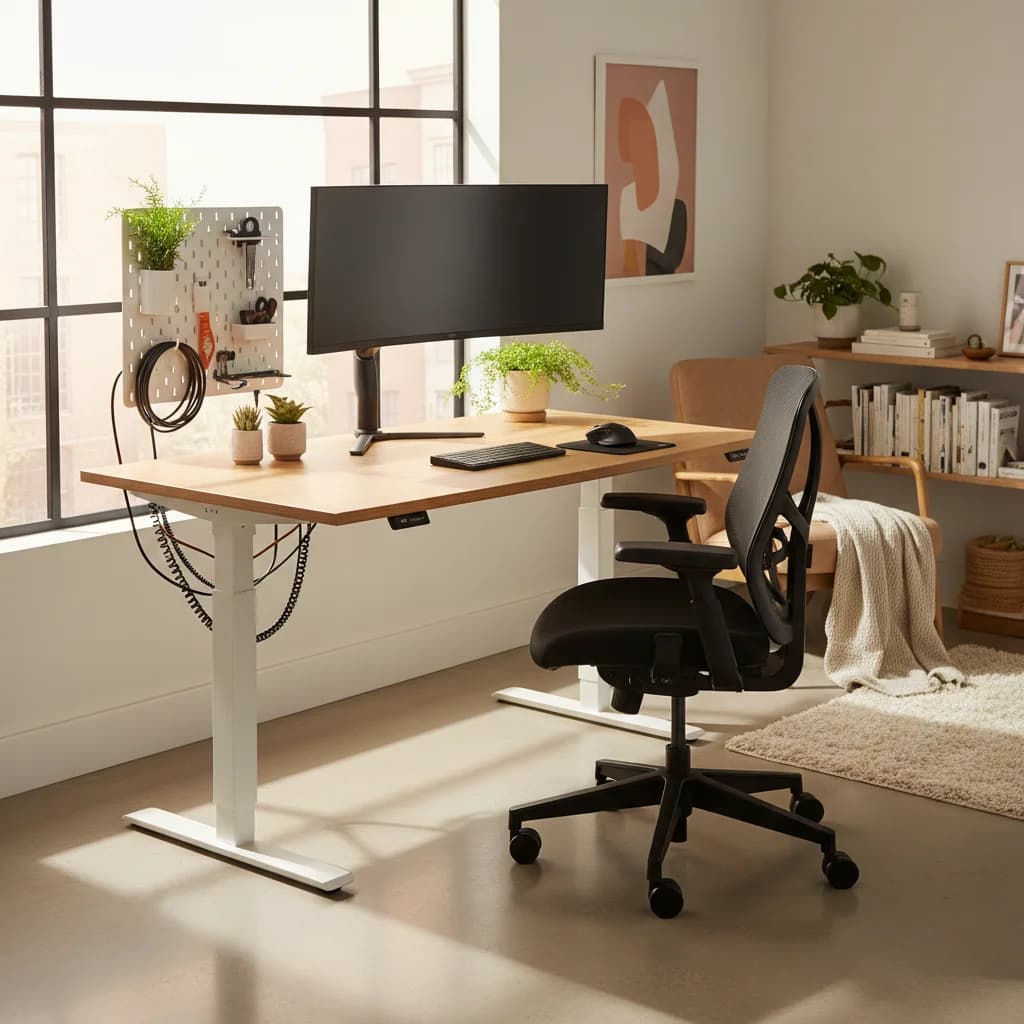
If you have a standing desksit-stand deskA desk whose surface raises and lowers (electric or crank) so you can alternate sitting and standing through the day. Cornell ergonomics research recommends ~30-min sitting / ~10-min standing / ~2-min walking cycles, not all-day standing. or a standing desk converter, alternating between sitting and standing throughout the day makes a measurable difference. Standing burns more calories than sitting, engages your core and legs, and naturally encourages more fidgeting and weight-shifting — all of which count as activity.
The ideal pattern is not standing all day. It is alternating: sit for 45 minutes, stand for 15 to 20 minutes, sit again. This cycle keeps your body engaged without creating the fatigue and foot pain that comes from prolonged standing.
A good anti-fatigue mat is worth mentioning here. Standing on a hard floor gets uncomfortable fast. The The Standing Desk Mat is a popular option among remote workers — it is thick enough to make standing comfortable but firm enough that you do not feel unstable.
Stretching and Mobility (5 Minutes, Twice a Day)
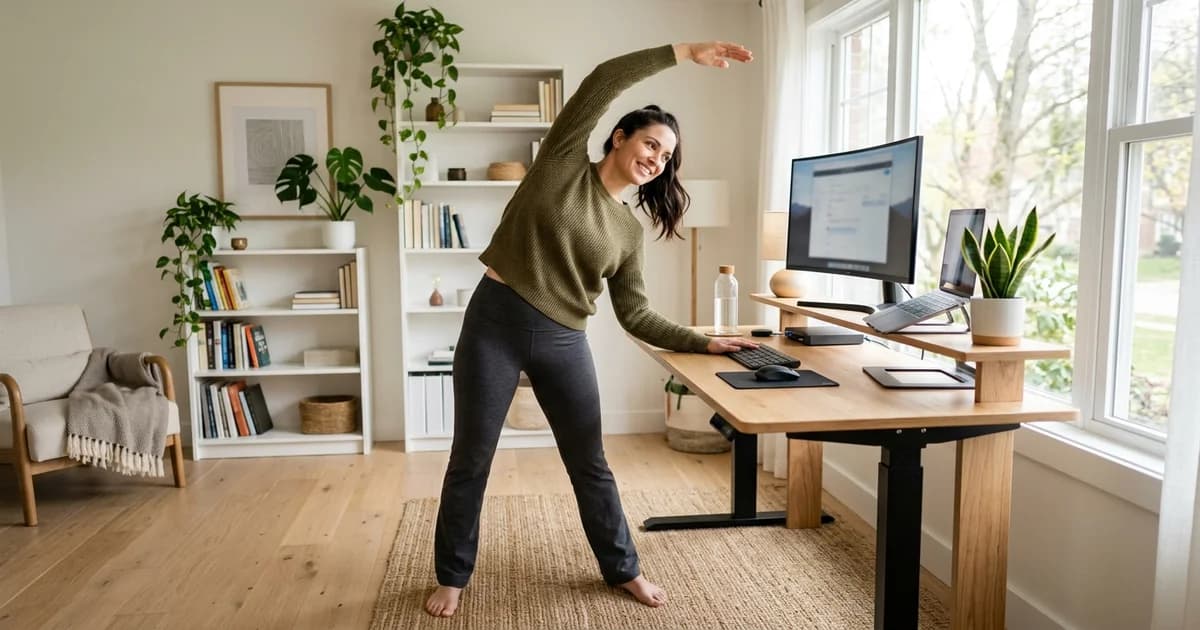
Desk work destroys your flexibility over time. Tight hip flexors, rounded shoulders, and a stiff neck are practically universal among remote workers. A five-minute stretch routine in the morning and afternoon can prevent these from becoming chronic issues.
Key stretches for desk workers:
- Hip flexor stretch. Kneel on one knee, push your hips forward. Hold 30 seconds each side.
- Chest doorway stretch. Place your forearm against a doorframe, lean forward gently. Opens up the chest and counters the rounded-shoulder posture from typing.
- Neck rotations. Slowly rotate your head in circles, then tilt your ear toward each shoulder. Releases tension from screen staring.
- Cat-cow stretch. On hands and knees, alternate between arching and rounding your back. Loosens the entire spine.
- Figure-four stretch. Sitting in your chair, cross one ankle over the opposite knee and lean forward. Targets the glutes and piriformis, which get tight from sitting.
The Walking Meeting
This is a game-changer that more remote workers should adopt. Any meeting that is audio-only — no screen sharing, no document review — can be a walking meeting. Put in your earbuds, grab your phone, and walk while you talk.
Walking meetings tend to be more creative and efficient than sitting meetings. Something about the physical movement frees up cognitive resources. Stanford research found that walking increased creative output by an average of 60 percent compared to sitting.
Tip: let your colleagues know you are walking. "I am taking this one on a walk" is completely normal in remote culture now. Most people appreciate it because it gives them permission to do the same.
Home Workout Equipment That Earns Its Space
You do not need a home gym. (If you decide you want a real one anyway, the starter home gym build at GymScored lays out what to buy in what order without sacrificing a spare room.) But a few compact pieces of equipment can expand your options significantly:
- A set of resistance bands. These store in a drawer and can replicate most gym exercises. A full set of loop bands costs less than $20 and lasts for years.
- A yoga mat. For stretching, bodyweight exercises, and the occasional YouTube workout.
- A pull-up bar. Doorframe-mounted pull-up bars require no installation and store in a closet. Even if you cannot do a pull-up yet, dead hangs are excellent for grip strength and shoulder health.
- An under-desk elliptical or pedal exerciser. These let you pedal gently while working. They are not intense exercise, but they keep your legs moving during long stretches of desk work. The Cubii JR2 is one of the more popular options and is quiet enough for video calls.
For tips on fitting exercise equipment into a compact workspace, our guide to ergonomic home offices on any budget covers space-efficient gear choices.
Tracking Without Obsessing
A basic activity tracker or the step counter on your phone can provide useful awareness without turning movement into a source of stress. The goal is not hitting a perfect number every day — it is noticing patterns. If you see that Tuesdays consistently show 1,500 steps, that tells you something about your Tuesday schedule that you can adjust.
Aim for a daily baseline rather than a rigid target. For most remote workers, 6,000 to 8,000 steps per day plus a few movement snacks puts you well ahead of the sedentary curve.
Building the Habit
The best fitness routine is the one you actually do. Start with what feels easy — embarrassingly easy. A five-minute walk after lunch. Five squats between meetings. A stretch while your coffee brews. Stack these habits onto things you already do, and they will stick.
Protecting your physical health is a core part of maintaining work-life balance as a remote worker. You do not need to train for a marathon. You just need to move more than your desk job wants you to.
Your body was not designed to sit in a chair for eight hours. Give it a reason to move, and it will reward you with better energy, sharper focus, and a much better relationship with your work-from-home life.
Related Reading
Your next step
Move while you work — the gear that helps.
Hilly Shore Labs
Editorial TeamWFH Lounge is published by Hilly Shore Labs. Every recommendation is built by synthesizing ergonomic research, manufacturer specs, expert reviews from outlets like Wirecutter, RTINGS, and The Verge, and aggregated long-term owner sentiment from thousands of verified buyers.
All product reviews are independently researched. Our recommendations are based on ergonomic guidelines, manufacturer specifications, and verified buyer sentiment. See our methodology.