Do You Need an Air Purifier in Your Home Office?
Buy a True-HEPA air purifier if you have a real particle problem (allergens, pets, smoke) you can't ventilate away, and add a carbon filter if odors or VOCs are the issue. Skip it if the room just feels stuffy, that's CO2, which ventilation fixes and a filter does not. Avoid ozone-generating ionic units. The focus-and-productivity claim is real research applied to the wrong tool: those gains came from ventilation, not particle filtration.
Quick Answer
Only sometimes. A HEPA air purifier removes airborne particles (dust, pollen, dander, smoke), so it's worth it for allergies, pets, or smoke you can't ventilate away. But it does not lower CO2 and only handles odors/VOCs if it has a carbon filter. The EPA's order is source control, then ventilation, then filtration, so for a stuffy room or a 'focus boost,' open a window first. A purifier is a supplement, not the first move.
Key Takeaways
A HEPA air purifier removes particles, not CO2 or gases. Here's when a home office actually needs one, what the focus research really says, and what to skip.
As an Amazon Associate I earn from qualifying purchases. Product prices and availability are subject to change.
Search "air purifier for your home office" and every result says yes. Most of those pages are written by companies that sell purifiers. The honest answer is narrower: a True-HEPA purifier is a real upgrade for some offices and a waste in others, and the "it'll make you focus better" pitch leans on research a basic purifier can't deliver on.
Here's the gap the seller blogs skip. A HEPA filter removes particles. It does almost nothing about carbon dioxide and only handles gases (VOCs) with a separate carbon filter. But the cognition research everyone cites is driven by CO2 and ventilation, not particles. So before you buy a box that hums on your desk all day, know what it does and doesn't fix.
The EPA's order of operations is: remove the source, ventilate, then filter. A portable air purifier is the third lever, a supplement to the first two, not a substitute. In a typical home office, opening a window and cutting the pollutant source usually beats buying a purifier. Buy one when you have a particle problem you can't ventilate away, and make sure it has a carbon filter if odors or VOCs are the issue.
What the EPA and the research say
- HEPA = particles only. A True-HEPA filter pulls dust, pollen, smoke, and pet dander out of the air. It does not lower CO2 and only removes gases/odors if the unit also has an activated carbon filter, per the EPA.
- The "focus" research is about ventilation, not filtration. The Harvard COGfx study (Allen et al., 2016) found cleaner air improved decision-making in 5 of 9 cognitive domains, but the driver was lower CO2 and lower VOCs from better ventilation. A particle filter doesn't move those numbers.
- Source control and a window come first. The EPA's stated most-effective steps are reducing pollutant sources and ventilating with outdoor air. Filtration is the supplement.
- Avoid ozone-generating "ionic" units. The EPA cautions against purifiers that intentionally produce ozone (some ionizers, electrostatic precipitators, plasma units). Ozone is a lung irritant.
What an air purifier actually does (and doesn't)
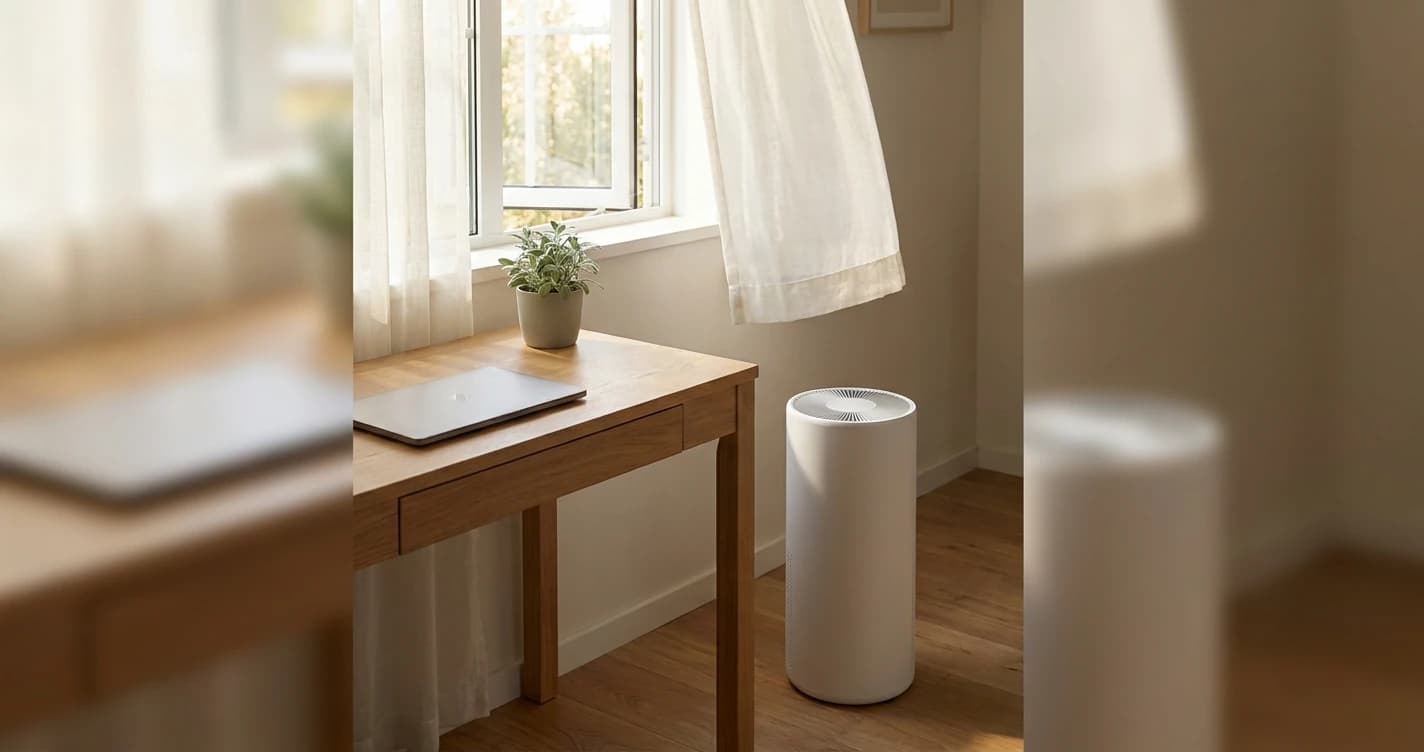
A HEPA purifier is a fan pulling air through a dense filter. Its whole job is pulling particles out of the airstream, useful if your office air carries a particle load. It is not an air-freshener, an oxygen machine, or a focus pill.
| Office air problem | Does a HEPA purifier fix it? |
|---|---|
| Dust, pollen, pet dander, smoke particles | Yes — this is exactly what HEPA is for |
| Odors, off-gassing furniture, paint/cleaning VOCs | Only with a carbon filter, and there's no standard rating for how well it works |
| Stuffy room, afternoon brain fog, high CO2 | No — CO2 needs ventilation, not a filter |
| Mold and dampness | No — fix the moisture; a filter won't resolve the cause |
That second row is the one sellers gloss over. The EPA notes that to filter gases you need an activated carbon filter, and that there's no widely used performance rating system for gas removal. So "removes VOCs and odors" on the box is largely unverifiable marketing. For particles, the spec to trust is CADR (Clean Air Delivery Rate) matched to your room size; for gases, you're taking the brand's word for it.
Why "it'll help you focus" is half true
The focus claim traces back to real science, just misapplied. In Harvard's controlled COGfx study, office workers exposed to cleaner indoor air scored significantly higher on cognitive tests, with statistically significant decision-making gains in 5 of 9 domains. The conditions that drove those gains were higher ventilation rates and lower VOC concentrations (the study modeled CO2 at 945 vs 1,400 ppm).
Read that carefully: the wins came from more fresh air and fewer chemical sources, not from a particle filter. A HEPA purifier doesn't lower CO2 at all, and only touches VOCs if it has a carbon stage. If your 3pm fog is CO2 building up in a closed room, the fix is a cracked window or an HVAC vent, not a $250 box. Buy the purifier for the particle problem; fix focus with airflow.
So when is a home-office purifier worth it?
It's a good buy in specific situations and a non-purchase in others.
| Your situation | Verdict |
|---|---|
| Seasonal allergies, asthma, or you share the room with a shedding pet | Worth it — particle removal is the right tool; get a True-HEPA unit |
| Wildfire smoke, nearby construction, or city air you can't ventilate | Worth it — keep windows closed and let HEPA scrub the particles |
| New desk, fresh paint, or strong off-gassing smells | Worth it only with a carbon filter — and open a window too |
| Room just feels stuffy / you get foggy by afternoon | Skip it — that's CO2; ventilate instead |
| Clean, well-ventilated room and you want a "focus boost" | Skip it — there's no particle problem to solve |
If you land in a "worth it" row and want specs and ranked picks, that's a separate buying question. Our home-office air purifier picks and the best air purifiers for a home office cover CADR-by-room-size and the quiet-enough-for-calls units.
What most people get wrong
The biggest mistake is treating a purifier as the first air-quality move when the EPA puts it third. The two cheaper, more effective levers come first: reduce the source (move the laser printer out, fix the damp corner) and ventilate (open a window, run the HVAC fan). A purifier running 24/7 over an unfixed pollutant source is bailing a boat without plugging the hole.
The second mistake is buying an ozone-generating "ionic" unit because it sounds high-tech. The EPA warns against air cleaners that intentionally produce ozone, including some ionizers, electrostatic precipitators, and plasma units, because ozone is a lung irritant. A purifier meant to make your office healthier shouldn't emit a pollutant. Stick to mechanical True-HEPA (plus carbon if you need gases handled) and skip anything advertising ozone or ions as a feature.
FAQ
Does an air purifier help you focus better while working from home?
Indirectly, and only sometimes. The cognition research (Harvard's COGfx study) showed cleaner air improves decision-making, but the gains came from better ventilation and lower CO2 and VOCs, not from particle filtration. A standard HEPA purifier doesn't lower CO2, so it won't fix the stuffy-room fog that ventilation solves. It can help if the issue is genuinely particles (allergens, smoke) irritating you.
Does an air purifier remove CO2 from a room?
No. HEPA filters and carbon filters do not remove carbon dioxide. The only practical way to lower CO2 in a home office is ventilation: opening a window, running the HVAC fan, or cracking the door to mix in fresher air.
HEPA or carbon filter for a home office?
HEPA handles particles (dust, pollen, dander, smoke); activated carbon handles gases and odors (VOCs, off-gassing). If your problem is allergens or smoke, HEPA alone is fine. If it's odors or off-gassing from new furniture, you need a carbon stage. Per the EPA, there's no standard rating for how well carbon removes gases, so treat those claims with caution.
Do I really need an air purifier if my home office has a window?
Often not. The EPA ranks source control and ventilation above filtration, so a room you can open to outdoor air already has the two most effective levers. A purifier earns its keep when you can't ventilate away the problem: allergy season, wildfire smoke, or a specific particle source that keeps the air dirty regardless of the window.
Sources
- →EPA — Air Cleaners and Air Filters in the Homemost effective steps are source control and ventilation; filtration is an effective supplement; air cleaners cannot remove all pollutants.
- →EPA — Guide to Air Cleaners in the HomeCADR sizing for particles via HEPA; gases require a separate activated-carbon filter with no widely used rating system; avoid units that intentionally produce ozone.
- →Allen et al., 2016, Environmental Health Perspectives (COGfx study)cleaner indoor air (higher ventilation, lower CO2 and VOCs) was associated with statistically significant improvements in decision-making in 5 of 9 cognitive domains.
Hilly Shore Labs
Editorial TeamWFH Lounge is published by Hilly Shore Labs. Every recommendation is built by synthesizing ergonomic research, manufacturer specs, expert reviews from outlets like Wirecutter, RTINGS, and The Verge, and aggregated long-term owner sentiment from thousands of verified buyers.
All product reviews are independently researched. Our recommendations are based on ergonomic guidelines, manufacturer specifications, and verified buyer sentiment. See our methodology.