The Work-From-Home Coffee Setup: Better Coffee, Less Café Spend
Keep the café trip for the days you need to leave the house, and make the other four days cheap and good at home — a grinder, a single-cup brewer, and an insulated mug fix more than an espresso machine will.
Quick Answer
Unbundle the café run: the walk is worth keeping, the daily $6 cup is not. At home, brew for one rather than making a pot, use an insulated mug so it does not go cold mid-focus-block, and set an early-afternoon caffeine cutoff — constant kitchen access is why remote workers drink coffee later than they used to. A grinder and a simple brewer beat an espresso machine.
Key Takeaways
Cut the cafe habit without cutting the walk: brewing for one, cold desk coffee, caffeine timing, and coffee as a commute replacement.
As an Amazon Associate I earn from qualifying purchases. Product prices and availability are subject to change.
Nobody decides to spend a thousand-odd dollars a year on coffee. It happens one $6 oat milk latte at a time, on a walk you took because the apartment was starting to feel small and the meeting had been rescheduled twice. Five of those a week, most weeks of the year, is what the arithmetic quietly adds up to.
That is the honest version of the WFH coffee problem. It is not that remote workers are bad at math. It is that when you worked in an office, the café run was bundled into a commute and a lunch break and a colleague asking if you wanted anything. Now it is a standalone decision you make every single weekday, alone, from your kitchen — and the thing you are actually buying is often not coffee.
So this is not a "brew at home and save money" lecture. It is what actually changes about coffee when your kitchen is thirty seconds from your desk: the cost line, the brewing-for-one problem, the mug that goes cold at 10:40, the caffeine you drink at 3 PM because it is simply there, and the small ritual that tells your brain the workday has started.
First, Be Honest About What the Café Run Is For
Separate the two things happening on that walk. One is coffee, which is genuinely replaceable at home, and cheaply.
The other is leaving the house — daylight, a short walk, a room with other humans in it, ten minutes where nobody can Slack you. That part is not a spending problem. It is one of the few structural defenses remote workers have against the days that blur into each other, and it is a big reason WFH burnout builds so quietly. Cutting it to save money is a bad trade.
The useful move is to unbundle them. Make good coffee at home the default, and keep the café trip a deliberate thing — twice a week, on the days you need to be around people, ideally paired with a walk you were going to take anyway. You keep the part that was doing real work for you and drop the part that was just habit.
You Probably Do Not Need an Espresso Machine
The most common WFH coffee mistake is skipping straight to the expensive answer. Six weeks into working from home, tired of mediocre cups, people buy a $700 espresso machine — and then discover it demands:
- A grinder they did not buy
- A learning curve they did not want
- A cleaning routine that eats the ten minutes they were trying to protect
If your goal is "coffee that does not taste sad, made in four minutes, for one person," espresso is the wrong tool. The upgrades that actually move the needle are boring and cheap in comparison:
- Fresher beans
- A grinder
- Water at the right temperature Order matters more than budget here, and BrewSift's guide to building a home coffee setup walks through what to buy in what sequence, so you do not end up with a nice machine and stale pre-ground beans going into it.
Buy in that order and most people stop at step two.
The Money Part, Without the Guilt Trip
Once the walk and the coffee are unbundled, the math gets simple. Five café coffees a week is a real recurring expense; two is a rounding error on most budgets. The gap between those two numbers is roughly what a decent home setup costs in its first year, and after that the gap is just money.
Home brewing has its own running cost, though, and it varies more than people expect — pods and whole beans are not close, and the difference compounds over a couple of hundred cups. If you want the actual per-cup numbers rather than a vibe, our sister site BrewSift has a pods-versus-whole-beans cost calculator that runs your own consumption instead of an average.
The point of doing the math is not to shame the latte. It is so the café trip becomes a thing you chose rather than a thing that happened.
Brewing for One Is a Different Problem
Almost all home coffee equipment was designed for households, not for one person at a desk.
A twelve-cup drip machine brews a pot. You drink one cup. The rest sits on a hot plate turning bitter, and by 11 AM you are pouring most of it out, which quietly cancels the savings you were after. Meanwhile there is a carafe, a basket, and a filter holder to wash — for one cup.
Single-serve methods exist precisely because of this, and they suit remote work well:
- A pour-over cone
- A French press small enough to be honest about
- An AeroPress-style press
All of them make one good cup, take under five minutes including cleanup, and cost less than a month of café habit. The tradeoff is that you are now doing four minutes of manual work; some people find that meditative and some find it infuriating, and it is worth knowing which one you are before buying.
If you want the equipment comparison in detail — grind consistency, brewer types, what actually justifies its price — that is BrewSift's coffee maker coverage, and it goes deeper on gear than this post is trying to.
The Mug Goes Cold. Every Time.
You make coffee. You sit down. A message comes in, then a call, and when you next look at the mug it is 10:40 and the coffee is room temperature.
It has two possible fixes.
- Reheating — free, and slightly worse every time. It drives off the aromatics and pushes the bitter compounds forward, so the second half of the cup never tastes like the first
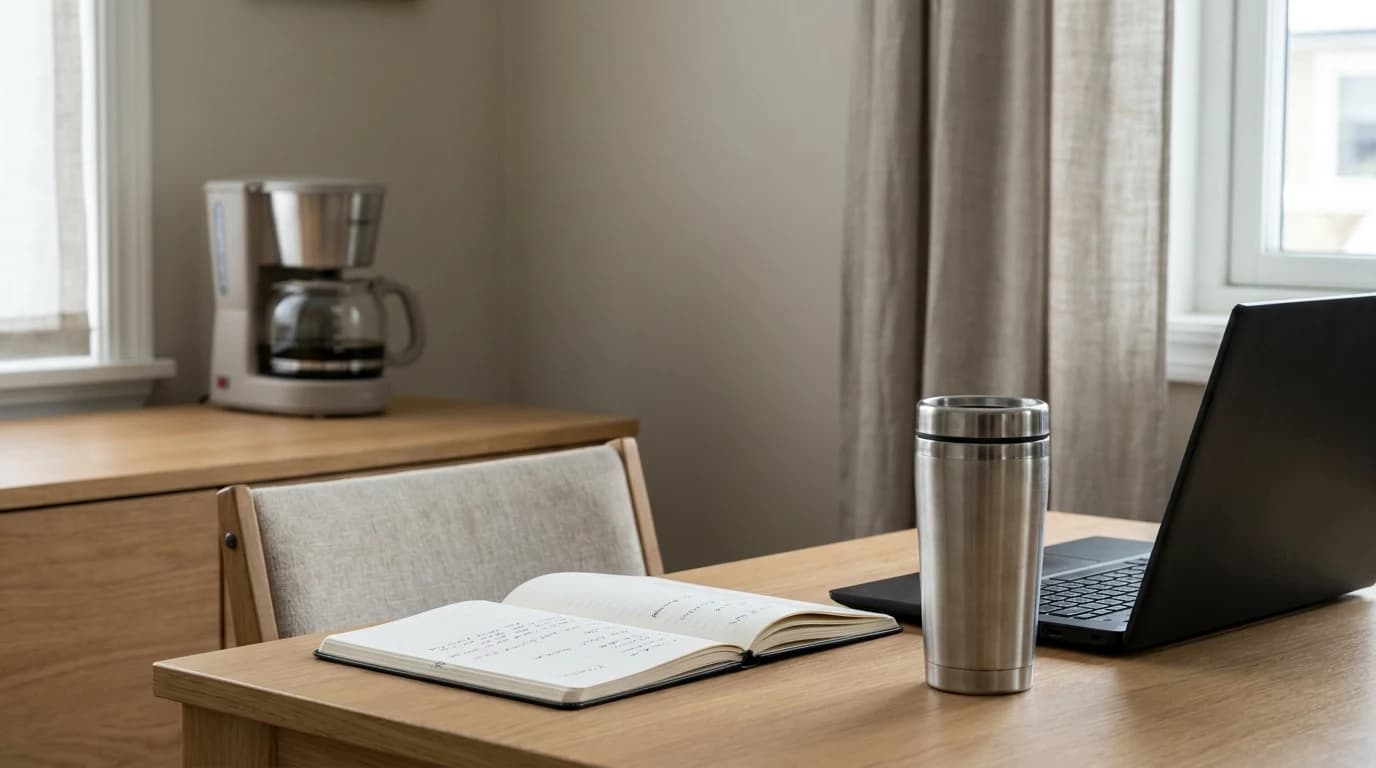
- An insulated mug — solves it structurally. A vacuum-insulated mug with a lid keeps a cup genuinely hot for a couple of hours, which happens to match the length of a focus block. The lid also turns a knocked-over mug into an annoyance rather than a keyboard replacement
Odd as it sounds, the mug is often the highest-impact purchase in a WFH coffee setup — because it fixes the thing that actually ruins your coffee daily. BrewSift's rundown of insulated mugs and tumblers covers which lids seal, which ones fit under a brewer, and which ones survive being knocked around.
If the mug never leaves your desk, though, there is a second answer the insulated-mug advice skips: a heated mug or a mug warmer plate holds the cup at a set temperature indefinitely instead of just slowing the decline.
Timing: The Reason Coffee Is Always Available Is the Problem
In an office, coffee has friction: you walk to the kitchen, someone talks to you, the pot is empty. At home there is none, which means remote workers routinely drink coffee later in the day than they used to. Two things follow.
The 2 PM cup is usually treating the wrong problem.
The post-lunch dip is largely circadian, and it is made worse by a heavy lunch or by having eaten nothing but a handful of almonds since breakfast — which is why what you eat during the day affects your afternoon more than your third cup does. If the dip is the real issue, a ten-minute walk, a glass of water, or moving low-focus work into that window will do more than caffeine. There are other levers for afternoon focus worth trying before the mug.
Caffeine sticks around longer than the alertness does. It has a half-life of several hours in most adults, so a mid-afternoon cup can still be measurably in your system at bedtime. Plenty of people who have slept badly since going remote are really just drinking coffee three hours later than they did when a commute ended the day.
A practical cutoff — early afternoon, adjusted for how you personally react — costs you nothing. And if you want a smaller dose rather than none, caffeine content varies a lot by brew method, which BrewSift breaks down in its caffeine-by-brew-method reference.
Coffee as the Commute Replacement
The last piece has nothing to do with the coffee. Remote work removed the transition. There is no drive, no train, no walk from the parking lot — no fifteen minutes where you stopped being a person at home and became a person at work. Without it, the workday tends to either start in a fog or never quite end.
Making coffee is an unusually good replacement for that transition, because it is already a small sequence of physical steps that takes a few minutes and cannot be done while reading email.
- Grind
- Brew
- Wait
Then you sit down and work. Do it in the same order every morning and it becomes a signal rather than a chore — the same principle behind every other morning routine that actually holds up.
The bookend works too. A last cup that is deliberately decaf or herbal tea, made at the same time each afternoon, marks the end of the workday about as well as anything else does. It sounds thin written down. It works better than it reads.
What This Actually Costs You
The whole setup:
- A grinder
- A single-cup brewer
- An insulated mug
- Beans you buy every few weeks
It lands well under what most people spend on café coffee in a couple of months.
The gear is the easy half. The half that matters is deciding when you drink it, when you stop, and keeping the walk to the café for the days you need the walk more than the coffee.
Hilly Shore Labs
Editorial TeamWFH Lounge is published by Hilly Shore Labs. Every recommendation is built by synthesizing ergonomic research, manufacturer specs, expert reviews from outlets like Wirecutter, RTINGS, and The Verge, and aggregated long-term owner sentiment from thousands of verified buyers.
All product reviews are independently researched. Our recommendations are based on ergonomic guidelines, manufacturer specifications, and verified buyer sentiment. See our methodology.