Home Coffee Setups for Remote Workers: Replace the Office Espresso Bar
You don't need to miss the office espresso bar. The right setup for a remote worker is the one that fits how you actually take breaks — a slow ritual, a fast button, or something in between. All three tiers beat a sad mug of instant.
Quick Answer
The office espresso machine was quietly one of the best perks of going in. Rebuilding it at home is cheaper than you'd think: under $100 gets you a pour-over or French press ritual that beats most office drip; $200–$300 buys a capable espresso setup; and $400–$500 gets a push-button bean-to-cup machine that matches the office bar with zero effort. Match the spend to whether you value the ritual or just want a good cup fast.
Key Takeaways
The office espresso machine was an underrated perk. Here's how to rebuild it at home on three budgets, from a $50 pour-over to a $500 push-button machine.
As an Amazon Associate I earn from qualifying purchases. Product prices and availability are subject to change.
Quick answer
One perk nobody warns you about losing when you go remote: the office coffee. Whether it was a proper espresso machine, a bean-to-cup dispenser, or just a decent drip pot someone kept stocked, it was better than what most people make at home — and it was free. Rebuilding that at home is one of the cheapest upgrades you can make to the remote workday, and it doubles as a built-in break structure.
Here's how to rebuild the office coffee bar at three budgets, matched to what you actually want out of a coffee break.
| Tier | What you're buying | The catch |
|---|---|---|
| Tier 1: the ritual | Pour-over dripper, gooseneck kettle, burr grinder | Four or five minutes of active attention |
| Tier 2: the espresso setup | Entry-level espresso machine plus a decent grinder | Dialing in grind size, dose and timing |
| Tier 3: the push-button bar | Super-automatic, bean-to-cup: beans in the hopper, press a button | Upfront cost; reliability is the whole game |
Why coffee is a remote-work productivity tool, not just a drink
The coffee break was never really about the caffeine. It was a boundary — a reason to stand up, walk to the kitchen, and let your brain idle for three minutes. Remote workers who skip that end up glued to the chair from 9 to 5, and the day blurs. A deliberate coffee ritual rebuilds the boundary the office used to impose for free.
The frame for this whole guide: you're not just buying a machine, you're buying a reason to take breaks that feel earned rather than guilty.
Tier 1: The ritual (under $100)
If you like the idea of a coffee break — the pause, the smell, the small ceremony — a manual setup is the best money you'll spend. A pour-over dripper, a gooseneck kettle, and a burr grinder land under $100 together and make coffee that embarrasses most office drip machines.
The catch is time: manual brewing takes four or five minutes of active attention. For a lot of remote workers that's the point — it's a forced micro-break.
BrewSift's manual brewer guide walks through the pour-over-versus-press-versus-AeroPress decision, which mostly comes down to how much fuss you enjoy. If the ritual sounds like a chore rather than a treat, skip straight to Tier 3.
Tier 2: The espresso setup ($200–$300)
Miss actual espresso — the crema, the small strong shot, the milk drinks? An entry-level espresso machine plus a decent grinder lands in the $200–$300 range and gets genuinely close to a cafe. This is the sweet spot for people who used to hit the office espresso bar three times a day and felt the withdrawal.
Be honest about the learning curve, though: real espresso means dialing in grind size, dose, and timing, and the grinder matters more than the machine. If tinkering sounds fun, this tier is deeply rewarding. If it sounds like a second job, again — Tier 3.
Tier 3: The push-button bar ($400–$500)
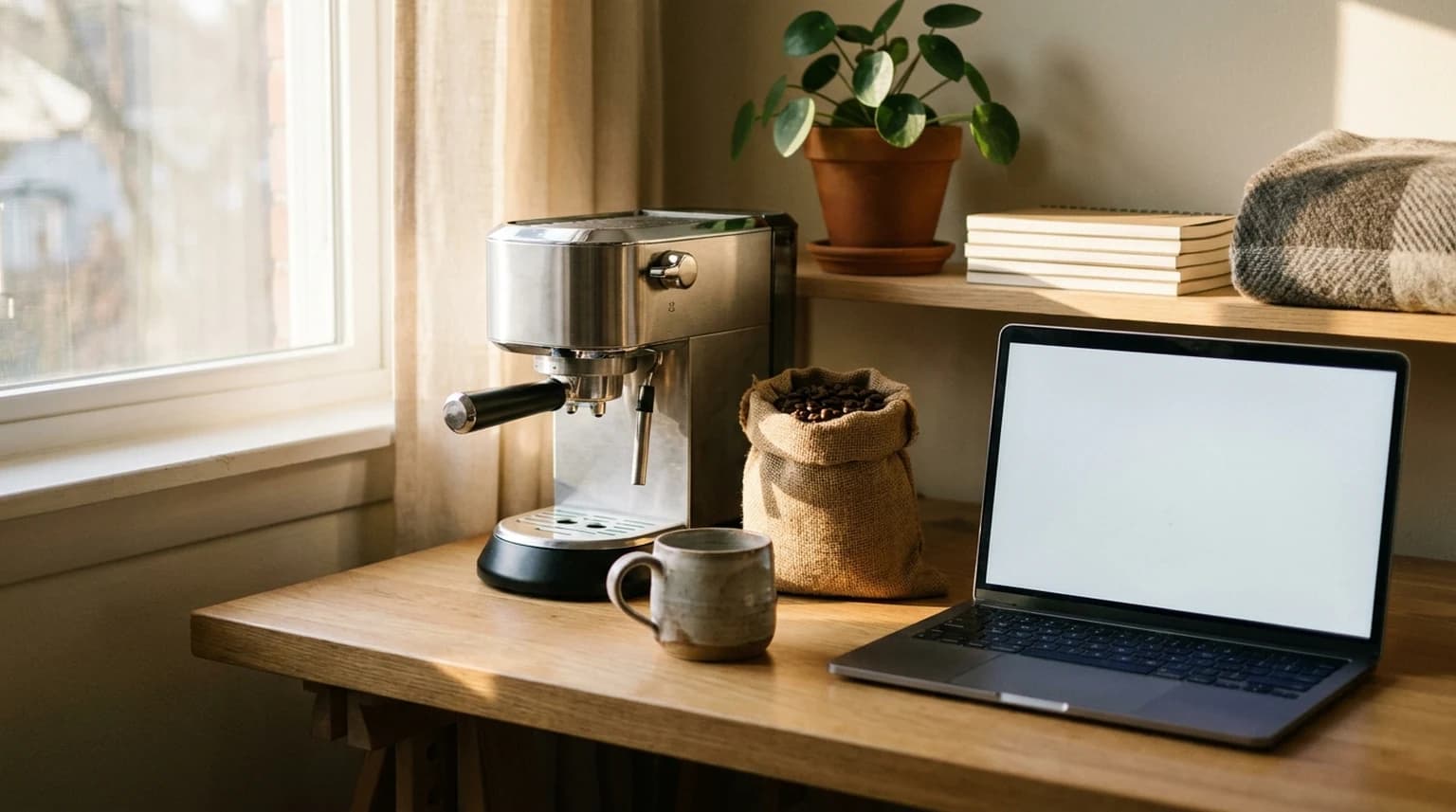
This is the true office-espresso-bar replacement: a super-automatic, bean-to-cup machine. Beans in the hopper, press a button, walk away with a latte. No grinding, no dialing, no cleanup beyond a rinse cycle. For remote workers who want the result without the hobby, it's worth every dollar.
Whichever tier you land on, the cup is a separate problem from the machine: coffee brewed at any of these tiers still goes cold during a long call, which is what a heated mug or warmer plate is for.
The upfront cost stings, but do the math against a daily cafe habit and it pays for itself in months. BrewSift's super-automatic espresso rankings cover which machines are reliable versus which ones become expensive paperweights — reliability is the whole game at this tier, because a broken push-button machine is just a $500 brick.
Pods: the honest middle ground
Pod machines deserve a mention because they're the fastest path to "fine coffee, zero effort."
The tradeoff is cost-per-cup and waste.
If you're weighing a pod machine against grinding your own, BrewSift has a pod-vs-beans cost calculator that does the per-cup math over a year — the gap is bigger than most people guess, but convenience has real value when you're between meetings.
Which tier is right for you?
- You want a break more than a drink → Tier 1. The ritual is the product.
- You're a former office-espresso-bar regular → Tier 2 if you like tinkering, Tier 3 if you don't.
- You want great coffee with zero thought → Tier 3, or a pod machine if the budget's tighter.
Whatever you pick, put it somewhere that requires standing up to use it. The walk is half the benefit.
Pair it with a real lunch instead of desk-crumbs — our meal prep ideas for remote workers covers the other half of taking care of yourself during the day.
Frequently asked questions
Is a home espresso setup actually cheaper than buying coffee out?
Over any meaningful time horizon, yes. A $400 machine versus a $5 daily latte pays for itself in about four months, and everything after that is savings. The break-even is faster the more coffee you drink.
Do I need an expensive grinder?
- For espresso: the grinder matters more than the machine — budget accordingly.
- For pour-over or French press: a modest burr grinder is plenty.
- At every tier, avoid a blade grinder: it grinds unevenly and caps how good your coffee can get.
What's the lowest-effort option that still tastes good?
A super-automatic bean-to-cup machine (Tier 3) or a good pod machine. Both trade upfront cost or per-cup cost for near-zero effort, which is the right trade for a lot of busy remote workers.
Hilly Shore Labs
Editorial TeamWFH Lounge is published by Hilly Shore Labs. Every recommendation is built by synthesizing ergonomic research, manufacturer specs, expert reviews from outlets like Wirecutter, RTINGS, and The Verge, and aggregated long-term owner sentiment from thousands of verified buyers.
All product reviews are independently researched. Our recommendations are based on ergonomic guidelines, manufacturer specifications, and verified buyer sentiment. See our methodology.