Meal Prep Ideas for Remote Workers Who Snack All Day
The best WFH meal prep is a calendar support system, not a Sunday performance. Prep a few flexible components, use shallow dated containers, keep perishable food cold promptly, and make lunch assemble-able in under five minutes. That is enough to stop the all-day grazing loop without turning remote work into a meal-planning hobby.
Quick Answer
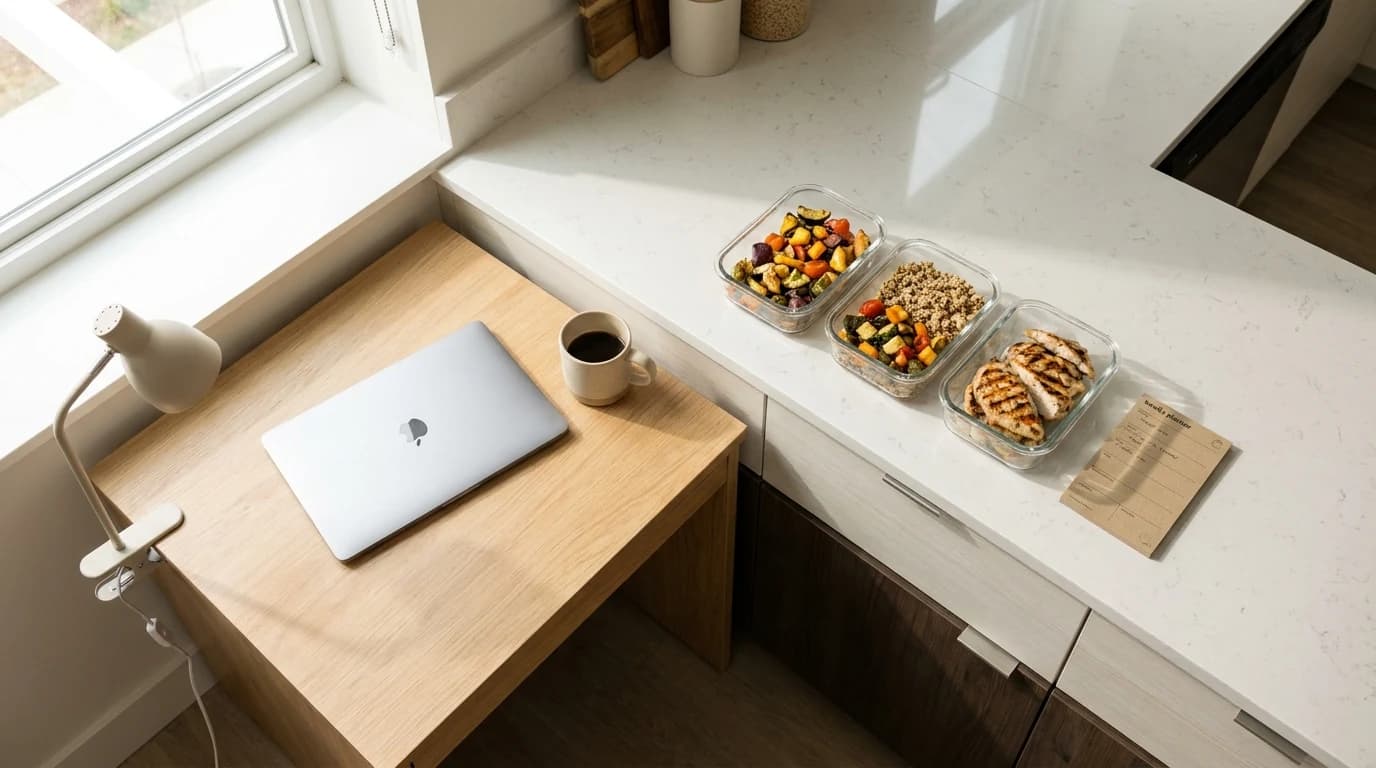
Meal prep for remote workers should solve decision fatigue, food safety, and afternoon energy. Prep two proteins, two vegetables or fruits, one grain or starch, and one sauce. Keep lunches plate-style, refrigerate perishable food promptly, and schedule snack windows so the kitchen does not become a constant workday distraction.
Key Takeaways
A practical WFH meal-prep framework: quick lunches, safer leftovers, snack windows, and plate templates that survive busy call days.
As an Amazon Associate I earn from qualifying purchases. Product prices and availability are subject to change.
Remote work changes lunch in a weird way. You are near a kitchen all day, but that does not mean you eat better. It often means grazing through meetings, forgetting lunch until 2:30, then grabbing whatever is fastest because the next call starts in eight minutes.
The useful version of meal prep is not a Sunday production line. It is a small set of ready ingredients that make the good choice faster than the random one.
Quick answer
Meal prep for remote workers should solve three problems: decision fatigue, food safety, and afternoon energy. Prep two proteins, two vegetables, one grain or starch, and one sauce on Sunday or Monday. Keep lunches plate-style, refrigerate perishable food promptly, and build snack breaks into the calendar so the kitchen does not become a background tab all day.
The remote-work meal-prep map
| Workday problem | Prep move | What it prevents |
|---|---|---|
| Grazing between calls | Pre-portion two snack boxes | Endless pantry trips |
| No lunch window | Make 3 microwave-ready bowls | Skipping lunch, then crashing |
| Decision fatigue | Repeat one base with different sauces | Daily "what do I eat?" drag |
| Heavy lunch slump | Half plate produce, quarter grain, quarter protein | The 2 p.m. nap feeling |
| Forgotten leftovers | Label date + use shallow containers | Mystery fridge archaeology |
The 2+2+1 formula
Do not prep five complete meals unless you enjoy eating the same thing every day. Prep components instead:
| Component | Prep two or one | Examples |
|---|---|---|
| Protein | 2 | Beans, lentils, tofu, chicken, eggs, yogurt |
| Vegetables or fruit | 2 | Roasted vegetables, chopped greens, berries, carrots |
| Grain/starch | 1 | Rice, quinoa, potatoes, whole-grain pasta, oats |
| Sauce/flavor | 1-2 | Salsa, tahini lemon, vinaigrette, yogurt herb sauce |
This gives you variety without extra decisions. A grain bowl, wrap, salad, snack plate, and soup add-in can all come from the same five containers.
The work-from-home trick: make lunch assemble-able in under five minutes. If it takes longer than that, it competes with your calendar and loses.
Three lunch templates that do not feel like leftovers
1. The focus bowl
Base grain, protein, vegetables, sauce. Keep the sauce separate until lunch so the texture holds. This is the default for days with deep work because it is filling without being complicated.
Build it: grain + protein + roasted vegetable + crunchy raw vegetable + sauce.
2. The no-reheat plate
Useful when calls are stacked and the microwave is a bottleneck. Think cold protein, cut produce, whole-grain toast or crackers, and fruit. It feels more like a lunch board than a sad desk snack.
Build it: protein + two produce colors + whole grain + dip or spread.
3. The emergency soup upgrade
Keep one simple soup or broth base, then add prepped vegetables, beans, grains, or shredded protein. It turns a low-effort lunch into something warm without cooking from scratch.
Build it: soup base + protein + vegetable + grain + herbs or acid.
Food safety rules for the WFH fridge
Working from home makes leftovers feel harmless because the fridge is right there. The safety rules still matter.
CDC's core food-safety steps are clean, separate, cook, and chill. For meal prep, the "chill" step is the one remote workers most often bend: CDC says perishable food and cooked leftovers should be refrigerated within 2 hours, or within 1 hour if exposed to temperatures above 90°F. CDC also recommends keeping the refrigerator at 40°F or below and the freezer at 0°F or below.
Practical rules:
- Use shallow containers. Big pots cool slowly; shallow portions chill faster.
- Date the lid. If you cannot tell when it was made, it is not a plan.
- Keep raw and ready-to-eat foods separate. Do not let raw meat prep share boards, containers, or drips with lunch ingredients.
- Do not thaw on the counter. CDC warns bacteria multiply quickly in food parts that reach room temperature.
The snack station should be scheduled, not ambient
Remote work makes snacking frictionless. The fix is not willpower; it is removing ambiguity.
Build two scheduled snack windows: one mid-morning, one mid-afternoon. Put one pre-portioned option in the fridge and one shelf-stable option near the desk. If the snack is already chosen, you are less likely to wander through the kitchen while mentally half-reading Slack.
Good snack formats:
| Need | Better format |
|---|---|
| Crunch | Cut vegetables, roasted chickpeas, popcorn |
| Sweet | Fruit plus yogurt or nuts |
| Protein | Eggs, yogurt, beans, tofu, cottage cheese |
| Meeting-safe | Smoothie, yogurt cup, soft fruit |
What most meal-prep advice gets wrong
It optimizes for Sunday ambition, not Wednesday reality. Remote workers do not need twenty matching containers. They need a kitchen that supports the calendar.
The Harvard Healthy Eating Plate is a useful sanity check: make most of the meal vegetables and fruits, add whole grains, add healthy protein, and drink water, coffee, or tea with little or no sugar. ODPHP's current Dietary Guidelines page points in the same direction: nutrient-dense foods like protein, dairy, vegetables, fruits, healthy fats, and whole grains, with less reliance on highly processed foods high in refined carbohydrates, added sugars, excess sodium, and unhealthy fats.
That does not require a perfect diet. It means your default lunch should have a recognizable plant, a filling protein, and a carbohydrate that does not leave you hungry an hour later.
A 45-minute Sunday plan
| Minute | Action |
|---|---|
| 0-10 | Wash/chop produce; start grain or potatoes |
| 10-25 | Cook protein or open/season ready protein |
| 25-35 | Roast or steam vegetables; mix one sauce |
| 35-40 | Portion two lunches and two snack boxes |
| 40-45 | Label dates; move everything into the fridge |
That is enough. The goal is not to win meal prep. The goal is to make Tuesday lunch boringly easy.
Sources
- CDC — Preventing Food Poisoning (clean/separate/cook/chill, refrigerator and freezer temperatures, prompt refrigeration)
- ODPHP — Current Dietary Guidelines (2025-2030 Dietary Guidelines overview and nutrient-dense food pattern)
- Harvard T.H. Chan School of Public Health — Healthy Eating Plate (plate proportions: produce, whole grains, protein, water/low-sugar drinks)
Your next step
Keep the workday fuel simple.
Hilly Shore Labs
Editorial TeamWFH Lounge is published by Hilly Shore Labs. Every recommendation is built by synthesizing ergonomic research, manufacturer specs, expert reviews from outlets like Wirecutter, RTINGS, and The Verge, and aggregated long-term owner sentiment from thousands of verified buyers.
All product reviews are independently researched. Our recommendations are based on ergonomic guidelines, manufacturer specifications, and verified buyer sentiment. See our methodology.