High-Protein Snacks for Work: What to Keep at Your Desk
Protein content and eating distance do most of the work; the specific snack does very little. Stock the desk drawer with shelf-stable protein so the closest food is also the best one, put one snack on the calendar instead of grazing, and eat it somewhere your brain records it. The satiety research is modest and comes from small samples, so treat it as a lever on comfort and timing rather than a weight-loss claim.
Quick Answer
Aim for 10 g of protein or more per snack, and screen on protein per 100 calories rather than protein per package. In one controlled trial, a 160-calorie yogurt snack with 24 g of protein delayed the next meal by 54 minutes versus no snack; the 5 g version bought 28. Then eat it away from the keyboard, because distracted eating raises later intake more than it raises the intake in front of you.
Key Takeaways
The fridge is ten feet away. What the protein research says about desk snacking at home, plus the label math that spots a fake protein snack.

As an Amazon Associate I earn from qualifying purchases. Product prices and availability are subject to change.
In an office, snacking is rate-limited by a walk to the kitchen and the mild awkwardness of being seen at the biscuit tin for the third time. Working from home removes both. The fridge is ten feet from the chair, nobody is counting, and the snack gets eaten one-handed while the other hand keeps typing.
That last detail matters more than what the snack is. Three things decide how a work-from-home afternoon goes: whether you were paying attention while you ate, how much protein was actually in the thing, and how far the food sat from your chair. Only one of those is printed on the label.
Eating at the keyboard is the part that backfires
The most robust finding here is not about food at all. Robinson and colleagues pooled 24 experiments in the American Journal of Clinical Nutrition in 2013 and found that eating while distracted produced a moderate increase in how much people ate at that moment — and roughly twice as large an increase in what they ate later in the day. Enhancing someone's memory of what they had eaten cut later intake instead.
Read that against a home-office day and it stops being abstract. Lunch at the keyboard during a call, a handful of something at 3pm while reading Slack, and by evening your body is working from a very thin record of the afternoon.
Rule of thumb: the real cost of a desk snack is not its calories. It is the snack you do not remember eating, and the larger dinner that missing memory buys you.
Protein is the variable that moves the afternoon
The clearest experiment on afternoon snacking held everything constant except protein. Douglas and colleagues gave 15 women identical 160-calorie Greek yogurt snacks three hours after lunch, varying only the protein, then measured when each person voluntarily asked for dinner.
| Afternoon snack (all 160 calories) | Dinner requested after |
|---|---|
| No snack | 124 min |
| 5 g protein | 152 min |
| 14 g protein | 158 min |
| 24 g protein | 178 min |
Same calories, same food, nearly an hour of difference between the ends of that column. A companion study from the same lab swapped the comparison to what people actually reach for — 160 calories of high-protein yogurt against high-fat crackers or chocolate — and found the yogurt pushed back the next eating occasion by about 30 minutes versus chocolate and led to roughly 100 fewer calories at dinner. The crackers comparison did not reach statistical significance.
Both are single-lab studies of 15 and 20 women, so treat the minutes as a direction rather than a dose chart. The wider review of this literature, Leidy et al. 2015, reports a modest satiety effect from higher-protein eating while explicitly not supporting an effect on how much people eat at the next occasion.
What protein is buying. Comfort and time, on small-sample evidence. Whether it makes you eat less across the whole day is not settled.
There is a second reason to care about protein at 3pm and not only at dinner. Mamerow and colleagues fed eight healthy adults the same daily protein either evenly across three meals, around 30 g each, or skewed toward the evening — and measured 25% higher 24-hour muscle protein synthesis on the even pattern. Eight people is a small study, but it points the same way: the afternoon is where most people's protein day is emptiest.
The number that makes something a protein snack
Snack packaging is the most protein-marketed shelf in the store, which makes the label rules worth knowing. The FDA sets the Daily Value for protein at 50 grams for adults and children over four, and the nutrient-content claim thresholds at 10-19% of that DV for "good source" and 20% or more for "high" or "excellent source". Do the arithmetic once and you never have to trust a front-of-pack starburst again:
- Good source of protein = 5 g per serving. That is a claim, not an achievement.
- High / excellent source = 10 g per serving.
- Percent DV for protein is optional on a label unless a protein claim is made, so read the grams.
Grams alone still miss what matters most at a desk, which is density. A bar with 10 g of protein and 280 calories is a dessert with protein in it. Screening on protein per 100 calories sorts the shelf fast, and it is the same screen used by people eating on a medication-shrunk appetite, where only two or three small things fit in a whole day and each one has to earn its place.
Sort your food by distance, not by virtue
Stop grading snacks as good or bad and start placing them by how far they sit from the chair. Whatever is closest wins on a busy afternoon, every time.
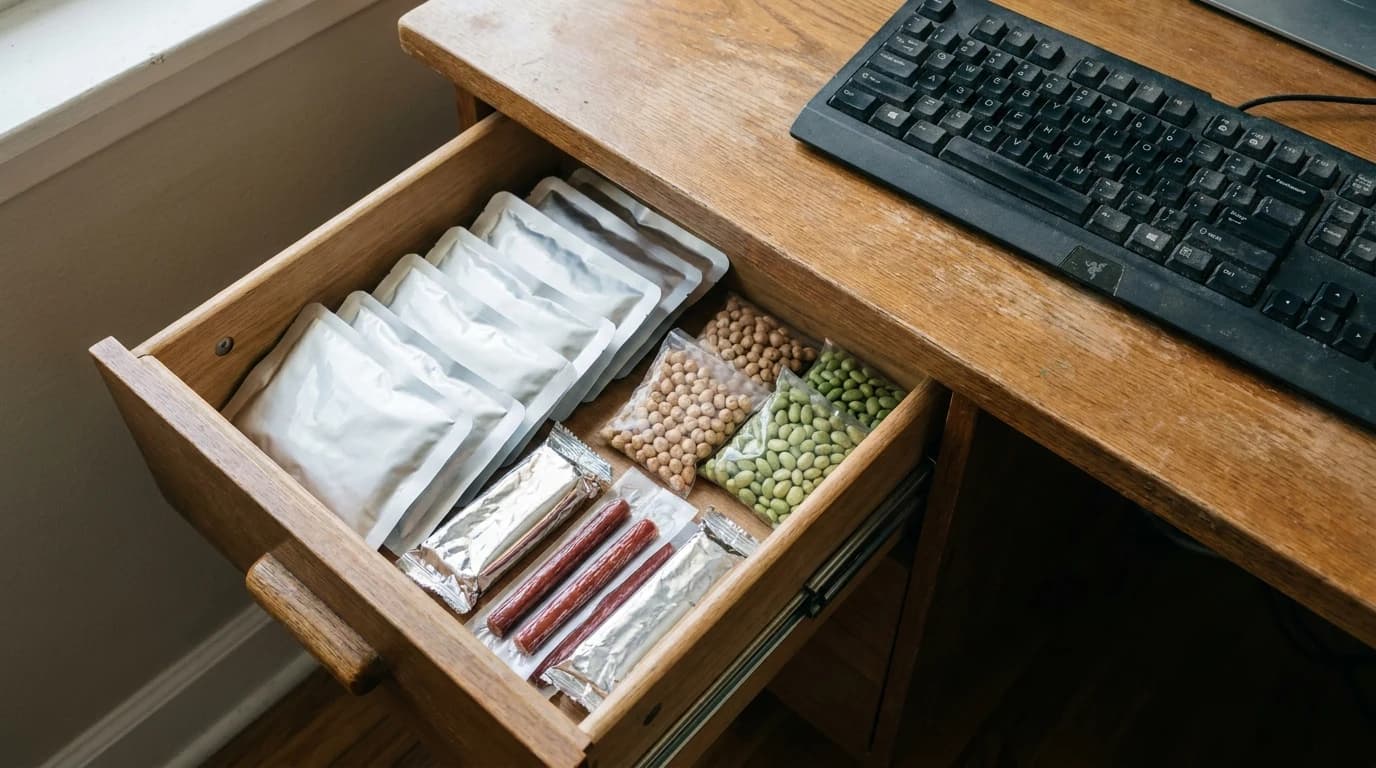
Worth keeping in the desk drawer — shelf-stable, no prep, no smell on a call:
- Tuna or salmon pouches, and the fork to eat them with
- Roasted edamame, chickpeas or lupini beans
- Meat sticks or jerky, accepting that these are the salty option
- A single protein bar chosen on protein-per-calorie, kept as the backstop rather than the default
Worth the ten-foot walk to the fridge — because the walk is a feature:
- Greek yogurt or cottage cheese, the snack the research above was actually built on
- Hard-boiled eggs, cooked in the batch you already do for weekday lunches
- Leftover cooked chicken or tofu in a container you can eat straight from
- Ready-to-drink shakes, for the days when chewing is losing to the calendar
The drawer is not a compromise. It is the only shelf that reliably beats the pantry at 3pm.
Put snacks on the calendar, not on ambient access
Grazing is not a character flaw at home; it is what happens when food is permanently available and attention is permanently elsewhere. Given that the distraction effect is the mechanism, the fixes that work are the ones that restore a memory of eating.
What actually helps:
- One scheduled snack block, mid-afternoon, on the calendar like a meeting
- Eating it away from the keyboard — even two minutes at the kitchen counter creates the memory
- Portioning into a bowl instead of eating from the bag, so the amount is visible
- Anchoring it to something you already do, like the midday walk or the end of a focus block
What people try that does not hold:
- Banning snacks entirely, which just moves the eating to 6pm
- Buying only "healthy" snacks and grazing on them continuously
- Relying on willpower to beat a fridge that is ten feet away and unmonitored
- Treating coffee as a snack replacement, which pushes the hunger later without answering it
None of this is a diet. It is the food being closer than the pantry, the protein being real, and the eating happening somewhere your brain registers it — the same conclusion the rest of a well-structured remote day keeps arriving at.
Frequently asked questions
How much protein should a work snack have?
Ten grams is the line where the FDA lets a label say "excellent source," and it is a reasonable floor for something meant to hold you until dinner. The afternoon-snack studies above used 14 g and 24 g, and the 24 g version delayed the next meal longest. Below about 5 g you are eating a carbohydrate snack with a protein claim on the front.
Are protein bars a good desk snack?
They are the most convenient option and rarely the best one. Judge a bar on protein per 100 calories rather than per bar — many land closer to a biscuit than to yogurt on that measure. Keep one in the drawer as a backstop rather than the everyday choice.
Does snacking at your desk actually make you eat more?
The pooled evidence says eating while distracted increases intake both then and, more strongly, later in the day. The snack is not the problem — eating it while your attention is on a spreadsheet is. If you change one thing, eat away from the screen. The other snack habits that hold up are downstream of that.
Sources
- Robinson et al. (2013), Am J Clin Nutr — eating attentively: distraction, memory and food intake
- Douglas et al. (2013), Appetite — low, moderate or high protein yogurt snacks and subsequent eating
- Ortinau et al. (2014), Nutrition Journal — high-protein vs high-fat afternoon snacks
- Leidy et al. (2015), Am J Clin Nutr — the role of protein in weight loss and maintenance
- Mamerow et al. (2014), J Nutr — protein distribution and 24-h muscle protein synthesis
- 21 CFR 101.9 — nutrition labeling, protein Daily Value
- 21 CFR 101.54 — nutrient content claims for "good source" and "high"
Hilly Shore Labs
Editorial TeamWFH Lounge is published by Hilly Shore Labs. Every recommendation is built by synthesizing ergonomic research, manufacturer specs, expert reviews from outlets like Wirecutter, RTINGS, and The Verge, and aggregated long-term owner sentiment from thousands of verified buyers.
All product reviews are independently researched. Our recommendations are based on ergonomic guidelines, manufacturer specifications, and verified buyer sentiment. See our methodology.