How Often Should You Stand at a Standing Desk?
The best standing-desk routine is not standing more, it is staying still less. Change posture every 20 to 30 minutes, actually move for a minute or two when you do, and match posture to the task. Standing motionless for hours trades the sitting problem for a standing problem.
Quick Answer
Change posture every 20 to 30 minutes rather than chasing a daily hours-standing target. Cornell ergonomics guidance is to sit for focused work, then stand about 8 minutes and actively move about 2 minutes each cycle, roughly 15 to 20 minutes of standing per hour. Frequency matters more than total time, and standing all day is its own health risk.
Key Takeaways
How often to stand at a standing desk, backed by ergonomics research: change posture every 20-30 minutes, move on breaks, and skip all-day standing.
As an Amazon Associate I earn from qualifying purchases. Product prices and availability are subject to change.
You bought the standing desk. You stood for most of the first morning, your feet ached by lunch, and within a few weeks the desk quietly lived at sitting height again. That arc is so common that researchers have measured it: most sit-stand desk owners end up standing only a few minutes a day, and within about a month a majority are back to sitting full time.
The fix is not willpower. It is a cadence. A standing desk is not a "stand instead of sit" tool, it is a "stop holding one posture for hours" tool. Below is what the ergonomics research actually recommends, why standing all day is its own mistake, and a schedule you can keep.
Quick answer
Aim to change posture every 20 to 30 minutes. The Cornell Ergonomics guidance is to sit for focused computer work, then stand for about 8 minutes and actively move for about 2 minutes each cycle, which works out to standing roughly 15 to 20 minutes per hour. The exact split matters less than the frequency: the goal is to never stay frozen in one position, sitting or standing, for an hour straight.
What the guidance really says
- Frequency beats duration. Breaking up sitting every 20 to 30 minutes is the recommendation that has research behind it, not "stand X hours a day."
- Standing all day is its own health risk, linked to leg and lower-back pain, varicose veins, and circulatory strain, so swapping eight hours of sitting for eight hours of standing trades one problem for another.
- Standing alone is not enough. The benefit comes from movement during the break, not from being upright while you type.
- Most owners under-use the desk and drift back to sitting full time within a month unless they build a trigger into their day.
The frequency-over-hours rule
The most common standing-desk question is "how many hours should I stand?" That framing is the trap. Ergonomists recommend breaking up prolonged sitting with periodic standing and moving, "preferably 1 to 2 minutes every 20 to 30 minutes," according to Cornell University's Ergonomics Web. The number that matters is how often you change posture, not the cumulative hours upright.
This is why people who try to "stand for four hours" burn out. Four unbroken hours of standing is just a different static load. The body is built to alternate, and the research consistently points at posture changes rather than a magic standing dose.
If you only remember one thing: set a timer for every 30 minutes. When it goes off, change what you are doing, sitting to standing or standing to sitting, and take a short walk to the kitchen. That single habit captures most of the benefit.
A sit-stand schedule you can actually keep
Here is a realistic cycle based on the Cornell 20-8-2 guidance, scaled to a normal workday. The point is the rhythm, so adjust the minutes to your comfort, but keep the transitions frequent.
| Time in cycle | Posture | What to do |
|---|---|---|
| 0-20 min | Sit | Focused computer work, keyboard at elbow height |
| 20-28 min | Stand | Reading, calls, email, lighter tasks |
| 28-30 min | Move | Walk, stretch, refill water, look out a window |
| Repeat | — | About 2 to 3 cycles per hour |
Across a 6-hour screen day that is roughly 15 to 20 minutes of standing per hour, plus a couple of genuine movement breaks each hour. Note what is not on this list: standing motionless for hours. Cornell's guidance is blunt on this point, that "simply standing is insufficient." The 2-minute move is the active ingredient.
What most standing-desk advice gets wrong
The marketing pitch is that sitting is killing you and standing is the cure. The evidence does not support that clean swap.
A CDC/NIOSH scoping review of 53 studies on sit-stand desks found they reliably change behavior, people do sit less, but those changes only mildly affect health outcomes. The desks helped most with discomfort and least with work performance. Translation: a standing desk is a useful tool for breaking up sitting, not a weight-loss device or a productivity hack.
Meanwhile, prolonged standing carries its own well-documented risks. A review in the journal Rehabilitation Nursing concluded there is "ample evidence" that prolonged standing at work is associated with lower-back and leg pain, cardiovascular problems, fatigue, and pregnancy-related outcomes. People who treat the standing desk as a standing-all-day desk often discover this the hard way, through aching feet, swollen legs, and lower-back fatigue.
Standing burns only about 20% more energy than sitting, per Cornell's figures, which is roughly a handful of extra calories per hour. If you bought a standing desk mainly to burn calories, you will be disappointed. Its real value is posture variety, not a workout.
How to make the habit stick
Knowing the cadence is easy. Keeping it is the hard part, because the desk does not remind you and deep focus erases the clock. A few things that work:
- Use an external trigger, not memory. A repeating 30-minute timer, a calendar nudge, or pairing transitions with natural events (every meeting, every coffee) beats relying on willpower.
- Make standing the easy state for the right tasks. Stand for calls, reading, and email; sit for anything that needs fine motor precision or long focus. Matching posture to task means you stand without thinking about it.
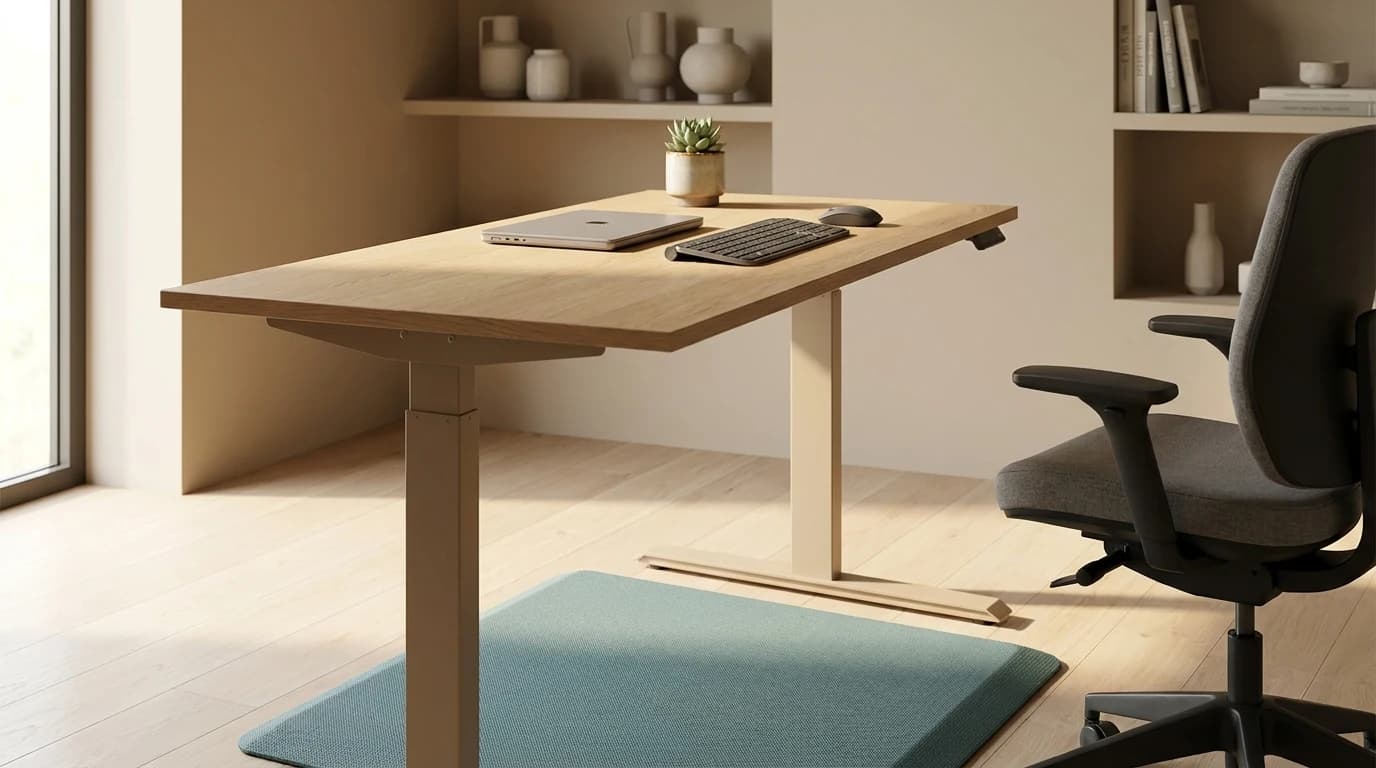
- Add an anti-fatigue mat. The same prolonged-standing research that flags the risks also lists floor mats, supportive shoes, and footrests as effective ways to reduce standing discomfort, which is what makes the standing intervals tolerable enough to repeat.
- Lower the bar for movement. The 2-minute move does not need to be exercise. Walking to refill water counts. The goal is to interrupt the static load, not to do a workout.
The best standing-desk routine is not "stand more." It is "stay still less." Change posture every 20 to 30 minutes, actually move for a minute or two when you do, and match posture to the task. Do that and the desk earns its keep. Stand frozen for hours and you have just bought a more expensive way to ache.
Frequently asked questions
How many hours a day should I stand at a standing desk?
There is no research-backed daily target. The recommendation is frequency, not hours: change posture every 20 to 30 minutes. In practice that lands around 15 to 20 minutes of standing per hour, but the transitions matter more than the total.
Is it bad to stand at a desk all day?
Yes. Prolonged standing is associated with lower-back and leg pain, varicose veins, and circulatory strain. All-day standing replaces the sitting problem with a standing problem rather than solving it. Alternate instead.
Does standing at a desk burn many calories?
Not really. Standing uses about 20% more energy than sitting, which is only a small number of extra calories per hour. The benefit of a standing desk is breaking up static posture, not weight loss.
Why do I get sore feet at my standing desk?
Usually from standing too long in one stretch on a hard floor. Shorten standing intervals, add an anti-fatigue mat and supportive shoes, and make sure you are moving during breaks rather than standing motionless.
Sources
- Cornell University Ergonomics Web — Sitting and Standing at Work (break up sitting every 20-30 minutes; standing uses ~20% more energy; "simply standing is insufficient")
- Rehabilitation Nursing (PubMed) — Evidence of health risks associated with prolonged standing at work (prolonged standing linked to back/leg pain, cardiovascular and pregnancy outcomes; anti-fatigue mats and footwear help)
- CDC / NIOSH — The Effect of Sit-Stand Desks on Office Worker Behavioral and Health Outcomes: A Scoping Review (sit-stand desks change behavior but only mildly affect health; best for discomfort, least for productivity)
Hilly Shore Labs
Editorial TeamWFH Lounge is published by Hilly Shore Labs. Every recommendation is built by synthesizing ergonomic research, manufacturer specs, expert reviews from outlets like Wirecutter, RTINGS, and The Verge, and aggregated long-term owner sentiment from thousands of verified buyers.
All product reviews are independently researched. Our recommendations are based on ergonomic guidelines, manufacturer specifications, and verified buyer sentiment. See our methodology.