How to Signal to Your Brain That Work Is Over
Create a consistent end-of-day ritual combining physical, digital, and environmental cues to train your brain to transition out of work mode.
Quick Answer
Train the transition with a consistent shutdown ritual: a five-minute brain dump, a three-minute plan for tomorrow, a physical reset of the desk, and a closing phrase — then movement that replaces the commute. The cues compound; after a few weeks the ritual itself triggers the disengagement.
Key Takeaways
Struggling to switch off after work from home? Learn research-backed rituals and habits that tell your brain the workday is done.

As an Amazon Associate I earn from qualifying purchases. Product prices and availability are subject to change.
When you worked in an office, the commute home was your transition. You packed up your bag, said goodbye to coworkers, walked to your car or the train, and by the time you arrived home your brain had shifted gears. That liminal space between office and home did real psychological work.
Now you work from home. You close your laptop at 5:30 and you are already home. There is no transition. Your brain does not get the signal. So at 9 PM you are still mentally composing that email. At 11 PM you are lying in bed replaying a meeting. On Saturday you catch yourself checking Slack "just in case."
This is one of the most common complaints in every WFH community online, and it is not a discipline problem. It is a signal problem. Your brain literally does not know work is over because none of the environmental cues have changed. Same room, same chair, same screen.
Here is how to fix it.
Why Your Brain Needs a Shutdown Signal
Your brain relies on contextual cues to switch between modes. Psychologists call this "context-dependent memory" — the environment you are in primes certain thoughts, behaviors, and emotional states. When you worked in an office, leaving that physical space triggered a cascade of mental shifts. Your brain associated "home" with rest, food, family, and leisure.
When home is also the office, those associations blur. Your brain stays in a low-level state of work alertness because the environment keeps priming work-related thoughts. The solution is to create artificial boundaries that replace the ones you lost.
The Shutdown Ritual: Your New Commute
Cal Newport popularized the idea of a "shutdown ritual" in his book Deep Work, and it is one of the most effective strategies for remote workers. The idea is simple: you perform the same sequence of actions at the end of every workday, and over time your brain learns that this sequence means work is done.
Here is a shutdown ritual that works:
Step 1: The Brain Dump (5 minutes)
Before you close anything, spend five minutes writing down everything that is on your mind about work. Open tasks, things you need to follow up on, ideas you had during the day, worries about tomorrow. Get it all out of your head and onto paper or into a task manager.
This works because of what psychologists call the Zeigarnik Effect — your brain keeps incomplete tasks in active memory, creating that nagging "I should be doing something" feeling. Writing them down tells your brain "these are captured, you can let go."
Step 2: Plan Tomorrow (3 minutes)
Look at your task list and your calendar for tomorrow. Identify the two or three most important things you need to accomplish. Write them down. This gives your brain confidence that tomorrow is handled, which reduces evening anxiety about work.
Step 3: The Physical Reset
This is the most important step. You need to physically change something about your environment. Some options:
- Close the door to your office. If you have a dedicated room, shut the door and do not go back in until morning. The closed door becomes your "leaving the office" cue.
- Put your laptop away. If you work from your kitchen table or living room, physically put your work laptop in a drawer, a bag, or a cabinet. Out of sight matters.
- Change your clothes. This sounds trivial but it is powerful. Changing from your "work clothes" (even if that is a nicer t-shirt) into your "home clothes" gives your brain a physical transition marker.
- Change your lighting. If you use bright, cool task lighting for work, switch to warmer, dimmer lighting for the evening. Your body responds to light temperature — warm light signals relaxation.
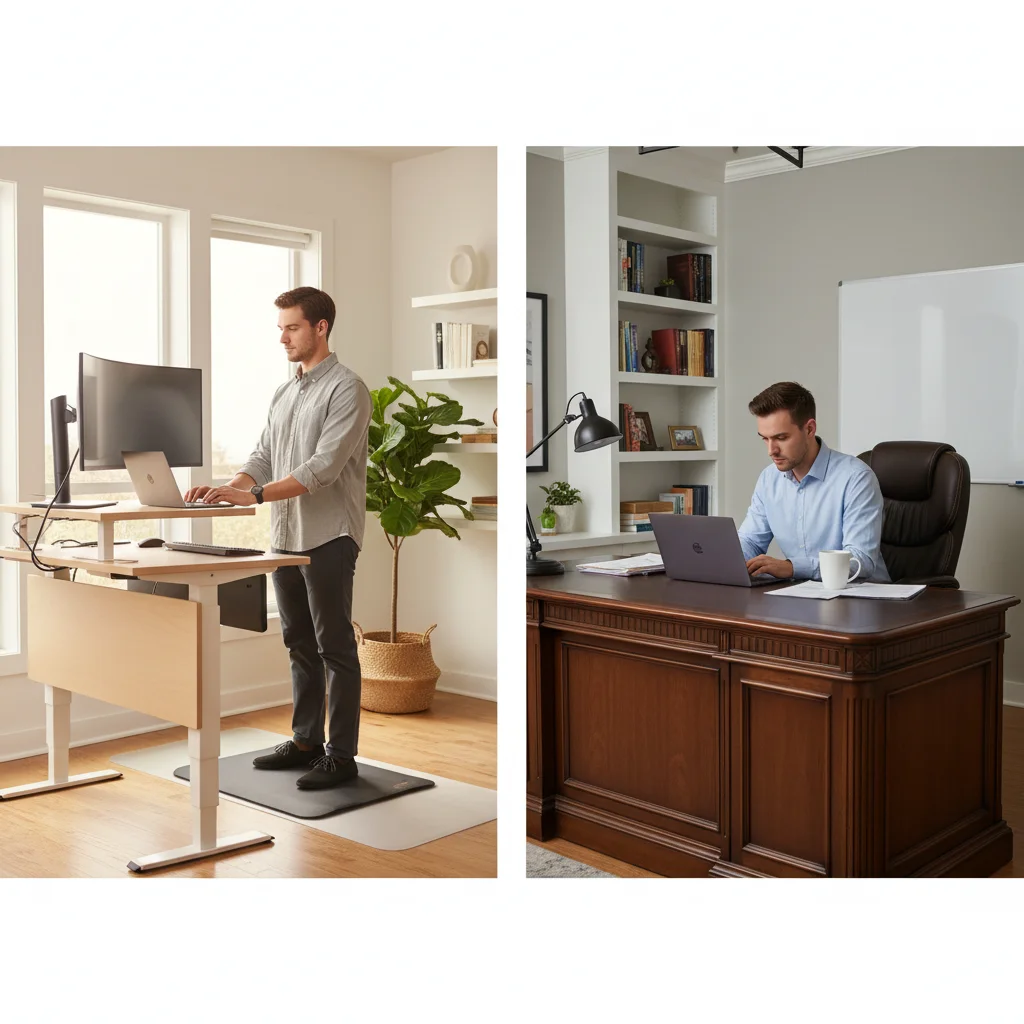
If you use a standing desk, lowering it to sitting height or stepping away from it entirely can serve as a strong physical cue that the active part of your day is winding down.
Step 4: Say the Words
This might feel silly at first, but say something out loud to mark the end of work. Cal Newport uses "shutdown complete." You can say whatever feels natural — "done for the day," "work is closed," or even just "that is it." The verbalization creates a cognitive marker that your brain latches onto surprisingly quickly.
Replace the Commute With Movement
One of the most effective shutdown strategies is a fake commute. After your ritual, leave the house. Walk around the block. Go to the mailbox and back. Drive to a coffee shop and get a drink. The physical act of leaving and returning mimics the commute your brain is missing.
A 15-minute walk after work does three things:
- It creates physical separation between work mode and home mode.
- It gives your brain processing time — that same unfocused mental wandering that used to happen during your drive home.
- It introduces movement after hours of sitting, which reduces the physical tension that accumulates during a desk-bound day.
If you want to make your walk more intentional, a good pair of wireless noise-canceling headphones lets you listen to a podcast or music that has nothing to do with work. The Bose QuietComfort Ultra headphones are excellent for this — the noise cancellation blocks out street noise and the audio quality makes your post-work wind-down feel like a genuine treat.
Digital Boundaries That Actually Hold
Physical rituals work best when they are reinforced by digital ones:
- Turn off work notifications after hours. On most phones you can set Focus modes or Do Not Disturb schedules that silence Slack, email, and Teams at a specific time. Set it and forget it.
- Use separate browser profiles. Keep one browser profile for work (with your work Gmail, Slack, and project tools) and another for personal use. At shutdown time, close the work profile entirely.
- Remove work apps from your phone home screen. You do not need to delete them, just move them into a folder on the second or third page. The friction of finding them reduces mindless checking.
- Set a status. When you sign off, change your Slack status to something like "offline until 9 AM." This communicates your boundary to others and reinforces it for yourself.
Learning to protect your non-work hours is a crucial part of maintaining work-life balance when you WFH. It is not about being unresponsive — it is about being sustainable.
Build an Environment That Supports Switching Off
If you work and relax in the same room, environmental design matters enormously. A few changes can help your brain understand that the space has shifted from work to rest:
- Use a room divider or curtain to visually separate your work area from your living area.
- Switch the soundtrack. If you listen to focus music or ambient noise during work, switch to a completely different genre or turn on a show in the evening.
- Light a candle or use a diffuser. Scent is one of the most powerful memory triggers. If you associate a particular scent with relaxation, using it after work creates an instant mood shift.
A smart light strip like the Govee RGBIC LED Strip lets you change your room's entire vibe with a tap. Cool white during work hours, warm amber in the evening — your brain picks up on the shift faster than you would expect.
What to Do When Work Thoughts Creep In
Even with a perfect ritual, work thoughts will still pop up during your evening. That is normal. The goal is not to eliminate them but to have a strategy for handling them:
- Acknowledge the thought. Do not fight it. Just notice it: "That is a work thought."
- Capture it quickly. Jot it down on a notepad you keep nearby (not on your phone where you might get sucked into work apps). A physical notebook works best.
- Let it go. You have captured it. It will be there tomorrow. Return to whatever you were doing.
Over time, this gets easier. Your brain learns that the shutdown ritual means thoughts will be captured and addressed tomorrow, so it stops generating them as frequently in the evening.
Start Tonight
You do not need to implement everything at once. Tonight, try the simplest version: spend five minutes writing down your open tasks, close your laptop, change your clothes, and take a 10-minute walk. Do it again tomorrow. And the day after that.
Within two weeks, your brain will start to anticipate the ritual. You will feel the mental shift beginning before you even start the sequence. That is the goal — not perfect separation, but a reliable transition that protects your focus during work hours and your peace during the rest.
Your brain wants to switch off. You just need to give it permission.
Related Reading
Your next step
Build the shutdown ritual.
Hilly Shore Labs
Editorial TeamWFH Lounge is published by Hilly Shore Labs. Every recommendation is built by synthesizing ergonomic research, manufacturer specs, expert reviews from outlets like Wirecutter, RTINGS, and The Verge, and aggregated long-term owner sentiment from thousands of verified buyers.
All product reviews are independently researched. Our recommendations are based on ergonomic guidelines, manufacturer specifications, and verified buyer sentiment. See our methodology.