How to Stop Your Family From Interrupting You While WFH
The traffic light system combined with clear conversations, age-appropriate kid strategies, and a closable door solves 90% of WFH family interruption problems — but consistency in enforcing boundaries is what makes it stick.
Quick Answer
The traffic-light system — a visible red/yellow/green signal on your door or desk — combined with one clear conversation per household member and age-appropriate expectations for kids solves about 90% of WFH interruption problems. The hard part isn't the system; it's enforcing it consistently for the first two weeks.
Key Takeaways
Family interruptions are the top WFH frustration. Here's how to set boundaries with kids, partners, and roommates without damaging relationships.
As an Amazon Associate I earn from qualifying purchases. Product prices and availability are subject to change.
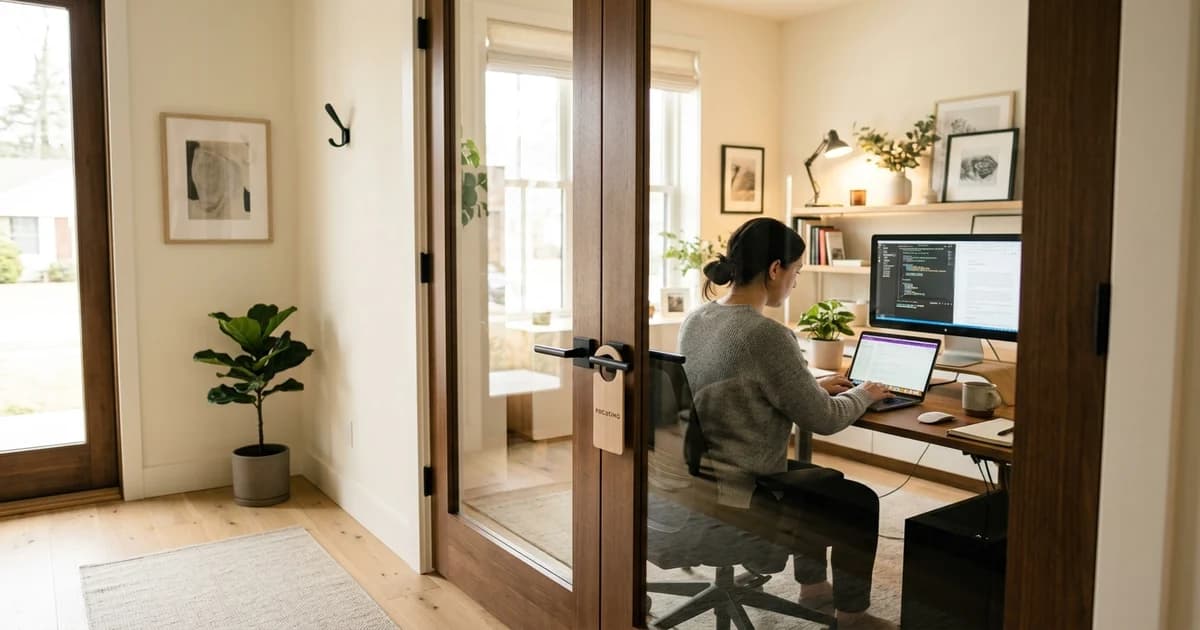
You're deep in a flow state — code is flowing, the presentation is coming together — and the door opens. "Hey, quick question..." or the dreaded toddler burst-through during a Zoom call with your manager.
Family interruptions are consistently the number one frustration of working from home. And unlike most WFH challenges, this one involves other people's feelings, making it harder to solve with gear or productivity hacks alone.
The good news: this is solvable. But the solution requires clear communication, physical signals, and consistent follow-through.
Why Interruptions Are So Destructive
Research from the University of California, Irvine found it takes an average of 23 minutes and 15 seconds to return to a task after an interruption. The person interrupting sees a 30-second question. You experience a 25-minute productivity loss.
This gap in perception is the root of most boundary conflicts. Your family isn't being inconsiderate — they genuinely don't understand the cognitive cost. Explaining this research is often the first step toward mutual understanding. Frame it as "here's why even quick interruptions have an outsized impact" rather than "you're bothering me."
The Traffic Light System
The most effective strategy reported by WFH parents and partners is the traffic light system — a visual signal that communicates availability without verbal negotiation.
- Red — Do not interrupt unless someone is hurt or the house is on fire. Deep focus mode.
- Yellow — Quick questions okay, but save anything longer than 30 seconds.
- Green — Fully available. Come in, chat, ask anything.
The physical implementation can be colored paper on your door, a small LED light that changes color, or a sliding doorknob sign. The critical factor is consistency — if you respond positively during "red," you've taught them the signal means nothing. A simple magnetic whiteboard mounted outside your door works well for families who want to leave notes instead of interrupting.
Setting Boundaries With Partners
Partners present a unique challenge because "don't interrupt me" can sound like "you're not important." The key is framing boundaries as something you're building together.
- Have the conversation outside work hours: Don't set boundaries when you're frustrated and they're confused. Over dinner, explain when you need deep focus and when you're available.
- Define "emergency" clearly: A package arriving is not an emergency. A question about dinner is not an emergency. Having this conversation once prevents recurring ambiguity.
- Create scheduled check-ins: If your partner pops in with questions throughout the day, suggest 10-minute check-ins at set times — maybe 10 AM and 2 PM. They batch non-urgent questions, and you get uninterrupted focus blocks.
- Acknowledge their needs too: Ask what they need from you during the day. A balanced arrangement builds goodwill that makes your focus boundaries easier to respect.
Managing Kids by Age
Toddlers and Preschoolers (Ages 1-5)
You cannot explain deep work to a three-year-old. At this age, manage through logistics:
- Childcare is non-negotiable. Trying to do focused work while supervising a toddler means doing both poorly.
- Nap time is focus time. Protect that window for your most demanding work.
- A closed door with white noise prevents the toddler from hearing you and becoming curious.
School-Age Kids (Ages 6-12)
Kids this age understand rules but need concrete instructions:
- Teach the traffic light system. Kids as young as six can learn it. Make it a game with small rewards for respecting the signal.
- Give them a question jar. Non-urgent questions go in the jar; you address them at your next break.
- Set up independent activities during your focus hours.
Teenagers (Ages 13-18)
Teens can understand cognitive switching costs if you explain them. Share the 23-minute research. A reasonable agreement: text me if you need something, and I'll respond at my next break. If it's urgent, call.
Physical Setup Strategies
- A door you can close: The single biggest reducer of interruptions. Even a closet converted to an office works. The physical barrier is worth more than any conversation.
- Noise-canceling headphones: When a door isn't possible, quality noise-canceling headphones block sound and act as a visible signal. Over-ear headphones work better as signals than earbuds because they're visible from across the room.
- A lock used sparingly: For critical calls or presentations only. Overusing a lock breeds resentment.
The Repair Conversation
Boundaries will get violated. When they do, how you respond matters more than the interruption itself.
Avoid snapping in the moment. A sharp "I told you not to come in!" damages the relationship and makes them defensive. Handle the immediate need briefly, then have a calm conversation later.
With kids, positive reinforcement beats punishment. "I noticed you checked the sign before knocking — thank you" is more effective than "don't interrupt me again."
Setting boundaries is ongoing. As schedules shift and kids grow, agreements evolve. Check in monthly and adjust. The goal isn't eliminating all interaction — it's making interactions intentional rather than random, so both your work and relationships get the attention they deserve.
For more strategies on maintaining focus while working from home, including digital distraction management, check our comprehensive guide.
Related Reading
Your next step
Can't stop the noise? Cancel it.
Hilly Shore Labs
Editorial TeamWFH Lounge is published by Hilly Shore Labs. Every recommendation is built by synthesizing ergonomic research, manufacturer specs, expert reviews from outlets like Wirecutter, RTINGS, and The Verge, and aggregated long-term owner sentiment from thousands of verified buyers.
All product reviews are independently researched. Our recommendations are based on ergonomic guidelines, manufacturer specifications, and verified buyer sentiment. See our methodology.