Home Office Ideas for a Bedroom Corner: Make It Work
A productive bedroom corner office needs just a 4x5-foot area, the right desk, and intentional boundaries between work and rest — no spare room required.
Quick Answer
A productive bedroom-corner office needs just a 4x5-foot area: pick the corner with side-on natural light, use a compact desk (40-48 inches), and create deliberate work-life separation with physical cues — a desk lamp that's only on during work hours, and packing the laptop away at day's end so the bedroom returns to being a bedroom.
Key Takeaways
Creative home office ideas for bedroom corners. How to set up a productive workspace in a small corner without sacrificing your sleep space.
As an Amazon Associate I earn from qualifying purchases. Product prices and availability are subject to change.
Not everyone has a spare room for a home office. For millions of remote workers, the bedroom is the only option — and specifically, that unused corner near the window or beside the closet. The challenge is creating a productive workspace that doesn't turn your bedroom into an office you happen to sleep in.
The good news: with the right furniture choices, lighting, and boundaries, a bedroom corner office can be surprisingly effective. Researchers at Stanford found that workspace quality — not size — is what predicts remote work productivity. A well-designed 4x4-foot corner can outperform a poorly organized spare room.
Planning Your Bedroom Corner Office
Choose the Right Corner
Not all corners are created equal. When picking your spot, consider:
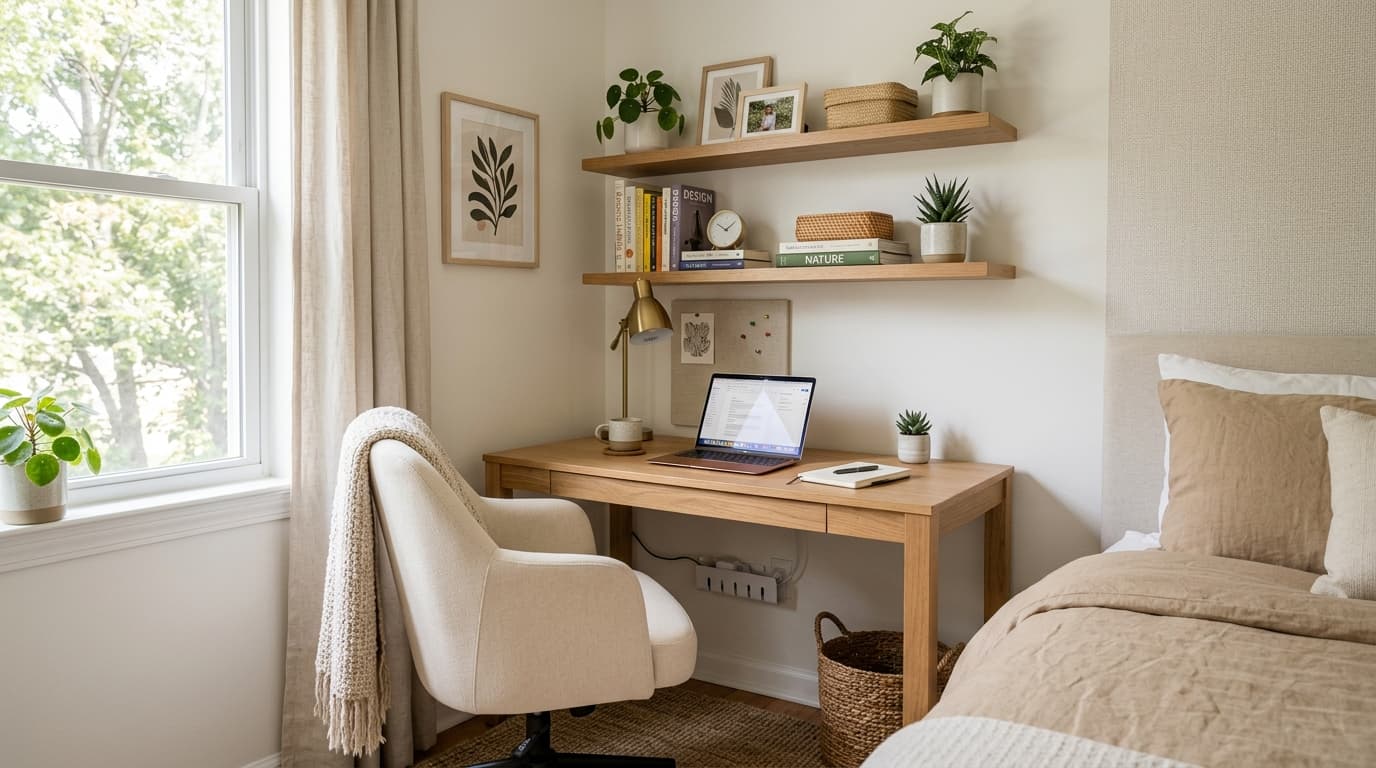
- Natural light: A corner near a window is ideal. Natural light improves mood, reduces eye strain, and makes you look better on video calls. Position your desk so the window is to your side, not directly behind you (which creates glare and video call silhouettes) or directly in front of you (which can cause screen glare).
- Distance from the bed: Put as much distance between your desk and your bed as possible. Even in a small bedroom, this physical separation helps your brain distinguish between work mode and sleep mode. The corner diagonally opposite your bed is the best choice.
- Outlet access: Your corner needs a power outlet within reach. Running extension cords across a bedroom floor is a tripping hazard and looks terrible. If no outlet is nearby, consider a flat-profile extension cord that runs along the baseboard.
Measure Your Space
Before buying anything, measure your corner. You need:
- Minimum width: 42 inches for a desk, plus 6 inches on each side for clearance
- Minimum depth: 24 inches for the desk, plus 30 inches for your chair's rolling range
- Total footprint: A functional bedroom corner office fits in roughly a 4x5-foot area
Furniture That Works in Small Corners
The Desk
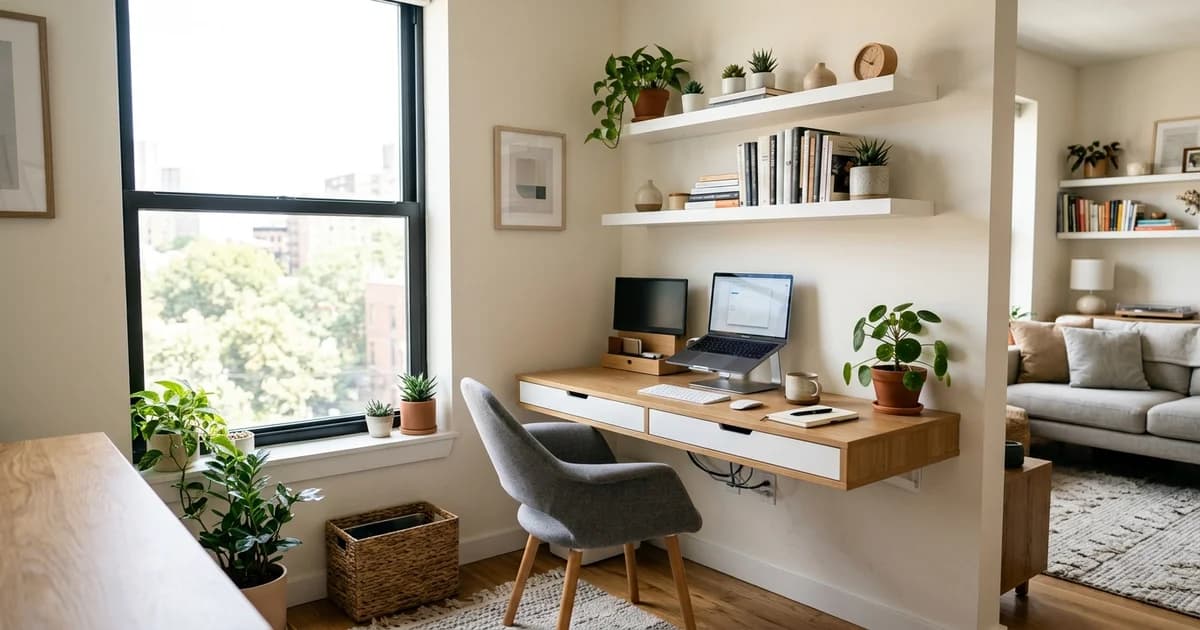
A corner desk (L-shaped) isn't actually the best choice for a bedroom corner — it takes up too much space and makes the area feel like a permanent office installation. Instead, go with a straight desk between 42 and 48 inches wide placed against one wall of the corner.
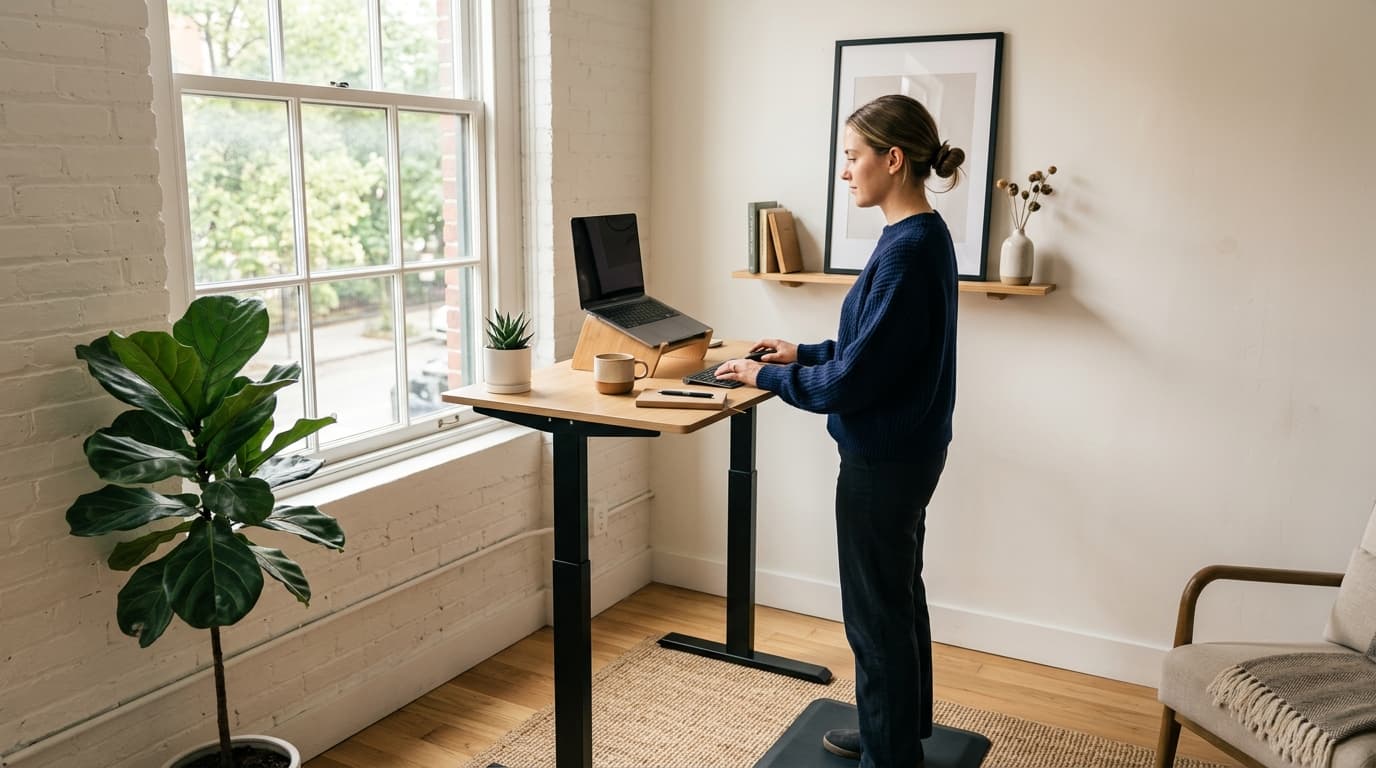
A compact standing desk is ideal if your budget allows. Standing desks in their lowered position are the same height as regular desks, but give you the option to stand during the day. The FlexiSpot E7 Pro in 48-inch configuration fits bedroom corners perfectly.
For a more budget-friendly option, the IKEA LAGKAPTEN table top (47 inches) on ADILS legs costs under $60 and looks clean. Add a monitor arm to maximize your usable desk surface.
The Chair
In a bedroom, your office chair needs to be as unobtrusive as possible when you're not working. Consider:
- A chair with a low back that doesn't stick up above desk height
- A chair without a headrest that looks less "office-y"
- A chair that tucks fully under the desk when not in use
The Branch Daily Chair ($350) hits this sweet spot — ergonomic enough for full workdays, low-profile enough to disappear under your desk. The HON Ignition 2.0 ($300) is another solid pick with a compact footprint.
Storage
Bedroom corner offices can't accommodate filing cabinets or bookshelves without encroaching on living space. Go vertical instead:
- Wall-mounted shelves above the desk for books, supplies, and a plant
- A desk-mounted monitor arm to free up desk surface (doubling as storage space)
- A small drawer organizer that sits on or under the desk for daily essentials
- A pegboard on the wall behind the desk for tools, headphones, and notes
Creating Work-Life Separation
The biggest challenge of a bedroom office is maintaining the psychological boundary between work and rest. Your brain associates spaces with activities — if you work where you sleep, both suffer.
Physical Boundaries
- A room divider or curtain between the desk area and the rest of the bedroom creates a visual boundary. A simple tension rod with a curtain takes 10 minutes to install and costs under $30.
- A small rug under your desk area defines the workspace visually and tactilely — when your feet are on the rug, you're "at work."
- Distinct lighting for the work zone vs. the rest of the bedroom. A desk lamp that's only on during work hours trains your brain that the lamp means work.
Digital Boundaries
- Use a separate browser profile for work (different bookmarks, no social media extensions)
- Turn off work notifications on your phone after hours
- If possible, use a different user account on your computer for personal time
- Close the laptop or turn off the monitor when the workday ends — a dark screen signals "closed for business"
Routine Boundaries
The most effective boundary is a consistent routine. Start work at the same time each day, take breaks at the same intervals, and end work at the same time. When you "leave" work, physically push in your chair, turn off your desk lamp, and step away. This ritual trains your brain to switch modes.
Lighting Your Bedroom Corner Office
Good lighting serves dual purposes in a bedroom office — it makes you productive during work and comfortable during downtime.
- Primary: A desk lamp with adjustable color temperatureKelvinColor temperature, measured in Kelvin. ~2700K is warm/yellow (incandescent), ~4000K is neutral white, ~5000–6500K is cool/daylight. Match desk-lamp temp to your monitor's white point so your eyes don't constantly re-adapt.. Use cool white (5000K-6500K) during work for alertness and warm white (2700K-3000K) in the evening for relaxation. The BenQ ScreenBar monitors clamp to your screen and illuminate your desk without taking up surface space.
- Ambient: LED strip lights along the shelf above your desk provide indirect ambient light. Many LED strips offer color temperature adjustment via app or remote.
- Natural: Maximize whatever natural light reaches your corner. Avoid heavy curtains that block light during work hours — use sheer curtains that diffuse light instead.
Bedroom Corner Office Examples
The Minimalist
- 42-inch white desk against the wall
- Monitor on an arm, keyboard and mouse on a desk mat
- Single floating shelf above for a plant and two books
- Desk lamp clipped to the shelf
- Chair that tucks fully under the desk
- Total cost: ~$250-$400
The Productive
- 48-inch standing desksit-stand deskA desk whose surface raises and lowers (electric or crank) so you can alternate sitting and standing through the day. Cornell ergonomics research recommends ~30-min sitting / ~10-min standing / ~2-min walking cycles, not all-day standing. in the corner
- Dual monitors on a single arm
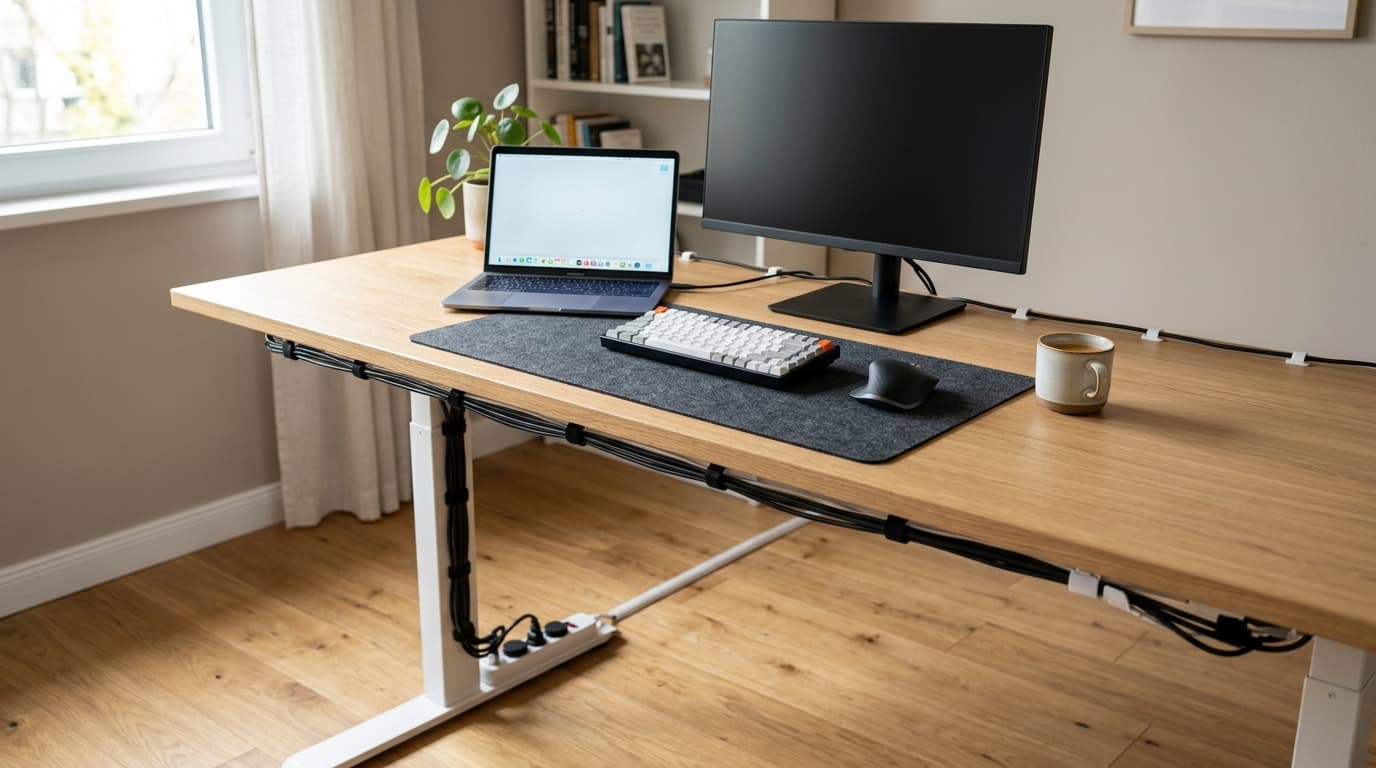
- Under-desk cable tray for clean cable management
- Two floating shelves for storage
- Ergonomic chair with low profile
- Curtain divider on a tension rod
- Total cost: ~$800-$1,200
Frequently Asked Questions
Will working in my bedroom affect my sleep? It can, if you don't create boundaries. Research shows that people who work in their bedrooms report more difficulty falling asleep. Physical separation (divider or curtain), consistent work hours, and turning off all work equipment at the end of the day mitigate this significantly.
What if my bedroom doesn't have a good corner? Consider the space beside your closet, the area under a window, or even a wide hallway outside your bedroom. If truly no corner works, a wall-mounted fold-down desk creates a workspace that literally disappears when not in use.
Can I take video calls from a bedroom office? Absolutely. Use Zoom's virtual background or blur feature to keep your bedroom private. Position your desk so the camera faces a wall rather than your bed. Proper webcam placement and lighting make any background look professional.
The Bottom Line
A bedroom corner office works when you're intentional about it. The keys are: choose the right corner (near a window, away from the bed), keep furniture compact and tuck-away friendly, create physical and routine boundaries between work and rest, and invest in proper lighting.
You don't need a dedicated room to be productive — you need a dedicated mindset and a well-designed 4x5-foot corner.
Related Reading
- →WFH in a Small Apartment: Making It WorkMore small-space strategies
- →Standing Desk for Small ApartmentCompact standing desk options
- →Home Office Lighting GuidePerfect your workspace lighting
- →Cable Management Ideas for Home OfficeKeep your corner clutter-free
- →Office ChairsLow-profile ergonomic chairs that fit small spaces
Your next step
Make the corner work — compact desk picks.
Hilly Shore Labs
Editorial TeamWFH Lounge is published by Hilly Shore Labs. Every recommendation is built by synthesizing ergonomic research, manufacturer specs, expert reviews from outlets like Wirecutter, RTINGS, and The Verge, and aggregated long-term owner sentiment from thousands of verified buyers.
All product reviews are independently researched. Our recommendations are based on ergonomic guidelines, manufacturer specifications, and verified buyer sentiment. See our methodology.