Home Office Ideas When You Don't Have a Dedicated Room
Closet office is the best no-room solution — door closes, work disappears. For living rooms, a bookshelf divider plus an end-of-day ritual creates the psychological separation that makes WFH sustainable.
Quick Answer
The closet office is the best no-room solution — the door closes and work disappears. For living rooms and studios, a bookshelf divider plus a folding or compact desk creates the visual separation that matters, and an end-of-day wrap-up ritual provides the psychological separation that makes the arrangement sustainable.
Key Takeaways
Home office ideas for apartments and shared spaces — corner setups, closet offices, bedroom desks, and dividers that create focus without a dedicated room.
As an Amazon Associate I earn from qualifying purchases. Product prices and availability are subject to change.
Most WFH guides assume you have a spare bedroom to convert. Most remote workers don't. Working from a living room couch, a kitchen table, or a cramped bedroom corner is the reality for millions of people — and it creates real problems: no separation between work and home, constant interruptions, nowhere to store work materials, and the cognitive difficulty of trying to focus in a space your brain associates with relaxation.
The good news: a dedicated room isn't required. A dedicated zone is. Here's how to create one.
The Core Principle: Visual and Physical Separation
The goal is to create a space that feels like "work mode" when you're in it and disappears from view when you're done. This matters neurologically — environmental cues help your brain switch between modes. A desk that's always visible from the couch is a constant reminder of work during your off hours.
Option 1: The Closet Office (Best for Apartments)
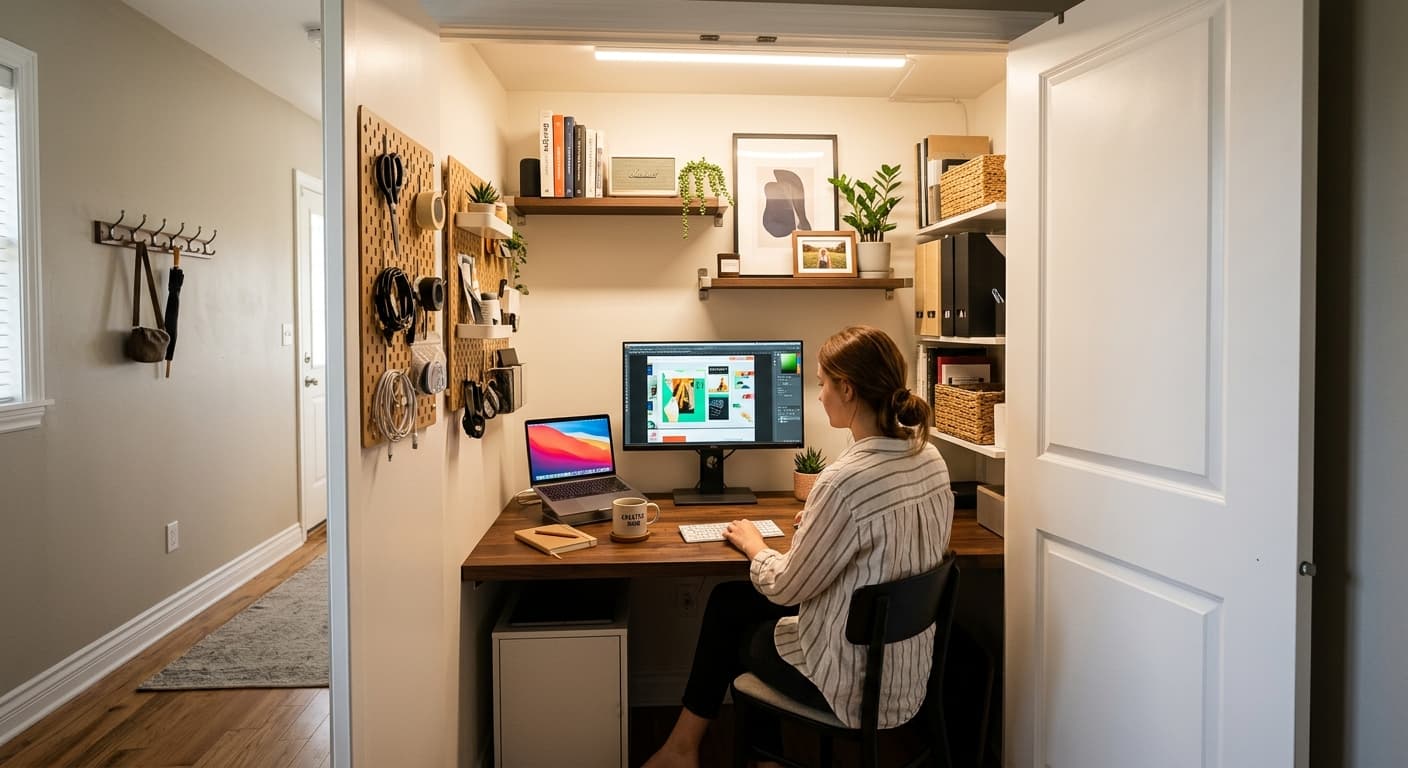
A reach-in or walk-in closet converted to a workspace is one of the best WFH solutions for limited apartments. The door closes — the office disappears. You get:
- Visual separation when you close the door
- Acoustic isolation from living space
- A contained organization system
What you need:
- A floating desk or shelf at desk height (24"–30" deep)
- Under-desk storage for files and equipment
- Good lighting (closets are dark — an LED desk lamp is essential)
- A proper chair you can roll out for sessions and roll back in
The depth of most reach-in closets (24") is exactly the depth of a standard desk. This is not a coincidence.
Option 2: The Room Divider Office (Living Room / Studio)
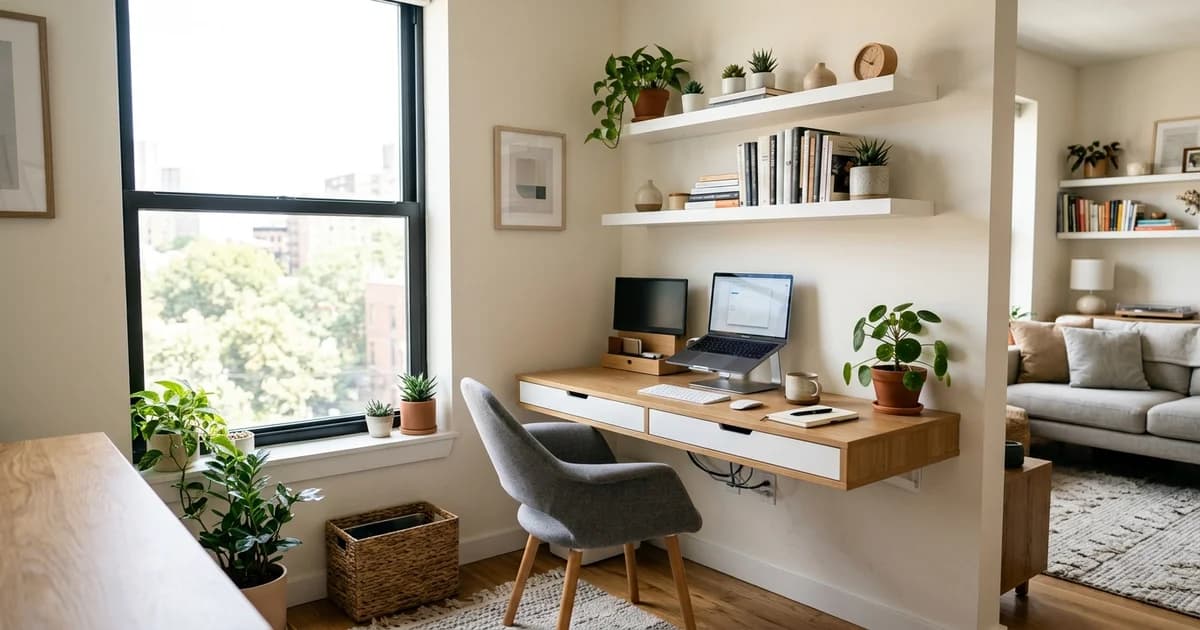
A bookshelf or folding divider panel creates a visual barrier between your work zone and the living area. This approach is particularly effective in studio apartments and living room setups.
Best dividers:
- A bookshelf placed perpendicular to the wall creates both division and storage
- Folding privacy screens (3–4 panels) for temporary separation
- Hanging curtains from ceiling tracks — the most affordable and flexible option
The key is that the divider should face your desk — so when you're working, you're facing a wall or the divider, not the living space. This reduces visual distraction and creates a psychological boundary.
Option 3: The Bedroom Corner Office
The bedroom office is the most common no-dedicated-room setup — and the most frequently done wrong. The research is clear: keeping work equipment visible in the bedroom disrupts sleep quality by creating cognitive arousal related to unfinished work.
If you must use the bedroom:
- Position the desk so it's not visible from the bed
- Use a folding desk that collapses flat against the wall when done
- Cover the desk with a cloth at the end of the workday — visual off switch
- Never work from the bed itself
Key Products for Small-Space Offices
Wall-mounted folding desk: Folds flat against the wall when not in use. Takes up zero floor space when collapsed. Best for the smallest apartments.
Pegboard wall organizer: Mounts to the wall above a desk to organize tools, cables, headphones, and supplies vertically — keeps the desk surface clear.
Cable management box: Groups power strip and cable clutter into a single contained unit. Makes a shared-space desk look cleaner and more intentional.
Good task lighting: In a closet or corner, overhead lighting is rarely adequate. A dedicated desk lamp with adjustable brightness and color temperature is one of the highest ROI small-office investments. See our desk lamps guide.
Acoustic panels: Stick-on foam acoustic panels on the wall behind a bedroom or closet desk dramatically reduce echo, making video calls sound more professional and improving your own focus.
The Psychological "Wrap-Up" Ritual
Without a door you walk out of, you need a ritual that signals "work is done." Options:
- Cover the desk with a cloth or close the closet door
- Log out of all work apps and close the browser tabs
- Take a 10-minute walk as your fake "commute home"
- Change clothes — sounds silly, works reliably
For more on managing work-life separation, see our work-life balance WFH guide and signal that your brain work is over.
🏆 Bottom Line: You don't need a dedicated room — you need a dedicated zone with visual separation from your living space. The closet office is the best no-dedicated-room solution. For living rooms and bedrooms, a divider or folding desk plus an end-of-day ritual creates the psychological separation that makes WFH sustainable.
Sources
- Stokols D et al. — "The ecology of work stress." Journal of Occupational Health Psychology, 2009.
- Walker MP — Why We Sleep: Unlocking the Power of Sleep and Dreams. Scribner, 2017.
- Duvall J et al. — "Restorative environments and attention restoration theory." Environment and Behavior, 2011.
- Society for Human Resource Management (SHRM) — Remote work environment design recommendations. shrm.org.
- Global Wellness Institute — Workplace wellness and cognitive environment design. globalwellnessinstitute.org.
Your next step
No room? These setups fold away.
Hilly Shore Labs
Editorial TeamWFH Lounge is published by Hilly Shore Labs. Every recommendation is built by synthesizing ergonomic research, manufacturer specs, expert reviews from outlets like Wirecutter, RTINGS, and The Verge, and aggregated long-term owner sentiment from thousands of verified buyers.
All product reviews are independently researched. Our recommendations are based on ergonomic guidelines, manufacturer specifications, and verified buyer sentiment. See our methodology.