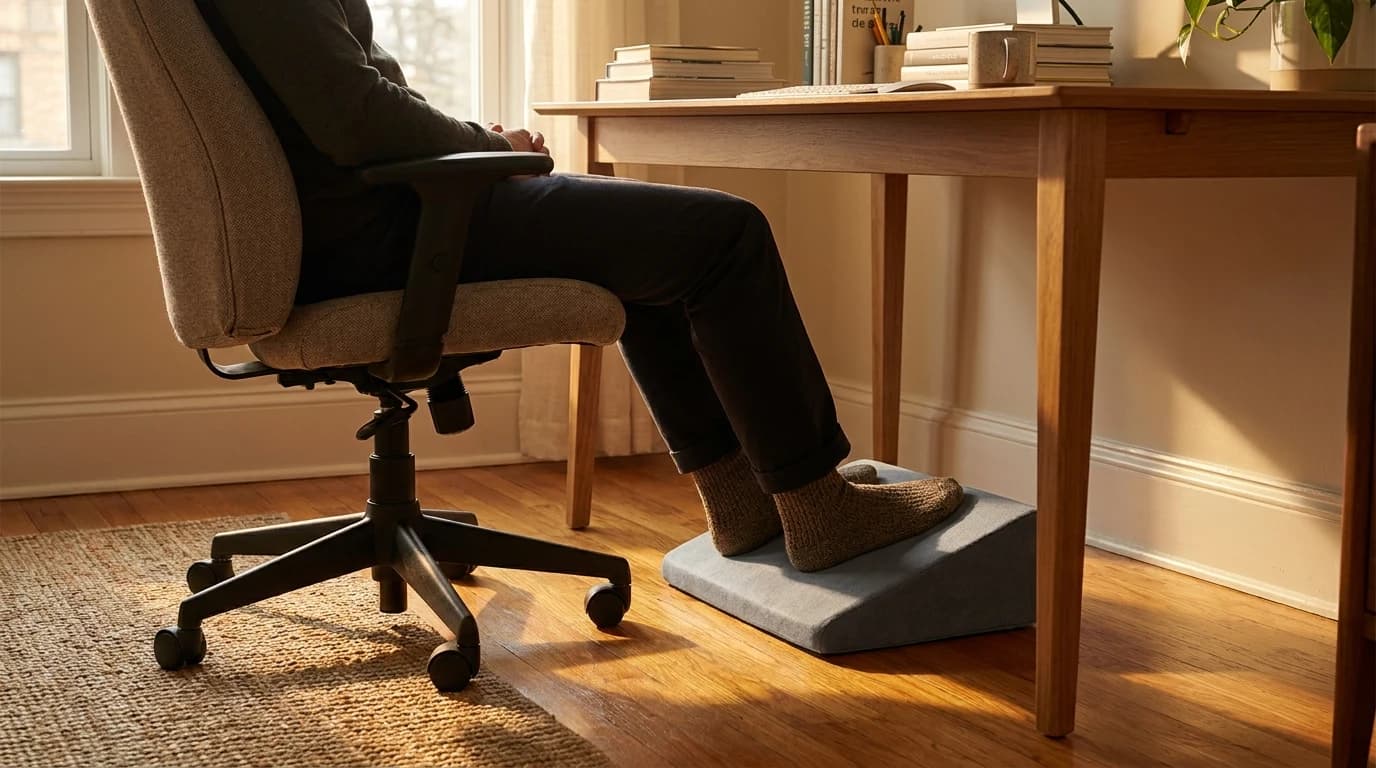
Heated Desk Pad vs Under-Desk Heater: Cost to Run Each
Buy for the cold spot, not the category. Cold hands: a heated desk pad. Cold feet: a heated mat. Cold legs: a low-wattage panel with a stated zero-clearance rating. Save the 1,500-watt heater for a genuinely cold room, set it three feet from anything that burns, and plug it directly into the wall.
Quick Answer
A heated desk pad or foot mat is cheapest, at about 7 to 9 cents for an 8-hour day at the August 2026 US average electricity rate. A 150-watt under-desk panel costs about 22 cents, and a 1,500-watt space heater on high can reach $2.18. Choose by where you are cold, because a pad warms hands while a mat or panel warms feet and legs.
Key Takeaways
Heated desk pad, foot mat, under-desk panel or space heater? See the 8-hour running cost of each with the sum shown, plus the clearance rule to check.

As an Amazon Associate I earn from qualifying purchases. Product prices and availability are subject to change.
Warming your hands with a heated desk pad or your feet with a heated mat is the cheapest fix, at roughly 7 to 9 cents for an 8-hour day. A low-wattage under-desk panel costs about 22 cents. A standard space heater on high can reach $2.18 a day, and it warms the air around you rather than you.
- 18.16¢ Average US residential electricity price per kWh, August 2026.
- 10× The power gap between a 150-watt panel and a 1,500-watt space heater on high.
- 1,600 Average fires a year involving portable heaters, 2020 to 2022, per CPSC.
Source: EIA Electric Power Monthly, Table 5.6.A (August 2026); Cozy Products and Lasko product pages; CPSC, January 2026.
Running cost, model by model
Every wattage below is the maker's own figure. Each cost uses the same sum, at the EIA's August 2026 US residential average of 18.16 cents per kWh:
The sum: watts ÷ 1,000 × 8 hours × $0.1816. For a 150-watt panel, that is 0.15 × 8 × 0.1816 = about 22 cents a day.
| Type and model | Rated watts | Cost per 8-hour day | Per 21-day work month | What it warms |
|---|---|---|---|---|
| Heated desk pad: WarmMat | 46 W | 7¢ | $1.40 | Hands, arms |
| Foot mat: Cozy Toes | 60 W | 9¢ | $1.83 | Feet |
| Heated footrest: Toasty Toes | 105 W | 15¢ | $3.20 | Feet |
| Under-desk panel: Cozy Legs | 150 W | 22¢ | $4.58 | Legs, whatever is close to the panel |
| Personal heater: Lasko MyHeat | 200 W | 29¢ | $6.10 | Whatever the small fan is aimed at |
| Space heater on low: Lasko 754200 | 900 W | $1.31 | $27.46 | Air in the room |
| Same heater on high | 1,500 W | $2.18 | $45.76 | Air in the room |
Treat these as ceilings. They assume full rated power for all 8 hours, so a heater that cycles on a thermostat or gets switched off at lunch costs less. We could not find a maker's published duty cycle to model that, so we haven't guessed.
Your local rate moves the numbers more than the brand does. The same EIA table lists Louisiana at 12.87 cents and California at 29.75 cents:
| Cost per 8-hour day | Louisiana | US average | California |
|---|---|---|---|
| 150 W panel, 8 hours | 15¢ | 22¢ | 36¢ |
| 1,500 W heater on high, 8 hours | $1.54 | $2.18 | $3.57 |
Start with where you are cold
The "vs" is a little misleading, because a desk pad and an under-desk heater don't do the same job. Makers pitch desk pads at hands and arms, and the mats and panels at feet and legs. Cozy Products says plainly that its panel is made to warm what is nearby, not to heat a room. Buy for the part of you that hurts.
| If this is you | Start with | Why |
|---|---|---|
| Stiff fingers, cold mouse hand | Heated desk pad | Lowest wattage we found, and the heat sits under your hands |
| Icy toes, warm everywhere else | Heated foot mat | The cheapest way to heat the floor under your feet |
| Cold shins and knees | Under-desk panel | Covers more of your legs than a mat can |
| Cold feet and tired legs | Heated footrest | Toasty Toes also works as a footstool, which may suit your desk height anyway |
| The whole room is freezing | Space heater, away from the desk | The mats, pads and panels warm one person's spot, not a room |
For the wider plan, including clothing and drafts, see how to stay warm working from home.
Check the label on desk pads: wattage is often missing. Victor's Heetz desk pad page lists size and auto shut-off, but we found no wattage there. If the listing omits it, read the rating on the unit, then run the sum above. A 100-watt pad would cost about 15 cents a day.
The clearance rule changes what belongs under a desk
This is the part that cost tables leave out. A standard space heater is the hardest of the four to place correctly in a footwell.
CPSC's January 2026 guidance says to keep portable heaters at least three feet from furniture and other combustibles. Its heater safety sheet lists papers and clothes too. A footwell, with a desk on three sides and your legs in front, cannot give you that.
Low-wattage panels are a different case, if the maker says so. Cozy Legs is listed as ETL-certified zero-clearance, with no clearance required. That claim belongs to that model, so check your own heater's manual instead of assuming it carries over.
Choosing for the spot under your desk
Look for
- A safety mark from a testing lab, which NFPA advises
- A stated zero-clearance rating, if it will sit near the desk
- Auto shut-off if it tips, for anything that can fall over
- A cord long enough to reach the wall
Walk away from
- A heater with no certification mark on it
- A manual that requires clearance your footwell can't give
- "No Auto Shut Off" on a unit your feet can knock, as Lasko's 754200 specs read
- Any plan that depends on a power strip
The desk-specific fire risks
The power strip within reach of your chair is exactly where a heater should not go.
- Skip the strip. CPSC and NFPA both say to plug a space heater straight into the wall, never an extension cord or power strip.
- Don't assume low wattage is exempt. Neither source carves out small heaters, so we would give a mat or panel a wall outlet too, unless its manual says otherwise.
- Keep the cord out from under the rug. CPSC warns this can damage the cord and set it and nearby objects burning. That includes the rug under your desk.
- Give it its own outlet. NFPA's electrical tips say to plug in one heat-producing appliance at a time. Your mug warmer counts.
- Feel the plug. CPSC says if the plug, outlet or faceplate is hot, stop using the heater and call an electrician.
- Switch off when you leave. NFPA says to turn off and unplug space heaters when you leave the room, so that means lunch and the school run as well.
Common questions
Is a heated desk pad enough on its own?
Only if your hands are the problem. Nothing the desk pad makers state suggests it warms your feet or legs, so pair it with a mat if your feet are cold too. Together, the two models in our table cost about 16 cents a day.
Is an under-desk heater cheaper than turning up the thermostat?
We can't give one number, because it depends on your fuel, your home and your rates. What we can tell you is that a 150-watt panel costs about 22 cents a day at the US average, so price it against your own heating bill.
Does a 1,500-watt heater use that much all day?
Not necessarily. At full power it would, which is why $2.18 is the ceiling. A thermostat, which the Lasko 754200 has, should ease off once the room reaches your setting, but Lasko publishes no figure for how much.
Hilly Shore Labs
Editorial TeamWFH Lounge is published by Hilly Shore Labs. Every recommendation is built by synthesizing ergonomic research, manufacturer specs, expert reviews from outlets like Wirecutter, RTINGS, and The Verge, and aggregated long-term owner sentiment from thousands of verified buyers.
All product reviews are independently researched. Our recommendations are based on ergonomic guidelines, manufacturer specifications, and verified buyer sentiment. See our methodology.