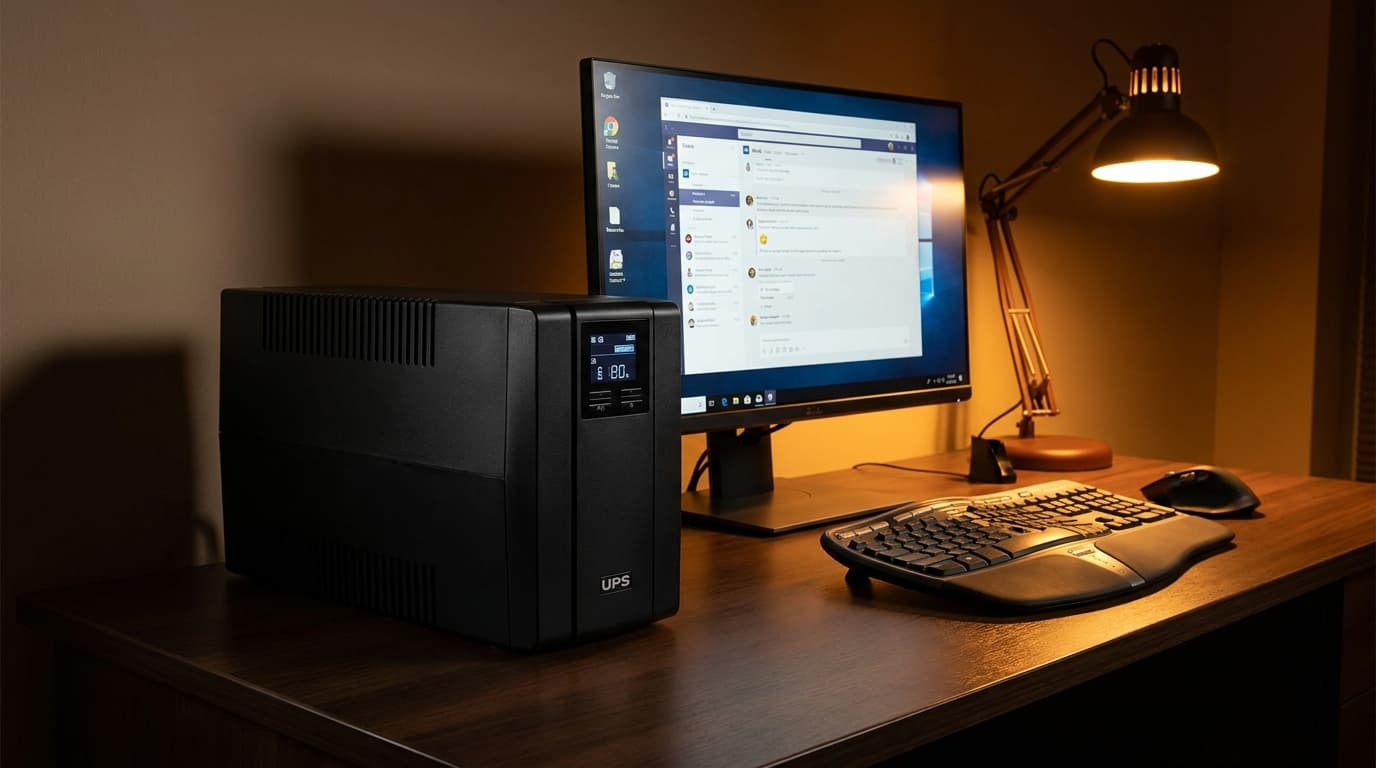
1500VA UPS: What You Really Get in Watts and Minutes
Shop the watt ceiling, then shop the runtime at your own load, because the VA rating answers neither question. The tell is that a 685VA unit at its published half-load point outlasts a 1500VA one at its own. If you want minutes rather than a clean shutdown, take load off the battery outlets instead of buying more VA.
Quick Answer
Volt-amps are not watts. Watts divided by VA is the power factor, and on consumer units it runs about 0.55 to 0.7 — so a 1500VA UPS is really a 900W to 1000W UPS. Runtime is a separate question, and manufacturers publish only two points: half load and full load. On CyberPower's 1500VA PFC unit those are 10 minutes and 2.5 minutes. A home-office desk usually draws far less than half load, which is why it does better than either figure — and why what you plug in matters more than the VA on the box.
Key Takeaways
A 1500VA UPS is rated 900 to 1000 watts, not 1500, and its published runtime is only two points: half load and full load. Read both before buying.
As an Amazon Associate I earn from qualifying purchases. Product prices and availability are subject to change.
VA is the number on the carton, and it answers neither question a home office actually has: how much gear can I run, and how long does it stay on when the lights go out. The first answer is printed a few lines below the VA rating. The second is printed twice, at two different loads, and almost nobody reads either one. Every figure below comes off a manufacturer's own spec table, so you can check the whole argument in about a minute.
Volt-amps are not watts, and the gap is published
Power factor is watts divided by VA — that is CyberPower's own definition — and on consumer units it lands somewhere between roughly 0.55 and 0.7. So a 1500VA box is really a 900W to 1000W box. APC does not hide this either: its 1500VA Back-UPS Pro BR1500MS2 is rated 900W on the spec sheet and in its own product title.
Rule of thumb: multiply the VA number by 0.6 and shop against that. The watt figure decides whether your gear fits; the VA figure mostly decides the size of the carton.
Which means VA is not comparable across models. Two units on the same shelf, both stamped 1500VA, can sit a hundred watts apart on usable ceiling.
Four units, and what their spec sheets actually promise
| Unit | Rated | Watt ceiling | Power factor | Runtime at half load | Runtime at full load |
|---|---|---|---|---|---|
| CyberPower CP1500PFCLCD | 1500VA | 1000W | 0.67 | 10 min (at 500W) | 2.5 min (at 1000W) |
| CyberPower CP1500AVRLCD3 | 1500VA | 900W | 0.60 | 12 min (at 450W) | 3 min (at 900W) |
| CyberPower CP1000PFCLCD | 1000VA | 600W | 0.60 | 6 min (at 300W) | 2 min (at 600W) |
| CyberPower CP685AVRG | 685VA | 390W | 0.57 | 11 min (at 195W) | 2 min (at 390W) |
Read the first two rows together: identical VA, same shelf, a hundred watts apart. Then read the last row, because it breaks the model most people shop with.
The 685VA unit that outlasts the 1500VA one
The uncomfortable comparison: at its published half-load point the 685VA unit runs 11 minutes and the 1500VA PFC unit runs 10. Half load means 195W on one and 500W on the other — minutes track the watts you draw, not the VA you bought.
Runtime also falls away faster than load rises. On that 1500VA unit, going from half load to full load doubles the draw and cuts runtime four-fold, from 10 minutes to 2.5. That asymmetry is the whole game: every watt you take off the battery outlets buys back more than its share of minutes, and every extra VA you pay for buys none at all unless you actually load the box.
Your desk is nowhere near either published number
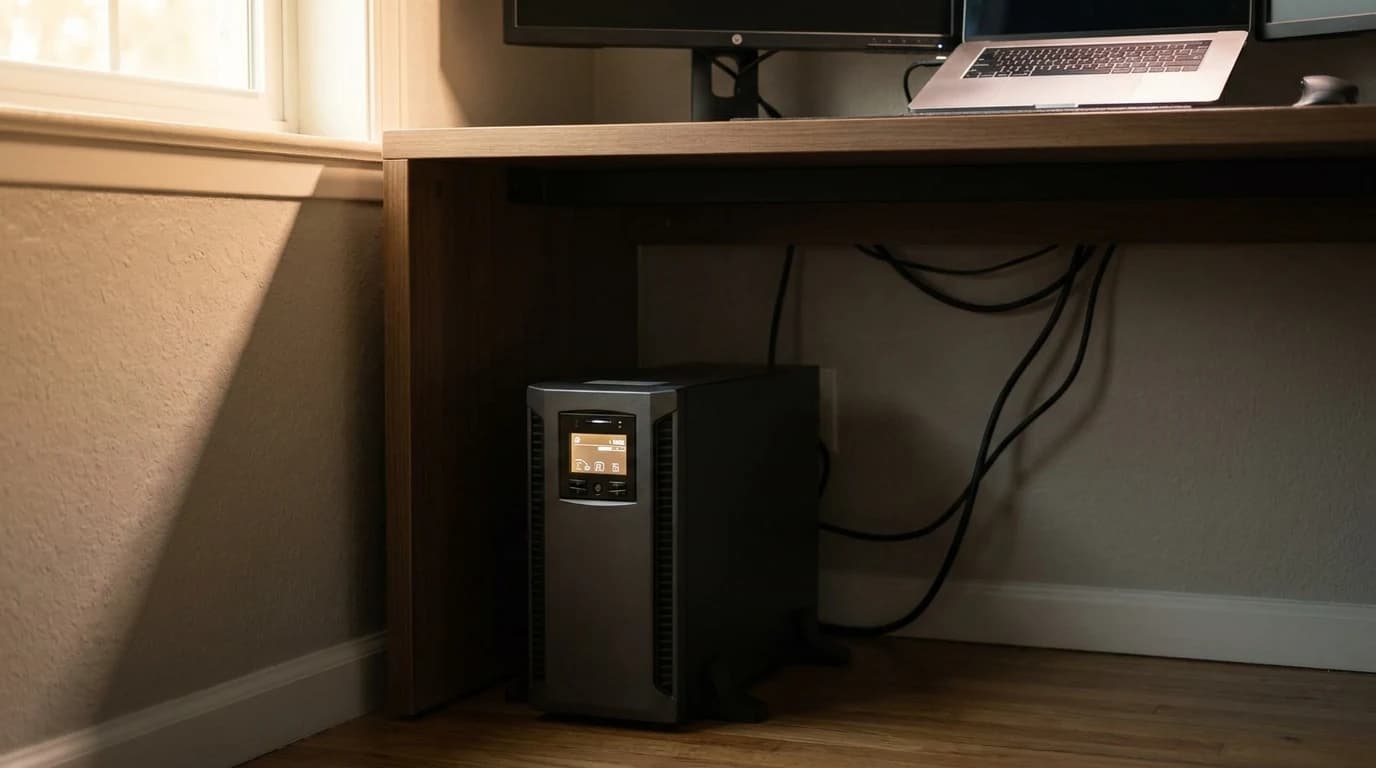
A laptop on a dock, one monitor, a router and a modem sit well under a quarter of a 1500VA unit's ceiling. That is good news for runtime and bad news for research, because it puts you off the bottom-left of a curve whose only two labelled points are much further right.
What the spec sheet can tell you:
- The hard watt ceiling you have to stay under.
- Two runtime points, both at loads heavier than yours.
- Whether the output is a true sine wave, which active-PFC desktops require.
What only your own load can tell you:
- The minutes you will actually get.
- Whether a second cheap box on the router beats a bigger box on everything.
- Whether the unit is simply oversized for the job you bought it for.
Five minutes with the screen already on the box
- Plug in everything you intend to protect, then work normally for a minute.
- Read the load, in watts or percent, off the unit's own display. Every model in the table above has one.
- Divide by the watt ceiling, not the VA rating. Under 25 percent is where a typical remote-work desk lands.
- Put your real number into CyberPower's runtime calculator — the spec sheet's two points will not cover it.
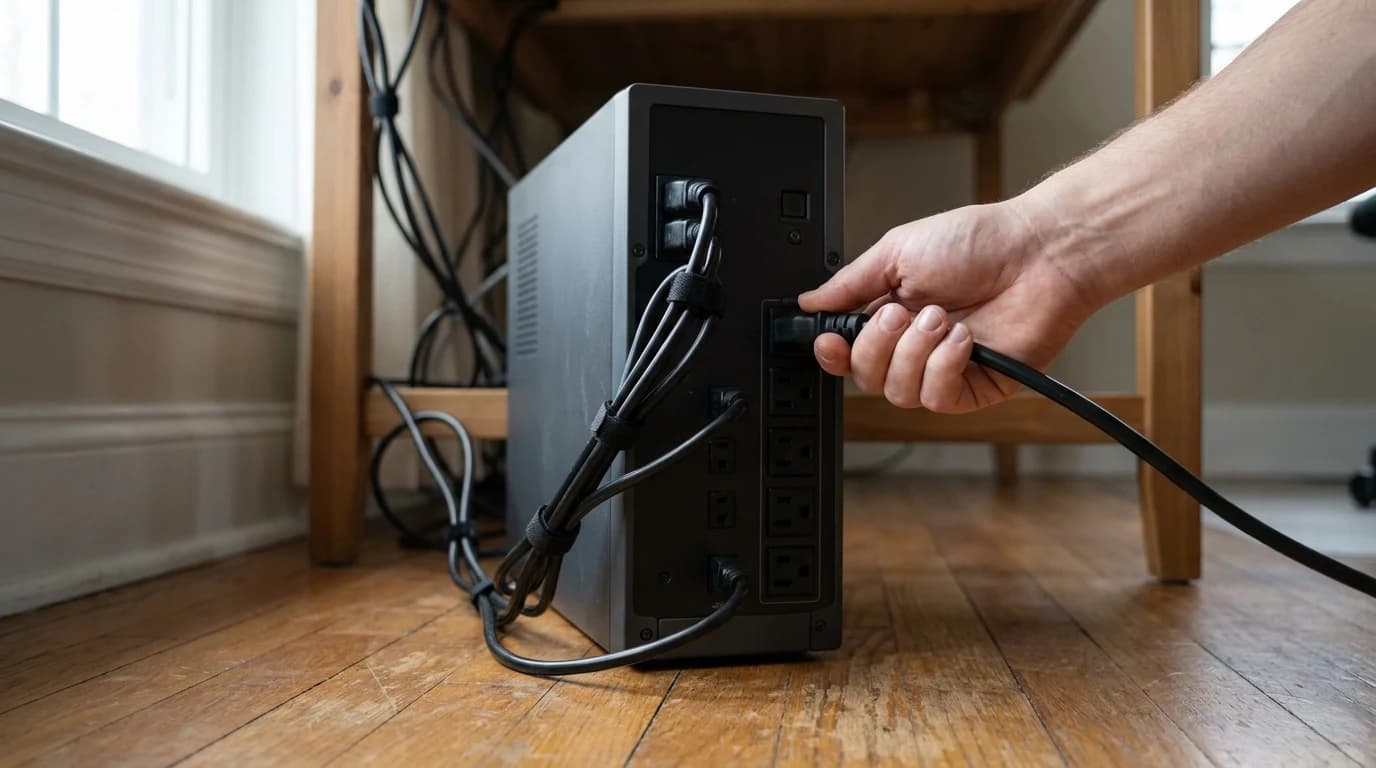
- Move the printer, the space heater and anything with a motor to the surge-only outlets.
So is 1500VA the right buy?
It is, if you run an active-PFC desktop and two monitors and want a comfortable ceiling. It is not, if what you actually want is an hour of internet during an outage: no consumer UPS does that at desk loads, and a small dedicated unit on the router does it far better than a large one on everything. Our UPS and battery backup picks work through that split, and the UPS category page tracks what is current.
FAQ
How many watts is a 1500VA UPS?
Between about 825W and 1000W, depending on the model's power factor. The two 1500VA units above are rated 1000W and 900W respectively. Always read the watt figure off the spec sheet rather than assuming a ratio.
Why does my 1500VA UPS only last a few minutes?
Because minutes are set by the watts you actually draw, and the published full-load figure is brutal — 2.5 minutes on one of the units above. If a UPS is dying quickly at a modest load, the more likely culprits are a battery near end of life or a high-draw device such as a laser printer sharing the battery outlets.
Does a bigger VA rating always mean longer runtime?
No. Runtime depends on battery capacity versus your load, and VA is a rating of instantaneous output, not stored energy. At the same real load a larger unit usually does last longer, but the VA number alone will not tell you by how much.
Where do I find the runtime at my exact load?
The manufacturer's runtime calculator, linked above. Spec sheets publish only the half-load and full-load points, and a home office typically runs well below both.
Sources
- →CyberPower CP1500PFCLCD specifications1500VA/1000W; 10 minutes at half load, 2.5 minutes at full load.
- →CyberPower CP1500AVRLCD3 specifications1500VA/900W; 12 minutes at half load, 3 minutes at full load.
- →CyberPower CP1000PFCLCD specifications1000VA/600W; 6 minutes at half load, 2 minutes at full load.
- →CyberPower CP685AVRG specifications685VA/390W; 11 minutes at half load, 2 minutes at full load.
- →CyberPower glossary, power factorpower factor is watts divided by VA.
- →Schneider Electric product page, APC Back-UPS Pro BR1500MS2a 1500VA unit rated 900W.
CyberPower notes that its published runtimes are measured on fully charged new batteries under normal operating conditions and vary with battery age and environment. Figures verified against the manufacturer pages above on 17 August 2026.
Hilly Shore Labs
Editorial TeamWFH Lounge is published by Hilly Shore Labs. Every recommendation is built by synthesizing ergonomic research, manufacturer specs, expert reviews from outlets like Wirecutter, RTINGS, and The Verge, and aggregated long-term owner sentiment from thousands of verified buyers.
All product reviews are independently researched. Our recommendations are based on ergonomic guidelines, manufacturer specifications, and verified buyer sentiment. See our methodology.