Why You Sound Bad on Video Calls (and How to Fix It)
Sounding good on calls is mostly free. Get your mic close to your mouth, take the call in a room with soft surfaces, and only then decide whether you need a headset or a USB mic. The order matters: distance is the biggest lever, the room is second, and the equipment is a distant third — a pricey mic two feet away in a bare room still sounds worse than a cheap one held close in a furnished one. It's worth the two minutes, because the research is clear that thin, tinny audio quietly drags down how intelligent and credible you seem, no matter how good your point is. For most people doing calls all day, a boom-mic headset is the highest-floor choice; reach for a USB mic only once your room is treated.
Quick Answer
Almost always it's not your voice — it's three fixable things, in order of likelihood. (1) Your mic is too far away: a laptop mic at arm's length picks up the room as loudly as you, so get a mic within a hand's width of your mouth (a wired earbud or boom headset does this for free). (2) Your room is too reflective: bare walls and hard floors smear your speech, so add a rug, curtains, or soft furniture. (3) Only after those, the gear itself adds a 'tinny' sound — the exact quality a 2025 Yale study found lowers how credible and hireable people judge you. Fix distance and the room before spending a dollar on a mic.
Key Takeaways
You sound worse on calls than you should — and it's almost never your voice. The three real causes, in order, and the free fixes that beat buying a mic.
As an Amazon Associate I earn from qualifying purchases. Product prices and availability are subject to change.
You can have a tidy background, good lighting, and a flattering camera angle and still come across worse than you should on a call. The reason is almost always the part you can't see: your audio. On a call with a dozen people, you're often the only one who doesn't know how you sound — you hear yourself as normal while everyone else hears something thin, echoey, or buried under room noise. And it matters more than most people think.
Bad call audio is rarely your voice. It's three fixable things, in order of likelihood: your mic is too far away, your room is too reflective, or your gear adds a tinny digital coloration. Fix distance first (it's free), treat the room second, and only then think about buying a mic or headset.
What the research actually shows
- Audio quality changes how people judge you — not just whether they hear you. A 2025 Yale study found a "tinny" mic sound lowered listeners' ratings of a speaker's intelligence, credibility, and hireability, even when the words were identical.
- Distance is the biggest lever and it costs nothing. Doubling the distance from your mouth to the mic dramatically increases how much room sound and noise it picks up relative to your voice.
- Hard, bare rooms smear speech. Reverberation degrades intelligibility by temporally "smearing" the sound; soft surfaces are the fix, not a fancier mic.
- What the research does not support: spending more automatically sounds better. A $150 mic two feet away in a tiled room sounds worse than $0 of laptop mic held close in a soft room.
First, why it actually matters
It's tempting to treat audio as the boring half of a video call. It isn't. Researchers at Yale ran six experiments in which people heard the same words delivered either through a clear, resonant recording or a distorted "tinny" version mimicking a cheap microphone. The tinny versions consistently made speakers seem less hirable, less credible, less intelligent — and even less romantically desirable — purely from the sound, with the message held constant.
The takeaway isn't "buy expensive gear." It's that the quality of your sound is doing quiet work on every listener, separate from what you say. That's a strong reason to spend two minutes fixing the free stuff before you spend a dollar.
The unsettling part, as the study's authors noted: during a call you can see yourself, so you manage your appearance — but you usually have no idea how your voice lands for everyone else. So let's diagnose it in order.
Cause #1: Your mic is too far away (free fix)
This is the single most common reason people sound distant, hollow, or "in a cave." A laptop mic sits roughly arm's length from your mouth, pointed at the ceiling, picking up your keyboard, your fan, and every reflection in the room about as loudly as your voice.
The physics is unforgiving: sound falls off sharply with distance, so the closer the mic is to your mouth, the more your voice dominates everything else it captures. A mic six inches away hears mostly you. The same mic three feet away hears you, plus a lot of room.
Quick test: read a sentence at your normal call distance, then again with the mic (or a headset boom) a hand's width from your mouth. Play both back. The close one will sound fuller and noticeably "closer" with less room behind it — no new gear required, just position.
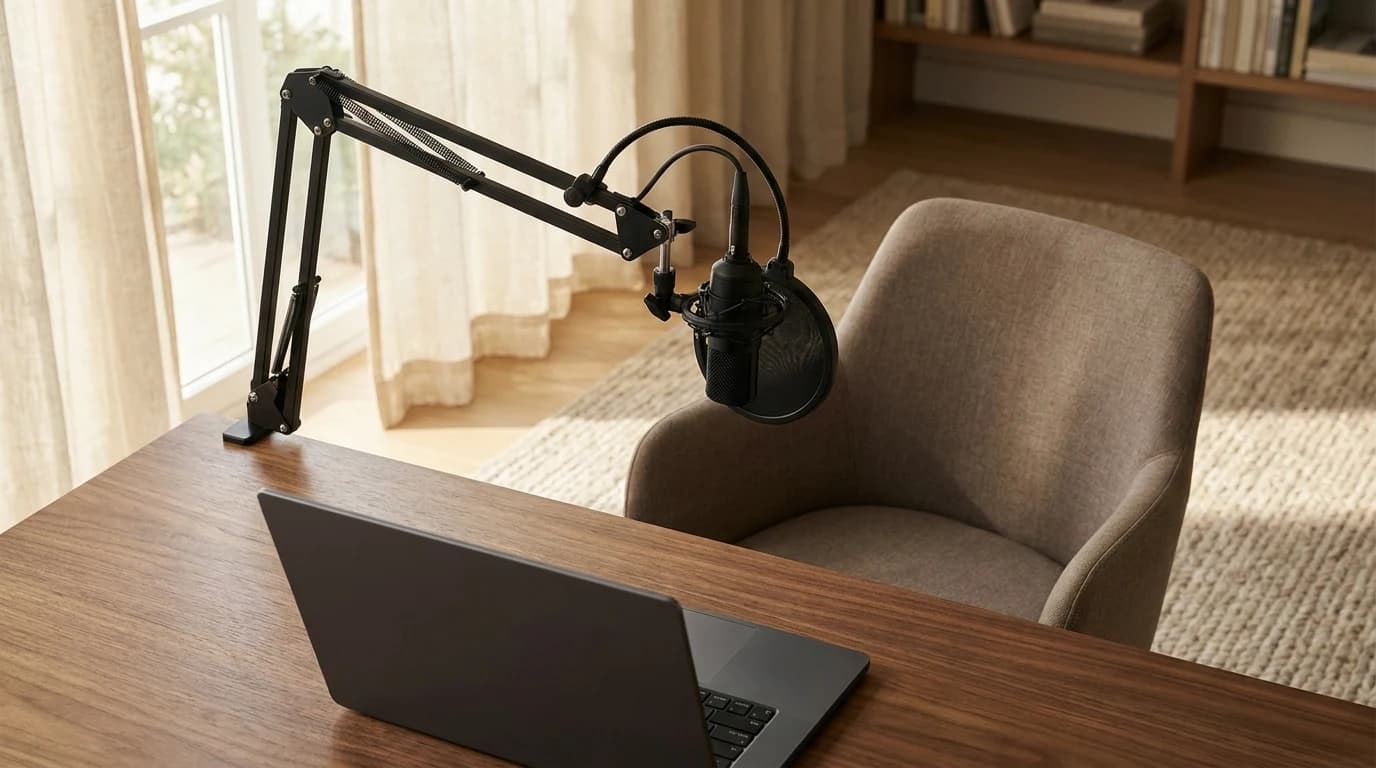
The cheapest real upgrade here isn't a microphone at all — it's anything that puts a mic near your mouth. Wired earbuds with an inline mic, or a headset with a boom, beat a far-off laptop mic almost every time because they close the distance.
Cause #2: Your room is too reflective
If you sound echoey even when the mic is close, the room is the culprit. Bare walls, hard floors, glass, and an empty desk bounce your voice around so the mic hears your words plus a trailing smear of those words a few milliseconds later.
This isn't subjective. A study in Royal Society Open Science found that reverberation degrades speech intelligibility through "temporal smearing of the target speech, which makes the speech less understandable." A reverberant room literally blurs your consonants together before the mic ever captures them.
The fix is soft surfaces, not a better mic. A rug, curtains, a bookshelf, a fabric chair, or even taking the call from a smaller, furnished room cuts reflections. A pristine mic in a tiled bathroom-like room will still sound bad. If noise from outside the room is the problem instead, that's a different job — see our home-office soundproofing guide.
Cause #3: The gear is adding a "tinny" coloration
Only after distance and the room are handled does the equipment itself become the limiting factor. Built-in laptop and cheap webcam mics often have that thin, metallic quality — exactly the "tinny" sound the Yale study penalized. This is where a real purchase earns its money.
For most people, the right buy is a headset or a USB mic, and the choice is about your situation, not price:
| Your situation | Best fix | Why |
|---|---|---|
| Calls all day, noisy household, kids/pets | Boom-mic headphones for Zoom meetings | Mic stays inches from your mouth; consistent regardless of how you move |
| Quiet room, want to sound polished, occasional recording | A USB microphone | Richer, more natural tone — but only if your room is treated |
| You just need clear voice + don't want a boom on camera | Good wired earbuds or noise-canceling headphones with an inline mic | Closes the distance cheaply |
If you do nothing else: a wired headset with a boom mic is the highest-floor choice for daily calls. It mechanically solves distance and largely sidesteps the room, which is why it beats a pricier desk mic for most remote workers.
What the research does not support
It's worth being honest about the limits, because the gear industry blurs them:
- More money ≠ better sound. Nothing in the evidence says a $200 mic outperforms a close-up cheap one in an untreated room. Distance and reflections dominate; the mic is third.
- A great mic won't rescue a bad room. Reverberation smears the signal before the mic captures it, so the mic can't "fix" it after the fact.
- Noise cancellation isn't magic. Software noise suppression helps with steady noise (a fan), but it can chew up the start of words and make you sound processed and tinny — the exact quality listeners judged harshly. Use it, but don't rely on it instead of fixing distance and the room.
If you've handled all three causes and still sound off, the issue is usually upstream — a weak connection causing dropouts, or a noisy USB port adding hum — not your voice or your mic.
Sources & Research
- Yale University — Zoom bias: The social costs of having a 'tinny' sound during video conferences (2025), summarizing the PNAS study by Walter-Terrill, Ongchoco & Scholl: poor microphone sound lowered judged intelligence, credibility, hireability, and desirability, with the spoken words held identical.
- Royal Society Open Science (2022) via PubMed Central — Effects of reverberation on speech intelligibility in noise: reverberation degrades intelligibility through temporal smearing of the target speech.
Your next step
Fix it at the source — mic and headset picks.
Hilly Shore Labs
Editorial TeamWFH Lounge is published by Hilly Shore Labs. Every recommendation is built by synthesizing ergonomic research, manufacturer specs, expert reviews from outlets like Wirecutter, RTINGS, and The Verge, and aggregated long-term owner sentiment from thousands of verified buyers.
All product reviews are independently researched. Our recommendations are based on ergonomic guidelines, manufacturer specifications, and verified buyer sentiment. See our methodology.