Desk Aquarium for a Home Office: What It Actually Takes
A desk aquarium is a hobby wearing the costume of a decor object. If the plants and the water chemistry interest you, a 5-gallon planted tank with a heater, a filter and about ten minutes a week is a genuinely good thing to have beside a monitor. If you only want ambience, the honest research on aquaria and calm is preliminary and mixed, the six-week cycling wait is real, and a plant does most of the visual job for none of the maintenance.
Quick Answer
Plan on six weeks before a fish goes in: a new tank has to grow its bacterial colony first, which Aqueon puts at three to eight weeks. A heater and a filter are not optional for a betta, whose care guide asks for 76-85F. And a filled 10-gallon tank is around 111 pounds on a footprint smaller than a keyboard tray, so it belongs over a desk leg and never on a smart plug.
Key Takeaways
A 3-10 gallon tank beside a monitor is heavier, slower and more electrical than it looks. The cycling wait, the heater math, the weight, the honest upside.
As an Amazon Associate I earn from qualifying purchases. Product prices and availability are subject to change.
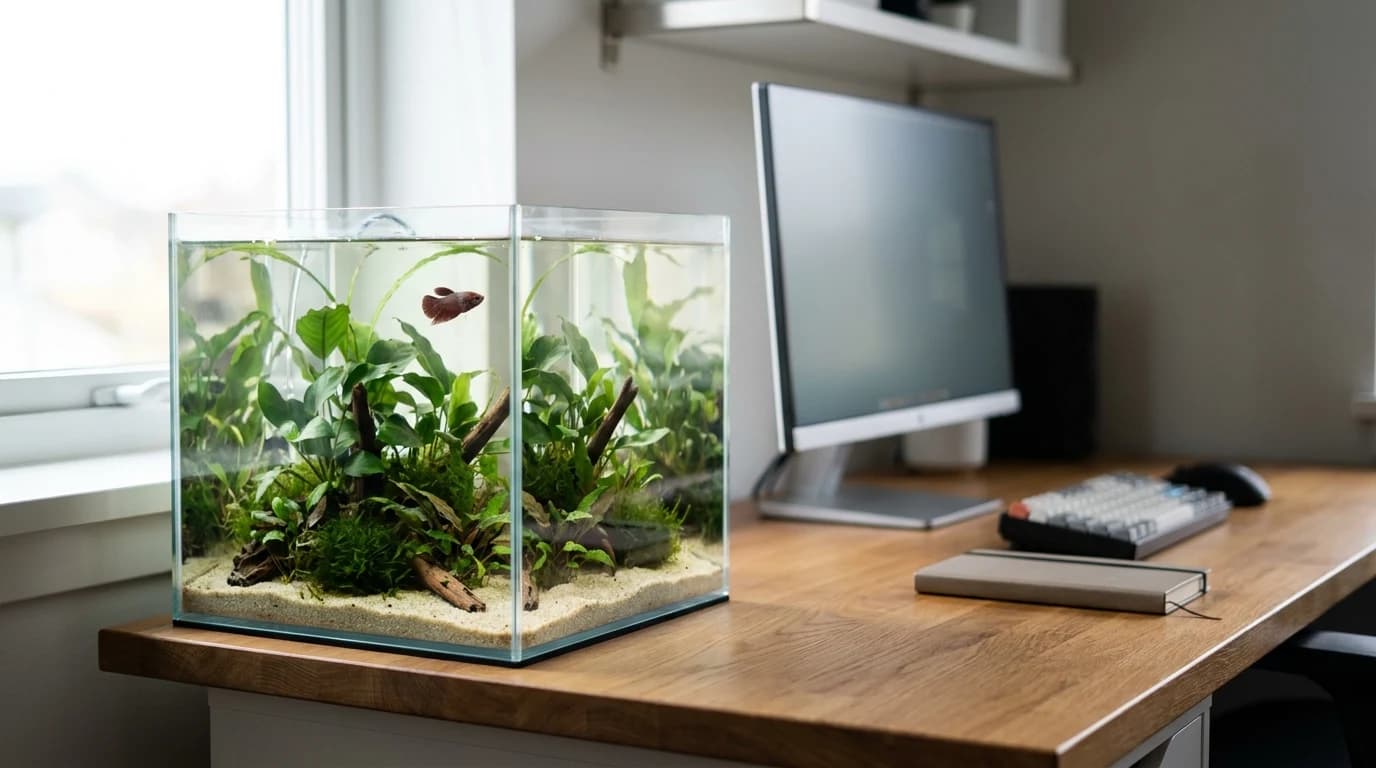
A planted nano tank on the corner of a desk is one of the few pieces of decor that genuinely changes how a room feels at 3pm. It is also a heated, wet, electrically powered animal enclosure two feet from the machine you work on. This is the second half: what a 3-to-10 gallon tank actually costs in setup time, weight, power, noise and weekly attention, and what the research does and does not support about the calm it supposedly delivers.
The first six weeks have no fish in them
The most common way a desk tank fails is that someone buys the tank and the fish on the same afternoon.
A new aquarium has no bacterial colony to process the ammonia fish produce, and that colony has to be grown before livestock arrives — the process the hobby calls cycling. Ammonia becomes nitrite, nitrite becomes nitrate, and nitrate is diluted out by water changes. Aqueon's care documentation puts full establishment at three to eight weeks, with nitrite typically appearing in the second week, and the tank counting as cycled only once ammonia and nitrite both read zero while nitrate is being produced.
You can do it without fish — dose an ammonia source, test every few days, wait. What you cannot do is skip it. Buy a liquid test kit before anything decorative.
Reality check: the setup weekend is the fun part, and it is maybe 10% of the commitment. If six weeks with a test tube sounds like a chore now, it will not sound better in October. Desk plants deliver a good share of the same visual payoff with none of it.
A bowl is not a tank
Two pieces of equipment are not optional for most of what people actually want to keep.
A heater. Tropical freshwater fish are tropical. Aqueon's betta care guide asks keepers to hold the temperature between 76° and 85° F — a band most home offices fall out of overnight in winter, particularly a room whose heating gets turned down when nobody is working in it.
A filter. Small volumes swing fast; ten gallons forgives a mistake far less than a hundred does. Aqueon notes that bettas "do not necessarily need a filter" but that one "provides them with optimum water quality and lessens the amount of maintenance you have to do." On a desk, where maintenance competes with work, take the filter.
Heater sizing is the part people guess at, and the usual guess is wrong in an interesting way. Wattage is not a function of gallons; it is a function of the gap between your coldest room temperature and your target tank temperature. The same 5-gallon tank needs a different heater in a 62°F converted garage than in a 70°F spare bedroom, which is exactly what watts-per-gallon cannot see. A heater wattage calculator that asks for your overnight room low and your target temperature will land closer than the rule of thumb. Round up between sizes — an oversized heater on a working thermostat just cycles off sooner.
The bowl question, settled: a heated, filtered 5-gallon tank and an unheated 1-gallon bowl are not two points on the same scale. The bowl misses the temperature band a betta care guide asks for and has no filtration to buffer a small volume. If a bowl is the budget, buy plants instead.
Sizing: weight, heat, and what can actually live there
| Tank | Typical footprint | Filled weight (approx.) | Common heater sizes | Realistic stocking |
|---|---|---|---|---|
| 2.5 gal | 12" x 6" | ~27 lb | 10-25 W flat or mini | Plants, snails, a small shrimp colony — no fish |
| 5 gal | 16" x 8" | ~62 lb | 25-50 W | One betta, or a Neocaridina shrimp colony |
| 10 gal | 20" x 10" | ~111 lb | 50 W | One betta with snails, or a small school of nano fish |
| 20 gal high | 24" x 12" | ~225 lb | 50-100 W | A genuine community tank — no longer a desk object |
Filled weights come from a retailer reference chart and are approximate; glass thickness, substrate and hardscape all move them. The arithmetic is easy to sanity-check: fresh water is 8.34 lb per US gallon, and once you add glass, sand and rock a filled tank lands nearer 10-11 lb per gallon.
That is the number worth sitting with. A 10-gallon tank is roughly 111 pounds on a 20" x 10" rectangle — heavier than many adults, on a footprint smaller than a keyboard tray. Particleboard desks with long unsupported spans do not enjoy this. Put a tank over a leg, a stretcher or the load-bearing edge, never mid-panel, and not on a sit-stand desk you actually raise and lower.
Power, and the one rule that is not negotiable
A nano tank draws almost nothing: a small heater, a pump, an LED. The risk is not consumption, it is interruption.
Filters and heaters are life support. If the outlet they sit on gets switched off — by a schedule, a voice command, a firmware update, a misremembered device name — the failure is silent and only visible days later. Our smart plug guide already draws this line for space heaters and refrigerators, and aquarium pumps belong in the same category: they stay on a normal, unswitched outlet. Put the smart plug on the monitor and the desk lamp, and leave the tank out of the automation.
Run a drip loop too, so water tracking down a cable drips onto the floor rather than into the socket, and keep the tank on a different surge-protected strip from your computer.
The one rule: heater and filter go on a dumb outlet. Every automation you add to that circuit is a way to kill the tank quietly while you are in a meeting.
Evaporation, noise, and the thing beside your screen
An open-top nano tank evaporates, and in a heated room that is a visible drop over a week. Topping off with dechlorinated water is the task people forget, and a partly exposed heater is a heater that can fail; a lid fixes most of it and stops jumpers too. The humidity a few gallons add to a room is not meaningful next to electronics. The splash from a careless water change is — keep the bucket on the floor and the laptop elsewhere.
Noise is small but constant. A hang-on-back filter's outflow is a trickle you stop consciously hearing in a fortnight, though your microphone may not. Keeping the water level high, so there is no waterfall drop, removes most of it.
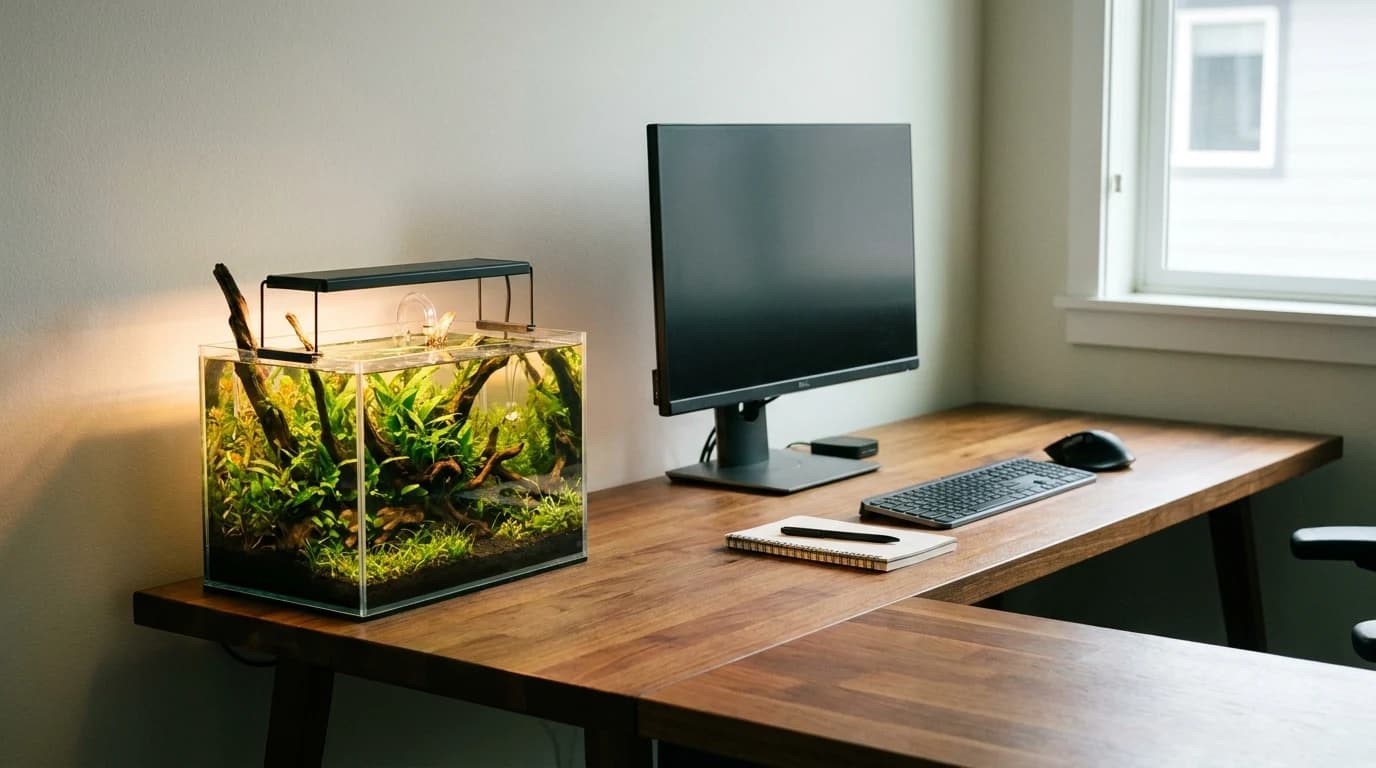
Lighting is where a tank most often annoys its owner. A planted nano light is bright, and level with the monitor a foot to the side it sits in your peripheral vision all day and bounces off a glossy panel. Put it low and off to the side instead, on a timer that ends before your workday does. Six to eight hours is plenty for plants, and less light means less algae.
What ten minutes a week actually covers
A stable, correctly stocked 5-to-10 gallon planted tank asks for roughly this:
- Weekly, about 10 minutes. A 25-30% water change with a small siphon, a wipe of the front glass, a top-off. Most weeks that is the entire routine.
- Monthly, about 20 minutes. Rinse filter media in the water you just siphoned out — never under the tap, because chlorine kills the colony you spent six weeks growing. Trim plants. Check the heater against a separate thermometer rather than its own dial.
- As needed. Test kit when something looks off, and every few days during the initial cycle.
What ten minutes does not cover is a tank that is overstocked, unfiltered or unheated. Those generate work continuously, and they are why most abandoned desk tanks were abandoned.
Does it actually help you focus?
Honestly, the evidence is thinner than the marketing.
The most-cited study is Cracknell and colleagues in Environment and Behavior in 2016 (volume 48, issue 10, pages 1242-1269). It used the restocking of a large public aquarium exhibit as a natural experiment and found that higher levels of marine life were associated with longer spontaneous viewing, greater reductions in heart rate, greater increases in self-reported mood and higher interest. A real result — but it describes a large exhibit viewed deliberately, not a five-gallon tank glimpsed between tickets.
The wider picture is more cautious. A 2019 systematic review in PLOS ONE by Clements and colleagues identified nineteen studies on interacting with fish in aquariums and reported that only two "provided tentative evidence that keeping home aquaria is associated with relaxation." Findings on anxiety, relaxation and physiological stress were mixed, with both positive and null results, and the authors judged risk of bias across the set to be high or unclear.
So the defensible claim is modest. A desk tank is a legitimate reason to look away from a screen at something alive, and there is preliminary evidence that watching fish is mildly calming. It is not a treatment, and a tank you resent is not calming at all. If the goal is a reset between blocks of work, a desk object you can pick up is a cheaper experiment, and the structural fixes for focus do more than anything on the desk.
Who should actually do this
Worth it if:
- The plants and the water chemistry interest you on their own terms
- You have a load-bearing spot low and off to the side of the screen
- Six weeks of testing before a fish sounds like anticipation, not a chore
Skip it if:
- You want the look without the hobby underneath it
- The only free surface is the middle of an unsupported particleboard span
- Ten minutes a week is already spoken for
The dividing line is whether you want the hobby or the ambience. Wanting the hobby carries you through week three of testing and the February water change you do not feel like doing. Wanting only the ambience produces the common failure, undramatic enough to live with for months: a cloudy, algae-streaked box you stop looking at and feel quietly guilty about. If you do start, start at five gallons, put a heater and a filter in before a fish, and give it six weeks before you give it anything alive.
Hilly Shore Labs
Editorial TeamWFH Lounge is published by Hilly Shore Labs. Every recommendation is built by synthesizing ergonomic research, manufacturer specs, expert reviews from outlets like Wirecutter, RTINGS, and The Verge, and aggregated long-term owner sentiment from thousands of verified buyers.
All product reviews are independently researched. Our recommendations are based on ergonomic guidelines, manufacturer specifications, and verified buyer sentiment. See our methodology.