Vacuum-Sealed WFH Lunches: Batch-Cook a Month Ahead
The freezer removes the five-day ceiling that makes fridge meal prep collapse by Thursday, and vacuum sealing helps mainly by keeping air off the surface rather than by extending any published safety window. No federal chart gives sealed food a longer number, so treat vendor multipliers as marketing. Cook one new braise each Sunday instead of four in a marathon, freeze flat and fast, keep every raw and crunchy component out of the bag, and thaw under refrigeration. If you would eat leftovers anyway, a carefully pressed zip bag is closer to a sealer than the marketing suggests.
Quick Answer
Freezer burn is not spoilage. USDA FSIS describes it as grayish-brown dry spots caused by air contacting the surface of the food, and says food held constantly at 0 degrees F is always safe, so freezer storage times are about quality only. That makes packaging a job of keeping air off the food: portion each lunch about an inch thick, seal it, freeze it flat in a single layer, and stack only once solid. FSIS quality windows cover a month comfortably, at 3 to 4 months for entrees and 2 to 3 for soups and stews. Thaw in the fridge, in cold water, or in the microwave, never on the counter.
Key Takeaways
Fridge meal prep runs out by Thursday. The freezer workflow that fixes it: what air does to food, how long lunches keep, and a two-hour Sunday.
As an Amazon Associate I earn from qualifying purchases. Product prices and availability are subject to change.
Fridge meal prep has a ceiling about five days tall. You cook on Sunday, eat well through Wednesday, and by Thursday the containers look like homework. Friday you order something. That is a storage failure, not a discipline failure.
Working from home sharpens it: the kitchen is fifteen steps away, so lunch is decided at 12:40 with a thread still open in your head. The grazing pattern that follows is its own subject. This is the problem underneath it: a month of lunches that still taste worth eating in week four.
What air actually does to your lunch
USDA's Food Safety and Inspection Service is blunt about the mechanism. Freezer burn "does not make food unsafe, merely dry in spots. It appears as grayish-brown leathery spots and is caused by air coming in contact with the surface of the food."
That reframes the project. Freezer burn is dehydration and oxidation at the surface, not spoilage. FSIS is equally clear on safety: food held constantly at 0°F "will always be safe," and freezer-chart numbers are quality recommendations, not expiry dates.
The distinction that matters: the freezer runs a quality clock, not a safety clock. Nothing at 0°F becomes dangerous. It becomes dry, grey and dull — which is exactly what makes you order a sandwich in week three.
So packaging is not preservation. It is keeping air off the food. A zip bag gets most of the air out of the bag; it cannot get it out of the crevices between rice grains. FSIS says the same of store wrap — "permeable to air and quality may diminish over time." A sealer is the thorough version of that instruction, not a different idea.
What freezes well, and what quietly does not
FSIS names three foods that do not freeze well: mayonnaise, cream sauce and lettuce. It also notes raw meat and poultry hold quality longer than cooked ones "because moisture is lost during cooking" — the most useful line here, since everything in this program is already cooked.
| Component | How it comes back | Why |
|---|---|---|
| Cooked grains — rice, farro, barley | Excellent | Starch rehydrates; sealed flat, little exposed surface |
| Braises, chilis, curries, stews | Excellent | The sauce is the barrier; food never meets air |
| Roasted hardy vegetables | Good, softer | Cell walls rupture — fine in a bowl, poor as a side |
| Cooked pasta | Poor alone | Returns past al dente — undercook and freeze it in sauce |
| Cream sauces, mayo-dressed salads | Bad, per FSIS | Emulsions separate and come back curdled |
| Raw lettuce, crunchy raw vegetables | Bad, per FSIS | Ice crystals destroy what made them crunchy |
Vegetables frozen alone need blanching first — brief partial cooking, then rapid chilling — to stop the enzyme activity that freezing only slows.
The design rule: build each lunch around a sauced component plus a grain, and keep the crunch out of the freezer. Raw vegetables, herbs, pickles and yogurt go on at the desk, thirty seconds before you eat — which is also what makes week four taste different from week one.
Portion flat, freeze fast, stack later
Two FSIS instructions do more for texture than anything else here. The first is speed: "Ideally, a food 2-inches thick should freeze completely in about 2 hours." Slow freezing grows large ice crystals that rupture cells, so meat "drips" on thawing and emulsions separate.
The second is the corollary: "Never stack packages to be frozen. Instead, spread them out in one layer on various shelves, stacking them only after frozen solid."
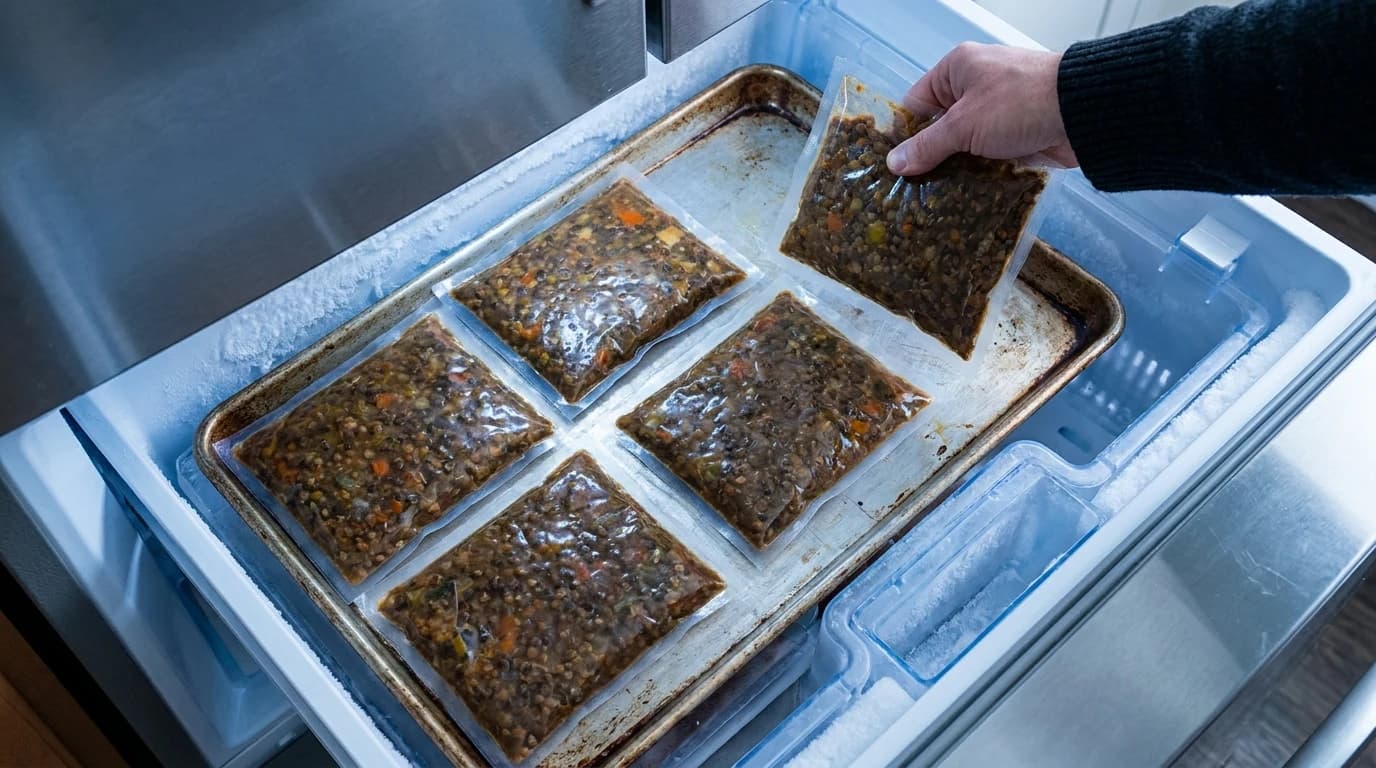
So press each pouch to about an inch thick before sealing, lay them on a sheet pan in one layer, and stack only once solid.
What flat-freezing buys you:
- A faster freeze, smaller crystals, better texture on reheat
- Pouches that file upright like books, not a layer you excavate
- Much faster thawing, since thickness is what thawing is measured in
What it costs you:
- A sheet pan of freezer space for one night
- Ten seconds per pouch, flattening before the seal
Label the flat side while the pouch is soft: contents, date, reheat method. A quality clock is invisible, and the person opening it at 12:40 has no working memory to spare.
How long they actually stay good
FSIS publishes a freezer storage chart for 0°F. These are the rows a lunch program touches.
| Food | Months at 0°F, for quality |
|---|---|
| Frozen dinners and entrees | 3 to 4 |
| Cooked poultry | 4 |
| Casseroles | 2 to 3 |
| Soups and stews | 2 to 3 |
| Cooked meat | 2 to 3 |
| Uncooked ground meat | 3 to 4 |
Now the part most articles get wrong. No federal chart publishes a separate, longer number for vacuum-sealed food. The "five times longer" figures in circulation are marketing, not a published standard. Oregon State University Extension is careful about it: removing oxygen "will preserve certain quality characteristics and extend the food's shelf life based on quality" — and, in the same document, that "traditionally recommended freezing procedures and packaging methods, if carried out carefully, will produce high-quality products with reasonably lengthy storage times."
That is the case for the machine and against it in one paragraph. Sealing pushes the quality clock out; careful wrapping with the air pressed out gets a real share of the same result. If you are weighing a sealer for a one-person lunch operation — where the recurring cost is bags, not the machine — there is an honest breakdown of whether a vacuum sealer is worth it that runs the payback math instead of assuming it. Either way, a month of lunches sits inside every window above: you do not need the long tail, you need four weeks.
The Sunday two-hour workflow
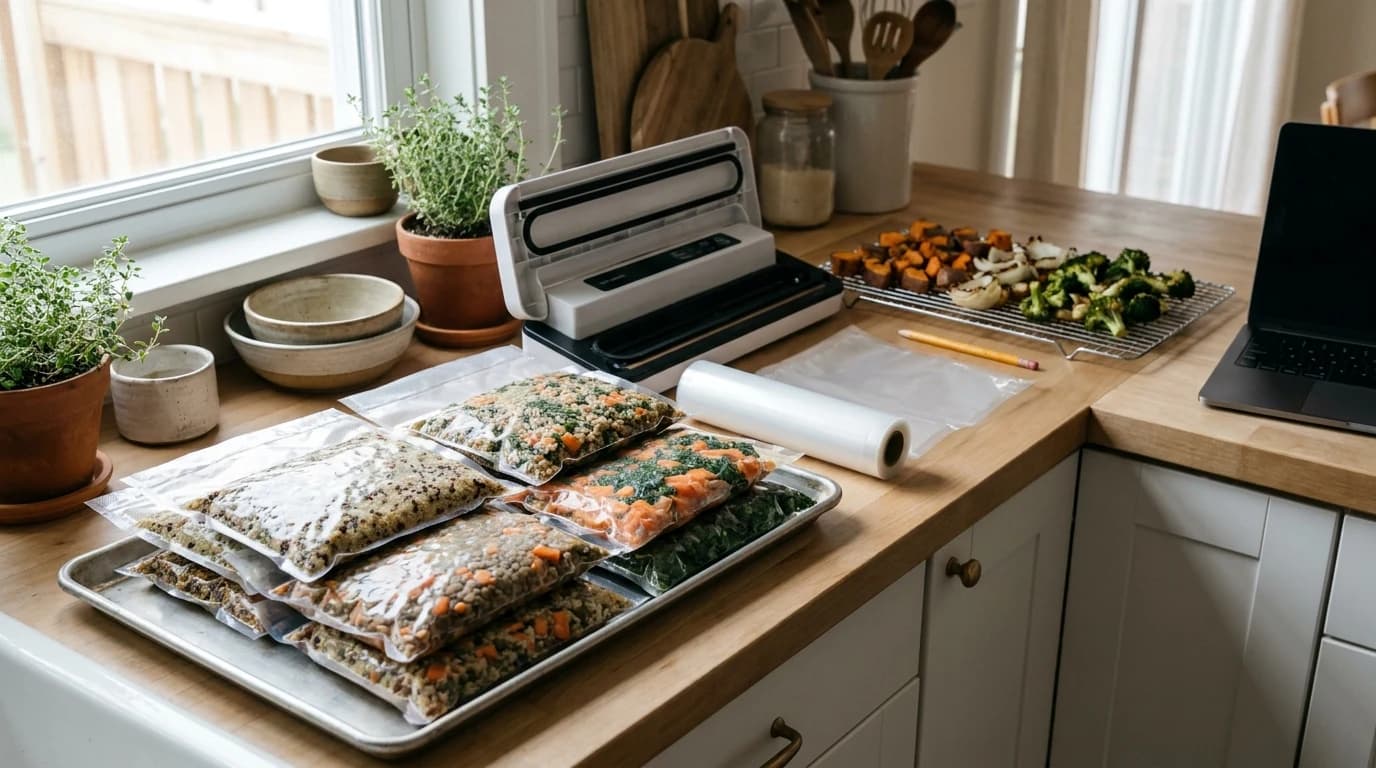
Four components, two hours, roughly twenty lunches. Nothing waits on anything else.
- 0:00 — Grains on: rice, farro or barley, double batch. Oven to 425°F.
- 0:10 — Two sheet pans of hardy vegetables in: sweet potato, broccoli, cauliflower, onion.
- 0:15 — Braise on the second burner — a chili, a curry, a lentil pot, better on day thirty than day one.
- 0:45 — Vegetables out, grains off, spread thin to cool. Nothing goes into a bag warm.
- 1:15 — Portion, press flat, seal, label.
- 1:35 — Sheet pan into the freezer, single layer. Stack them upright tomorrow.
The rotation rule: cook one new braise each Sunday rather than four in a marathon. After four weeks the freezer holds four different lunches and you are choosing, not enduring.
For the assembly logic rather than the freezing logic, the component-based meal prep framework covers it — and since no lunch closes the 3 p.m. gap alone, so do high-protein desk snacks and the focus-snack shortlist.
Thawing without undoing the work
FSIS allows exactly three thawing methods, and never the counter, garage or car.
- Refrigerator, the default. Move Tuesday's pouch over on Monday night; small items may defrost overnight.
- Cold water, when you forgot. Keep it sealed, submerge it, change the water every 30 minutes, cook immediately after.
- Microwave, when you forgot completely. Cook immediately — parts of the food begin to cook while defrosting.
One wrinkle is specific to sealed pouches, and Oregon State names it: a vacuum package stays a low-oxygen environment while it thaws, and some pathogens do well there without the spoilage bacteria that would otherwise warn you by smell. Refrigerator thawing closes that gap — an argument against thawing a sealed pouch on the counter, not against sealing.
On reheating in the bag: some manufacturers rate their bags for simmering water and some explicitly do not. That statement lives on the manufacturer's own support page and nowhere else. If you cannot find it, cut the pouch open and reheat in a dish. One closing FSIS note: a pouch thawed in the refrigerator can be refrozen uncooked, at some cost in quality.
The math, honestly
Run both on your own numbers, not a statistic. If lunch costs you twenty minutes a day, twenty workdays is roughly six and a half hours against eight for four Sunday sessions — so you only come out ahead by cooking one braise a week. The money case is a break-even: machine cost divided by what one avoided lunch out is worth to you, minus one bag. Bags are the recurring line, so bag price decides it.
What the freezer really buys is not money. It is the removal of a decision from 12:40 p.m.
Hilly Shore Labs
Editorial TeamWFH Lounge is published by Hilly Shore Labs. Every recommendation is built by synthesizing ergonomic research, manufacturer specs, expert reviews from outlets like Wirecutter, RTINGS, and The Verge, and aggregated long-term owner sentiment from thousands of verified buyers.
All product reviews are independently researched. Our recommendations are based on ergonomic guidelines, manufacturer specifications, and verified buyer sentiment. See our methodology.