Keyboard Wrist Rests: Do They Help or Hurt Your Wrists?
Wrist rests are neither the injury preventer the product pages claim nor the hazard the ergonomics sites imply. The measured evidence is about contact pressure on the underside of the hand, not about the pad itself, so the pad is not the variable — your technique is. If nothing currently hurts, you do not need one.
Quick Answer
A wrist rest is fine, and probably mildly helpful, if the heel of your palm settles on it between bursts of typing. It is a bad idea if you park your wrists on it and type from there. OSHA, Cornell and CCOHS disagree on nearly everything else, including whether the pad should be soft or firm.
The rule every authority shares
Palm heel, between bursts — never the wrist, while typing. OSHA, Cornell and CCOHS disagree on soft versus firm, and on whether wrist rests help at all. All three say the same thing about contact: the hands float while the fingers move, and the heel of the palm lands only in the pauses.
Key Takeaways
The claim that wrist rests double carpal tunnel pressure traces to no published study. What was actually measured, and where OSHA and Cornell disagree.

As an Amazon Associate I earn from qualifying purchases. Product prices and availability are subject to change.
Do you actually need a wrist rest?
Worth it if you…
- Catch yourself resting on the bare edge of the desk
- Use a tall keyboard whose front edge digs into your palms
- Get shoulder and upper-trap fatigue by mid-afternoon
- Want a defined place to park your hands during calls
Skip it if you…
- Are buying it to prevent carpal tunnel — no trial supports that
- Would type with your wrists on it, which is the risk case
- Have wrist pain caused by a keyboard sitting too high
- Type on a low-profile laptop keyboard with nothing to bridge
The disagreement is real: OSHA recommends supports that are fairly soft and rounded while Cornell says avoid soft and squishy ones. Nobody has settled it, so buy for the way your hands actually sit.
Ask whether a wrist rest is good for you and you get two confident answers. Product pages say it prevents carpal tunnel. Ergonomics sites say it causes it. Both claim far more than anyone has measured, and the number both lean on has no paper behind it.
The most-repeated claim has no study behind it
The figure you meet everywhere is that a wrist rest doubles the pressure inside your carpal tunnel. It traces to one origin: Cornell University's ergonomics guidelines, which state that "intracarpal pressure doubles with a wrist rest compared with floating the hands over a keyboard." Cornell cites no source for it, and neither does anyone repeating it.
We went looking. PubMed returns a handful of records for wrist rests and carpal tunnel pressure; none compared a keyboard wrist rest against floating hands. The 1993 study the figure is sometimes attributed to is not in the index at all.
Not a debunking. The mechanism is real and has been measured repeatedly; what is missing is this specific number. Treat "doubles" as Cornell's position, not a published result.
What has actually been measured
The solid evidence is not about wrist rests at all. It is about what happens when the underside of your hand presses into anything.
| Study | What it measured | What it found |
|---|---|---|
| Kubo et al., 2018 (J Biomech) | Palm contact force vs. carpal tunnel pressure, 8 cadaveric hands | Pressure rose linearly with force; about 293 g of palm contact reached the 30 mmHg threshold |
| Cobb et al., 1995 (J Hand Surg) | 1 kg pressed at 16 separate points on the hand | 103 mmHg over the flexor retinaculum, 75 mmHg thenar, 37 mmHg hypothenar |
| Keir et al., 2007 (Human Factors) | Wrist angle vs. tunnel pressure, 37 people | The most sensitive quarter reached 30 mmHg at roughly 33 degrees of wrist extension |
| Cook et al., 2004 (Applied Ergonomics) | Muscle activity while typing, 13 people, supported vs. unsupported | A wrist rest cut trapezius and deltoid activity, and "may be preferable to the 'floating' posture" |
Two things fall out. First, 293 g is about ten ounces — less than a full mug of coffee — so where you lean matters. Second, the bottom row is the one nobody quotes: support relaxed the shoulders, and those authors concluded it may beat floating. Nag et al., 2009 found the reverse, that wrist rests "increased load on the upper trapezius." Eight and thirteen people. The evidence pushes both ways.
Where the official guidance splits
Three respected bodies, one question, three different answers:
| OSHA | Cornell | CCOHS | |
|---|---|---|---|
| Use one? | Yes, "to maintain straight wrist postures and to minimize contact stress" | Research "haven't demonstrated any substantial benefits" | Both positions "can be challenged" |
| Soft or firm? | "fairly soft and rounded" | "Avoid soft and squishy wrist rests" | Repeats OSHA's soft-and-rounded advice |
| The overlooked risk | Contact stress on the wrist itself | Squishy pads "encourage more lateral deviation" | Going without means people lean on "the sharp edges of the desk" |
Primary pages: OSHA, Cornell, CCOHS. If one article told you gel pads are fine and the next said they are the whole problem, this table is why.
The one rule all three share
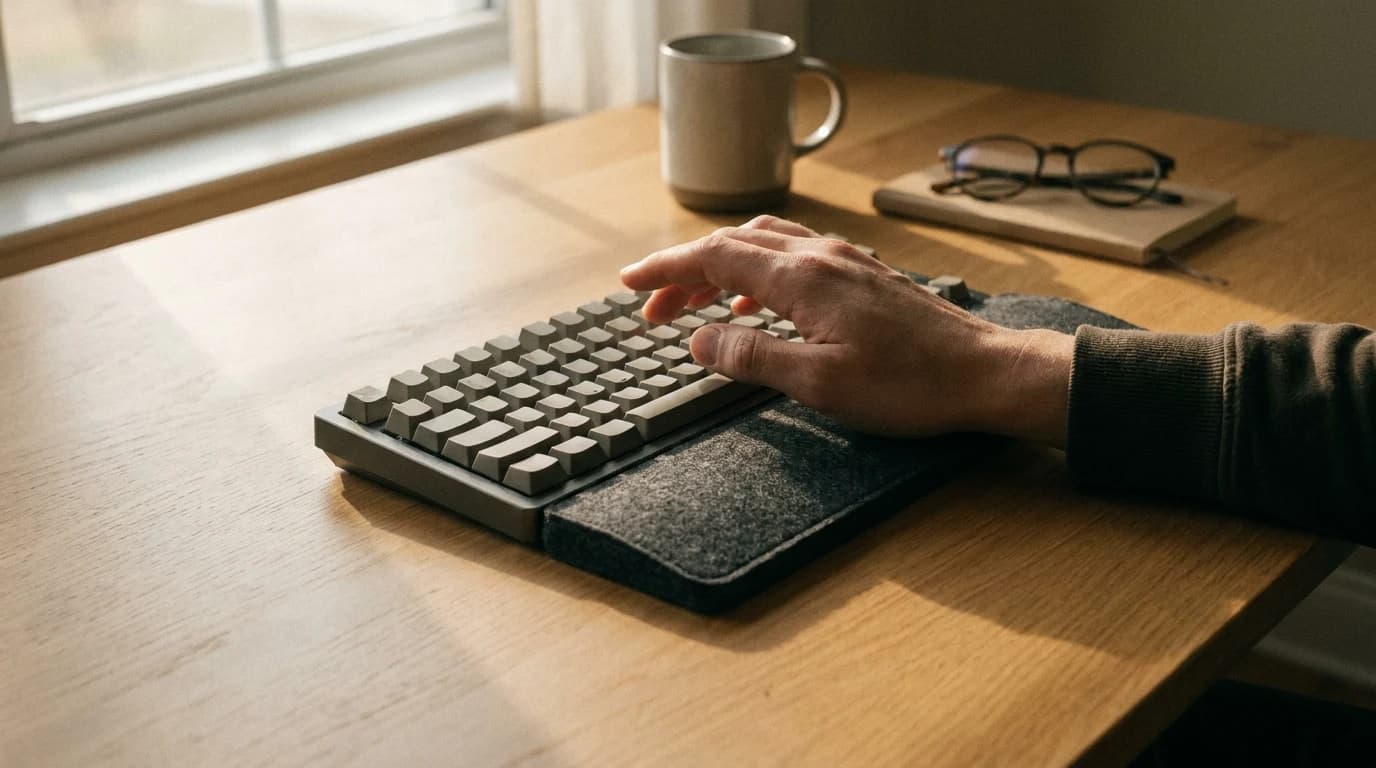
Strip the disagreement away and a single instruction survives everywhere: contact belongs on the heel of your palm, between bursts of typing — never on the underside of your wrist while your fingers are moving.
Do this:
- Float your hands above the rest while you are actively typing
- Let the palm heel settle during pauses, calls and reading
- Keep the rest level with the front edge of the keyboard, as OSHA advises
- Choose one at least 1.5 inches (3.8 cm) deep
Not this:
- Parking your wrists on the pad and typing from there
- Using a rest to patch a keyboard that sits too high — fix the desk and chair height instead
- Going without and leaning on a bare desk edge, the contact-stress case CCOHS warns about
Choosing one without picking a side
Because the authorities disagree on firmness, match the rest to how your hands already behave rather than to a rule nobody has settled.
- You type in long unbroken bursts. Go firm and flat, Cornell's preference. The Glorious Wrist Pad is medium-firm foam with a non-slip base that does not deform under the palm heel.
- The mouse hand is the sore one. A gel pad follows OSHA's soft-and-rounded advice, and it is the one firmness question with a data point: Nag's group found gel-filled rests reduced forearm muscle load more than bead-packed cushions. The Amazon Basics gel wrist-rest mouse pad is the cheap way to test that on yourself.
- Nothing hurts yet. Buy nothing. No adequately powered trial shows wrist rests prevent anything, and the rest of the ergonomic accessories worth owning solve problems you can actually name.
Two-second self-check: glance down mid-sentence. If the pad is touching you while your fingers move, you are using it the way every authority advises against.
Frequently asked questions
Do wrist rests cause carpal tunnel syndrome?
No study shows that. What is measured is that outside pressure on the palm raises pressure inside the tunnel — Cobb's group recorded 103 mmHg from 1 kg over the flexor retinaculum. Whether resting between bursts causes injury has never been tested in a trial, and the mechanism does not apply when contact sits on the palm heel.
Should your wrists touch the wrist rest while typing?
No. OSHA is explicit that your hands "should move freely and be elevated above the wrist/palm rest while typing," and that when you do rest, "the pad should contact the heel or palm of your hand, not your wrist." Cornell and CCOHS say the same thing in different words.
Is a gel wrist rest better than a firm one?
Nobody agrees. OSHA recommends supports that are "fairly soft and rounded"; Cornell says avoid soft and squishy ones because they contour to the wrist and encourage sideways deviation. Choose by feel, then check your hands still glide freely while typing.
Sources
- OSHA — Wrist/Palm Supports
- Cornell Ergonomics — Workstation Guidelines
- CCOHS — Wrist Rests
- Kubo et al. (2018), J Biomech — palm force vs. tunnel pressure
- Cobb et al. (1995), J Hand Surg — external forces on the palm
- Keir et al. (2007), Human Factors — wrist posture thresholds
- Cook et al. (2004), Appl Ergon — upper-limb support
- Nag et al. (2009), Appl Ergon — arm and wrist support
Hilly Shore Labs
Editorial TeamWFH Lounge is published by Hilly Shore Labs. Every recommendation is built by synthesizing ergonomic research, manufacturer specs, expert reviews from outlets like Wirecutter, RTINGS, and The Verge, and aggregated long-term owner sentiment from thousands of verified buyers.
All product reviews are independently researched. Our recommendations are based on ergonomic guidelines, manufacturer specifications, and verified buyer sentiment. See our methodology.